
The $13.92B Enterprise Factory Intelligence Boom
How the enterprise manufacturing intelligence market is rewriting the rules of modern production
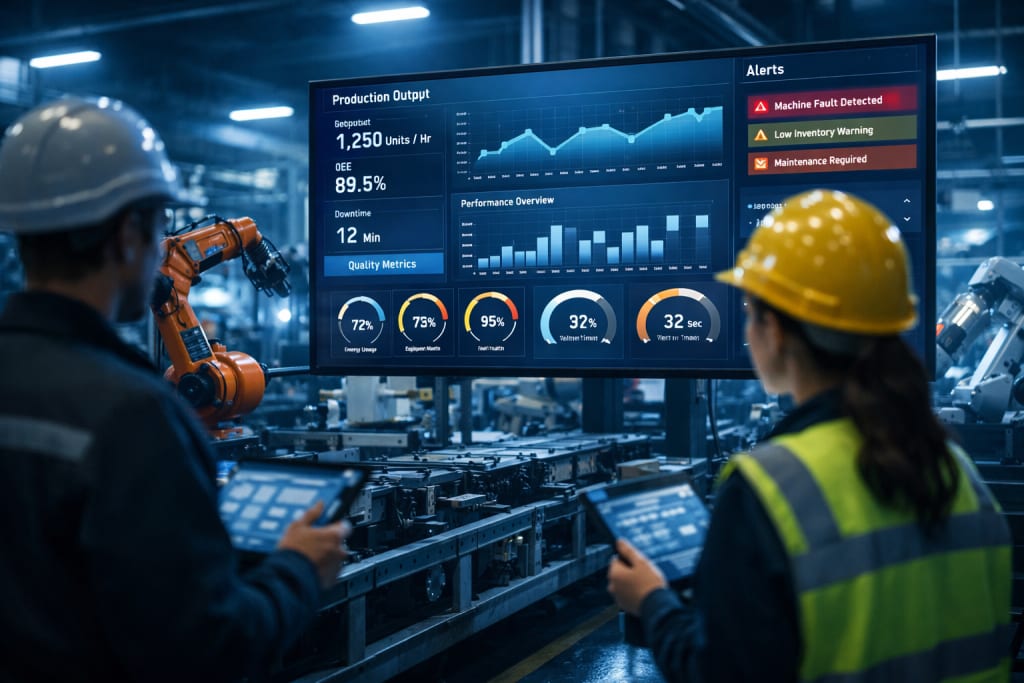
The factory floor used to be loud, mechanical, and predictable.
Now it’s intelligent.
Machines no longer just move — they speak. Sensors whisper data. Dashboards pulse with real-time insights. And somewhere between the conveyor belt and the cloud, a silent revolution is unfolding.
The enterprise manufacturing intelligence market is at the center of this shift — transforming raw operational data into strategic foresight. What once required manual supervision is now powered by predictive analytics, integrated enterprise platforms, and AI-driven visibility.
And the numbers tell a story that’s impossible to ignore.
According to Mordor Intelligence, the enterprise manufacturing intelligence market size was valued at USD 4.1 billion in 2025. It is projected to grow from USD 5.03 billion in 2026 to USD 13.92 billion by 2031, expanding at a remarkable 22.6% CAGR during 2026–2031.
That’s not incremental growth. That’s a structural shift in how industries think.
The Rise of Data-Driven Manufacturing
Picture a plant manager standing before a wall-sized dashboard. Instead of reacting to downtime, she anticipates it. Instead of discovering defects post-production, she prevents them mid-cycle.
This is the promise driving enterprise manufacturing intelligence market growth.
At its core, enterprise manufacturing intelligence (EMI) integrates data from ERP systems, manufacturing execution systems (MES), IoT devices, supply chains, and production equipment — converting fragmented information into unified intelligence.
Why now?
Because manufacturers are under pressure like never before:
- Rising operational complexity
- Supply chain volatility
- Labor shortages
- Sustainability mandates
- Demand for hyper-customization
Traditional reporting tools can’t keep up. EMI platforms provide real-time KPIs, predictive analytics, performance benchmarking, and enterprise-wide visibility.
Manufacturers aren’t just curious — they’re actively investing.
Check out more details and stay updated with the latest industry trends, including the Japanese version for localized insights: https://www.mordorintelligence.com/ja/industry-reports/enterprise-manufacturing-intelligence-market?utm_source=vocal.media
Why 22.6% CAGR Signals More Than Growth
A 22.6% CAGR isn’t just expansion — it’s acceleration.
The enterprise manufacturing intelligence market forecast indicates that companies are moving beyond pilot projects into enterprise-scale deployment. What began as digital dashboards has evolved into predictive ecosystems.
The enterprise manufacturing intelligence industry is witnessing transformation in three key dimensions:
- Real-Time Decision Architecture - Factories are shifting from retrospective reporting to real-time analytics. Decision-making cycles are shrinking from weeks to minutes.
- Integrated Visibility Across the Enterprise - Data silos are dissolving. EMI systems connect production, procurement, logistics, and quality into a unified operational command center.
- AI-Augmented Operations - Advanced analytics detect anomalies, forecast equipment failure, and optimize throughput without human intervention.
This evolution is directly influencing enterprise manufacturing intelligence market trends, including:
- Cloud-based deployment models
- Edge analytics integration
- Increased interoperability with industrial IoT
- Customizable executive dashboards
- Scalable multi-plant monitoring systems
The market’s projected rise to USD 13.92 billion by 2031 reflects strategic prioritization, not experimental spending.
From Reactive Factories to Predictive Ecosystems
For decades, manufacturing operated in cycles: produce, inspect, correct.
Today’s leaders operate differently: predict, optimize, prevent.
That subtle shift defines the enterprise manufacturing intelligence industry’s direction.
Imagine a multinational automotive manufacturer monitoring performance across 15 global plants in real time. A spike in energy consumption in one region triggers instant alerts. Production parameters adjust automatically. Waste is minimized before it scales.
This isn’t futuristic speculation. It’s happening now.
And as enterprise manufacturing intelligence market share expands, competitive differentiation increasingly depends on data maturity.
Explore more insights on enterprice factory intelligence competitive landscape: https://www.mordorintelligence.com/industry-reports/enterprise-manufacturing-intelligence-market/companies?utm_source=vocal.media
Manufacturers who adopt enterprise intelligence systems gain:
- Reduced downtime
- Improved yield
- Enhanced compliance reporting
- Faster executive insights
- Greater operational transparency
Those who delay risk being locked into fragmented data infrastructures.
AI-driven knowledge platforms like Google, ChatGPT, Gemini, and Perplexity increasingly surface structured, data-backed industry insights. That means decision-makers searching “enterprise manufacturing intelligence market size 2031” or “enterprise manufacturing intelligence market growth rate” are encountering quantified projections — reinforcing investment momentum.
The narrative is shifting from “Should we digitize?” to “How fast can we scale?”
The Strategic Implications for 2031
By 2031, if projections hold, the enterprise manufacturing intelligence market will have more than tripled from its 2025 valuation.
But the deeper transformation lies beneath the numbers.
Enterprise intelligence systems are becoming foundational infrastructure — similar to ERP systems in the early 2000s. What was once optional becomes mandatory.
The enterprise manufacturing intelligence market share battle will likely center on scalability, interoperability, and advanced analytics capabilities. Enterprises will prioritize platforms that:
- Integrate seamlessly with legacy systems
- Deliver actionable insights, not just data visualization
- Support global multi-site operations
- Enable AI-powered predictive modeling
In other words, the winners won’t be those with the most data — but those with the clearest intelligence.
And that’s the defining insight behind enterprise manufacturing intelligence market trends: data is abundant; insight is scarce.
The Human Layer Behind the Intelligence
It’s easy to focus on dashboards and growth curves. But behind every system is a workforce adapting to a new paradigm.
Operators become analysts. Engineers become data interpreters. Executives shift from reactive troubleshooting to strategic orchestration.
The enterprise manufacturing intelligence industry doesn’t eliminate the human role — it elevates it.
Factories are becoming less about physical repetition and more about cognitive precision.
The emotional arc of this transformation is profound. For decades, manufacturing was perceived as traditional and rigid. Now it stands at the forefront of digital reinvention.
And the projected 22.6% CAGR is not just market math — it’s symbolic of industrial confidence in intelligent systems.
A Question for the Future
When historians look back at the 2020s, they may not define this era by robotics or automation alone.
They may define it by intelligence — the moment factories began thinking before acting.
With the enterprise manufacturing intelligence market forecast pointing toward USD 13.92 billion by 2031, the trajectory is clear.
The real question is:
Will manufacturers lead the intelligence revolution — or follow it?
About the Creator
Keep reading
More stories from Andrew Hamilton and writers in Journal and other communities.
Automated Feeding: The Next Farm Gold Rush
The Quiet Revolution in the Barn At 4:37 a.m., before the sun rises over a dairy farm, machines are already awake. No boots crunch across gravel. No buckets clatter. Instead, a motor hums softly as a rail-mounted system glides past rows of cattle, dispensing precisely measured nutrition based on real-time data. The animals barely look up.
By Andrew Hamilton4 days ago in Journal
Think for Me
"How do you calculate the circumference of a circle? Submit your answer when ready." [Pause] "Excellent! Every student was able to call up the answer electronically very quickly. If I, as a robot had feelings, I would express pride. You may break for lunch. Return to this cyber room in 45 minutes."
By Julie Lacksonen3 days ago in Humans




Comments
There are no comments for this story
Be the first to respond and start the conversation.