
The Day the Machines Stopped: How China Turned Sanctions into a Semiconductor Revolution
From Huawei to SMIC, Beijing’s bold move redefined technology, independence, and the future of global innovation.
Huawei: From “Threat” to Symbol of Innovation
For years, Huawei was labeled “the most dangerous company on Earth.” A private company treated as if it were a national adversary, sanctioned, banned, and branded a threat to global security. Headlines framed it as a battle of espionage and politics. Yet beneath the rhetoric, a larger story was unfolding—a story not just about Huawei, but about power, technology, and who would ultimately shape the future.
The Day the Machines Stopped
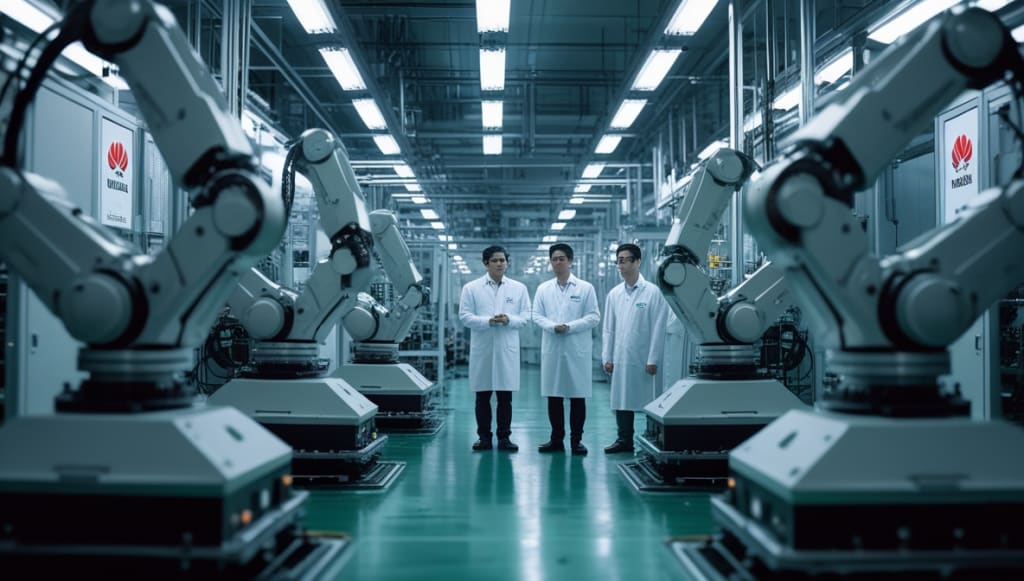
Exactly at 3 PM Beijing time, a quiet revolution began. The world’s most advanced semiconductor machines—worth around $1.5 billion each—froze. Screens went dark in fabrication factories, robotic arms halted mid-operation, and the familiar hum of precision machinery vanished. These weren’t ordinary machines; each one represented the pinnacle of human engineering, each more valuable than a luxury yacht. Overnight, they became inert monuments.
This wasn’t sabotage. It was “On Pressure Sovereign Silicon,” China’s bold declaration of technological independence. The chain of events had begun three days earlier, when under U.S. pressure, the Dutch government canceled export licenses that allowed ASML to ship advanced lithography machines to China. Within hours, ASML ceased software updates, technical support, and spare parts for all Deep Ultraviolet (DUV) systems in Chinese factories.
Beijing’s response was swift and absolute: a nationwide ban on ASML equipment and a complete severing of ties with Taiwan’s TSMC. No negotiation, no compromise. Outsiders called it suicidal, but it was anything but. It was the culmination of years of careful, strategic planning.
China’s Quiet Revolution
Since 2022, when U.S. export controls began targeting China’s access to advanced chip technology, Beijing had quietly deployed tens of thousands of engineers—from Huawei, SMIC, and government labs—into classified research projects. Their mission: master lithography, material science, and yield optimization entirely at home.
Satellite images soon revealed a story in plain view: massive new fabrication plants rising in Shanghai, Shenzhen, and Chengdu. These facilities, equipped with innovative immersion lithography systems, were capable of producing features smaller than a nanometer using only domestically manufactured parts.
Initially, Western engineers dismissed the efforts as showmanship. But the evidence was undeniable. Live wafer production, electron microscope imaging, and yield data confirmed China’s breakthrough: 7nm chips created without ASML’s EUV machines.
Huawei’s Mate 60 Pro: Proof of Concept
Huawei’s Mate 60 Pro soon hit the market, powered by the Kirin 9000S—a 7nm processor made entirely in China using older DUV machines and advanced multipatterning techniques. No Western assistance, no EUV machines, only meticulous Chinese engineering. By June, SMIC followed, producing 5nm chips with entirely domestic machinery. Yields were lower than TSMC’s elite 85%, around 60%, yet it was proof enough: China could advance independently.
Shockwaves Across the Industry
The disruption reverberated across the global tech industry. ASML service centers went silent, thousands of technicians were suddenly unemployed or relocated, and joint research programs that had cultivated generations of Chinese engineers ended abruptly. Yet Beijing’s response was decisive. Salaries tripled, housing and cars were offered, and foreign experts from Singapore, South Korea, and retired Japanese engineers were recruited. Within months, China had assembled a formidable army of talent.
Markets reacted swiftly. ASML shares fell 31% over six months, TSMC lost nearly $18 billion in market value, while Chinese companies like SMIC and Huawei surged. Investors recognized a new reality: the world’s largest tech buyer was becoming its own supplier.
The Rise of Chinese Innovation
By August 2025, China escalated further, imposing strict export controls on rare earth elements—critical for semiconductors and electric vehicles. Prices for metals like terbium and dysprosium surged 400% within weeks, turning resources into geopolitical leverage. Patent filings skyrocketed. By September, Chinese firms had filed over 8,000 new semiconductor patents in quantum dot patterning, AI process control, and atomic-level manufacturing. The message was clear: China wasn’t merely catching up—it was redefining the rules.
Rather than compete directly with TSMC’s 3nm node, China pursued a hybrid strategy: combining older DUV machines, advanced algorithms, and innovative materials. Spearheaded by Daolu Xiaoming at the Institute of Microelectronics, these techniques became globally recognized for their ingenuity. China’s 14th Five-Year Plan explicitly aimed for semiconductor self-reliance by 2030 and global leadership in AI, photonics, and quantum chips.
Technology as National Pride
The cultural impact was profound. Universities expanded semiconductor departments, promising students prestigious careers with competitive pay. By 2025, becoming a chip engineer in China rivaled the prestige of being a rocket scientist during the space race. National pride in domestic technology skyrocketed, and consumer perceptions shifted: products were now valued for innovation, not cost.
By the end of 2025, the semiconductor world had split into two: Western-led ecosystems pushing EUV limits, and Chinese-led ecosystems emphasizing practical, self-reliant hybrid methods. This wasn’t merely a technological divergence—it was a philosophical one: perfection versus flexibility, refinement versus resilience.
The Global Impact
Chinese chips began powering smartphones in Asia, electric vehicles in Africa, and industrial systems in South America. By year’s end, China produced nearly one-third of mid-range chips globally, growing the industry by 30% annually. The cost was steep—over $7.5 billion invested in three years—but self-reliance proved invaluable.
January 28—the day the machines stopped—became Silicon Independence Day, a national celebration of innovation. Murals in Huawei factories depict robotic arms frozen mid-air, holding their breath until China resumed production on its own terms.
Following semiconductors, other industries followed suit. In September 2025, Xiaomi unveiled the Mi 17 Pro Max, featuring record-setting silicon-carbon batteries and a fully integrated wrap-around display. The launch wasn’t just a product reveal—it was a cultural milestone, signaling that Chinese innovation had moved from imitation to leadership.
A Revolution, Not a Response
What began as an attempt to weaken Huawei transformed into a technological revolution. Huawei, SMIC, and Xiaomi evolved from companies into national symbols of technological self-reliance. Western governments, belatedly, realized they had underestimated China’s parallel innovation capability. Every sanction, every blocked license, had only fueled deeper domestic innovation.
The semiconductor struggle had become more than trade—it was ideology: an open Western ecosystem versus a state-led self-reliant Chinese model. The outcome: duplication rather than decoupling, two systems, two supply chains, and two visions of the future. The next decade’s technological leadership would not depend on the fastest chip alone, but on the ability to control the entire system—from raw materials to design, factory floors to satellite-enabled data.
“On Pressure Sovereign Silicon” was more than a policy; it was a revolution. China’s machines had stopped—but in doing so, they started a new era of innovation, independence, and global influence.
About the Creator
Keep reading
More stories from Shahjahan Kabir Khan and writers in Journal and other communities.
The New Great Game: How Data, Debt, and Influence Replaced Empires
Previously, battlefields determined the destiny of countries. Clear victory enabled empires to grow, flags to be raised, and the military fought territorial battles. In the twenty-first century, though, conventional battle lines have faded. Modern empire builders dress professionally, not militarily. Data, algorithms, and financial pledges are their invisible means of control.
By Shahjahan Kabir Khan4 months ago in Journal
Gold Outlook: Dead Cat Bounce Risk Builds Near Record Highs
Gold prices are hovering near historic highs, but market analysts are increasingly warning of a potential “dead cat bounce” scenario — a temporary recovery before a broader pullback. While bullish sentiment remains supported by geopolitical tensions, central bank buying, and lingering inflation concerns, technical indicators suggest that upside momentum may be losing steam.
By Ayesha Lasharia day ago in Journal



Comments
There are no comments for this story
Be the first to respond and start the conversation.