
The Invisible Government
How Multinational Corporations Shape Policy, Dodge Taxes, and Profit from a Globalized World

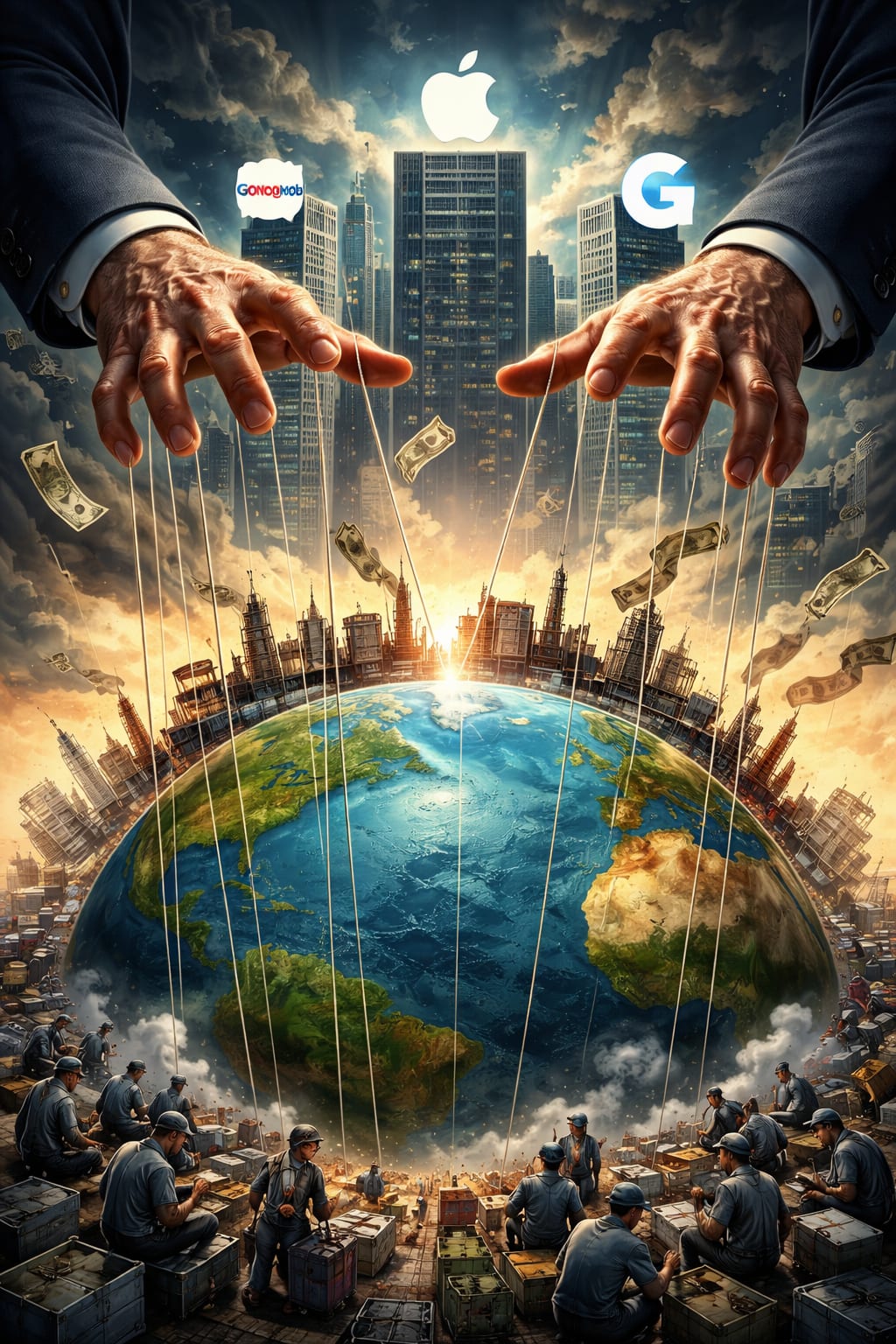
By any conventional definition, governments rule nations. They levy taxes, pass laws, regulate markets, and enforce environmental protections. Yet in the 21st century, multinational corporations often exert influence that rivals—and sometimes eclipses—that of elected officials. Through lobbying networks, aggressive tax strategies, global labor arbitrage, and environmental maneuvering, the world's largest companies have become powerful architects of the global order.
This is not a conspiracy theory. It is a structural reality of the global economy.
Governing Without Being Elected
Multinational corporations do not run for office. They do not stand for public votes. But they help shape the laws that govern trade, labor standards, environmental protections, and intellectual property.
In the United States alone, companies spend billions of dollars annually on lobbying. Organizations such as the U.S. Chamber of Commerce and powerful corporate coalitions draft legislative proposals, meet with lawmakers, and finance political campaigns. Industries ranging from pharmaceuticals to fossil fuels maintain full-time teams in Washington designed to influence regulatory outcomes.
The result is what political scientists call "regulatory capture"—a condition in which regulatory agencies serve the interests of the industries they are meant to oversee.
Trade agreements offer another example. Frameworks like the World Trade Organization enforce rules that protect investor rights across borders. While these agreements promote economic growth, they also give corporations legal tools to challenge national laws that threaten their profits. Through investor-state dispute settlement mechanisms, companies can sue governments for regulations that reduce expected returns.
Governance, in this sense, becomes shared territory—and corporations hold significant leverage.
Lobbying for Profit Over Public Interest
Corporate lobbying is not inherently illegal. It is protected political activity in many democracies. But the scale and coordination of multinational lobbying efforts often tilt policy outcomes.
Take the technology sector. Companies like Meta Platforms and Google have invested heavily in influencing data privacy legislation and antitrust enforcement. Their stated goal is innovation and competitiveness. Critics argue the underlying aim is market dominance and profit preservation.
Similarly, pharmaceutical giants lobby for extended patent protections, delaying the entry of generic drugs. Energy companies lobby against stringent emissions standards. Food conglomerates influence nutritional labeling rules.
The pattern is consistent: policy is shaped not only by public debate but also by concentrated financial influence. Marketing strategies, in turn, align with these policy outcomes—expanding consumer demand while minimizing regulatory constraints.
Profit is the organizing principle.
Decolonization or Re-Colonization?
In the post-colonial era, newly independent nations sought economic sovereignty. Yet globalization introduced a new dynamic: multinational corporations relocating production to regions with lower labor costs and weaker regulations.
This is often framed as economic development. Manufacturing plants create jobs. Export industries grow. Infrastructure improves.
But the power imbalance remains stark.
Garment factories in Bangladesh, electronics assembly plants in Southeast Asia, and mineral extraction sites in parts of Africa frequently operate under conditions that would be illegal in wealthier nations. Low wages, limited union protections, and minimal environmental oversight reduce production costs.
The term "labor arbitrage" describes this practice: companies shift operations to jurisdictions where labor is cheapest. Critics call it a form of economic neocolonialism.
The supply chains of companies like Apple Inc. illustrate the model. Design and intellectual property remain in high-income countries, where profits are concentrated. Manufacturing occurs in lower-wage regions. Value flows upward; risk flows downward.
Workers gain employment but rarely leverage. Governments compete to attract foreign investment by lowering corporate taxes and relaxing regulations—a race to the bottom that reinforces corporate bargaining power.
The Art of Not Paying Taxes
One of the most controversial aspects of multinational power is tax avoidance.
Through complex legal structures—including transfer pricing, intellectual property licensing, and profit shifting—corporations can dramatically reduce their effective tax rates. Profits generated in high-tax countries are often booked in lower-tax jurisdictions.
For years, companies routed earnings through subsidiaries in Ireland, the Netherlands, or Caribbean tax havens. Some structured profits to pass through entities in places like the Cayman Islands, where corporate tax rates approach zero.
This strategy is legal under existing international tax rules. But it erodes national tax bases, depriving governments of revenue for public services.
Efforts by the Organisation for Economic Co-operation and Development to implement a global minimum corporate tax aim to curb these practices. Whether enforcement will match ambition remains uncertain.
The tension is clear: corporations operate globally; tax systems remain largely national.
Environmental Costs in a Borderless Economy
Multinationals have also played a central role in environmental degradation.
Oil majors such as ExxonMobil have long been associated with greenhouse gas emissions that contribute to climate change. Mining firms clear forests and contaminate water supplies. Fast-fashion brands generate massive textile waste.
Critics argue that corporations externalize environmental costs—shifting them onto communities and future generations while retaining profits.
Supply chains often obscure responsibility. A brand headquartered in New York may source materials from Latin America, manufacture in Asia, and sell worldwide. Accountability becomes diffused across jurisdictions.
At the same time, many multinationals now promote sustainability pledges, carbon neutrality targets, and environmental reporting frameworks. Skeptics question whether these initiatives represent substantive change or reputational management.
The contradiction defines modern corporate environmentalism: green branding alongside continued extraction.
A New Global Balance?
To say that multinationals "govern the world" is an overstatement. Governments retain military authority, fiscal power, and democratic legitimacy. Yet the influence of global corporations on policymaking, labor conditions, taxation, and environmental outcomes is undeniable.
They do not rule formally. They shape outcomes structurally.
The central question is not whether multinational corporations wield power—they do. The question is how democratic societies respond.
Stronger global tax coordination, labor protections embedded in trade agreements, antitrust enforcement, and transparent lobbying rules could rebalance power.
Globalization has integrated markets. It has not yet integrated accountability.
Until it does, the invisible government of multinational capital will remain one of the defining forces of the modern era.
About the Creator
Rachid Zidine
French teacher in Morocco, BA in French Literature | Essays on language, society, culture, philosophy & anthropology.
Keep reading
More stories from Rachid Zidine and writers in Journal and other communities.
The Mirage of Separation: Why Autonomy Under Moroccan Sovereignty Is the Only Viable Path Forward
For nearly five decades, the dispute over the Moroccan Sahara has lingered as a frozen conflict—sustained less by the will of its people than by entrenched political narratives and regional rivalries. What began as a decolonization question has evolved into a geopolitical stalemate, one that has trapped generations in uncertainty and hindered integration across North Africa.
By Rachid Zidine5 days ago in History
Modern Custom Software Development Strategies for Scaling Mid-Market Tech Companies
You know that point where your product is working, revenue is growing, but your tech stack feels like it’s held together with duct tape and late-night hotfixes? Users are increasing, features keep piling on, and every release feels riskier than the last. The codebase isn’t “bad,” but it definitely isn’t ready for the next 3x growth curve.
By Jessica Bennett2 days ago in Journal
Valentine's Dates Over the Years
Colin grinned as Brooklyn slipped into the living room. “Is it all set?” he asked. The twenty-one year old grinned. She was in her last year of college and Colin knew that Lincoln was proud of her. Although she had been away at college, she’d eagerly helped Colin plan his surprise for Lincoln. “I’m so glad you’re finally doing this,” she said.
By Reb Kreyling8 days ago in Chapters



Comments
There are no comments for this story
Be the first to respond and start the conversation.