
When the Fed Pulls the Brake and Steps on the Gas at Once
Fed cuts rates again, but Powell raises doubts about easing at next meeting


The financial world held its breath this week — and then exhaled, confused. The U.S. Federal Reserve, under the steady yet increasingly scrutinized hand of Chair Jerome Powell, announced its second consecutive interest rate cut. But even as the markets celebrated, Powell’s tone at the press conference turned the cheers into cautious whispers.
This is not just another rate cut. It’s a message — one delivered with the precision of a surgeon and the hesitation of a man watching both the patient and the clock.
Welcome to the dance of monetary policy in 2025 — a performance where the tempo keeps changing and no one’s quite sure what song the economy is dancing to.
🏦 The Cut Heard Around Wall Street
By a 10-2 vote, the Federal Open Market Committee (FOMC) lowered its benchmark overnight borrowing rate to a range of 3.75%–4%. That’s not a minor adjustment. It’s a shift with consequences that ripple from Wall Street trading floors to small-town mortgage offices and every car dealership in between.
And there’s more — the Fed also announced the end of quantitative tightening (QT) starting December 1. That means the Fed will stop shrinking its massive $6.6 trillion balance sheet — a process that’s been quietly draining liquidity from the financial system.
It’s as if the Fed has decided to stop dieting, even though inflation is still nibbling at the edges of the economy.
💬 Powell’s Paradox: “Not a Foregone Conclusion”
During his post-meeting press conference, Powell gave the markets what can only be described as a riddle wrapped in an economic enigma.
“A further reduction in the policy rate at the December meeting is not a foregone conclusion. Far from it.”
That single phrase sent traders scrambling. Minutes earlier, the market had been 90% confident another cut was coming in December. After Powell’s remarks, that confidence plunged to 67%, according to CME’s FedWatch Tool.
It was the monetary equivalent of saying, “I love you, but let’s take a break.”
Stocks, which initially rallied on news of the rate cut, began to wobble. Then, as Powell spoke, they fell — not in panic, but in confusion. Because in the world of central banking, uncertainty is more dangerous than bad news.
⚖️ The Split Within the Fed
The FOMC’s decision wasn’t unanimous.
Governor Stephen Miran, a Trump appointee, wanted a bigger cut — half a percentage point.
Kansas City Fed President Jeffrey Schmid didn’t want a cut at all.
Two dissenters. Two completely opposite views.
That kind of division at the Fed isn’t just academic — it’s psychological. When the people steering the global economy’s most powerful central bank can’t agree on how fast to drive, everyone else tightens their seatbelt.
Flying Blind: The Fed Without Data
Here’s the plot twist: the Fed is making these decisions without access to full economic data.
Due to a government data collection suspension, the usual economic indicators — job numbers, retail sales, GDP revisions — have all gone dark.
Imagine piloting a plane through a thunderstorm with no radar. You can feel the turbulence, but you don’t know where the next lightning strike will hit.
The Fed’s official statement even nodded to this uncertainty:
“Available indicators suggest that economic activity has been expanding at a moderate pace… Job gains have slowed this year, and the unemployment rate has edged up but remained low through August.”
In simpler terms: We think things are okay, but honestly, we’re guessing.
🧩 The Labor Market Puzzle
Behind Powell’s caution lies a growing fear — that the U.S. labor market, once roaring like a jet engine, may be sputtering.
The Fed’s statement mentioned “downside risks to employment.” Translation: job growth is slowing, and layoffs could be next.
Even before the data blackout, the Fed had noticed the cracks:
Hiring was flattening.
Wages were cooling.
Unemployment, while low, was inching up.
At the same time, inflation remains above 3%, well above the Fed’s 2% target — fueled partly by energy costs and tariffs.
It’s an old economic dilemma: how do you cool prices without freezing jobs?
💣 The End of Quantitative Tightening (QT)
QT has been the Fed’s silent side hustle — selling off parts of its massive bond portfolio to reduce liquidity. Over the past year, this process shaved about $2.3 trillion off the central bank’s balance sheet.
But as short-term lending markets began to tighten, alarm bells rang. Some economists worried the Fed was draining too much liquidity — like wringing a towel that still needed to hold water.
Powell’s team decided to stop the roll-off of Treasury and mortgage-backed securities and start reinvesting proceeds into shorter-term bills instead.
This shift signals one thing: the Fed is prioritizing stability over discipline.
And it’s not without historical precedent. Every time the Fed has tried to normalize policy too quickly — from 2018’s QT panic to the 1937 tightening during the Great Depression — the economy wobbled. Powell knows that history doesn’t repeat, but it definitely rhymes.
📈 The Market’s Reaction: A Rollercoaster of Rational Fear
Traders love cuts. But they fear uncertainty even more.
After the announcement, markets soared briefly — then dipped once Powell started speaking. By the end of the day, major indices like the Dow and S&P had regained some ground, but the message was clear: The Fed may be losing its nerve.
Analysts split into two camps:
The Optimists: “The Fed is protecting jobs! A soft landing is still possible!”
The Realists: “They’re out of ammo. And inflation is still laughing in the corner.”
This tension is what makes 2025’s monetary policy environment unlike anything since the 1970s — a decade famous for inflation, oil shocks, and economic whiplash.
🧮 The Inflation Equation
The Fed’s dual mandate — full employment and stable prices — has never felt so impossible.
Inflation, which surged post-pandemic and was tamed through aggressive hikes, is rising again — gently, but persistently. The latest CPI report showed 3% annual inflation, driven by energy costs and global trade pressures.
In short: the economy’s temperature is rising again, and Powell’s thermometer is flashing yellow.
Some of that heat comes from the ongoing tariff disputes and geopolitical friction — factors outside the Fed’s control. Powell may hold the thermostat, but the building’s wiring runs through Washington, Beijing, and Riyadh.
📊 The Balance Sheet Dilemma
During the COVID crisis, the Fed’s balance sheet ballooned from $4 trillion to nearly $9 trillion — a money-printing marathon designed to prevent economic collapse.
Since then, the central bank has trimmed it to around $6.6 trillion, but analysts like Krishna Guha of Evercore ISI believe the Fed might actually restart asset purchases as soon as early 2026.
Why? Because the economy might demand it. As Guha put it, “for organic growth purposes.”
Translation: the market might not survive without a little more artificial oxygen.
🚀 The Market’s Highs, the Fed’s Headache
Here’s the irony — while Powell worries about jobs, Wall Street is still on a sugar high.
Big Tech is booming. Corporate earnings are strong. The S&P 500 has hit new records despite rising costs.
So, when the Fed cuts rates during a bull market, it creates a strange paradox: investors cheer, inflation risks rise, and policy credibility erodes.
It’s like throwing gasoline on a fire just to keep everyone warm.
🧠 Powell’s Tightrope
Jerome Powell isn’t just managing interest rates — he’s managing expectations.
His challenge is psychological as much as economic. Every word he utters moves trillions of dollars across the globe. Every hesitation fuels speculation.
His message this week was clear: the Fed will not be bullied by markets, presidents, or pundits.
But beneath that firmness lies unease. Because Powell knows the Fed is nearing the limits of its toolkit.
When you’ve already cut rates, ended QT, and still face inflation — what’s left?
🧭 Looking Ahead: December and Beyond
The Fed meets again in December, and the stakes couldn’t be higher.
If inflation ticks up, Powell may need to pause cuts — risking a slowdown.
If jobs weaken, he may be forced to cut again — risking inflation.
Either path leads through political and economic minefields.
And looming in the background is the 2026 election cycle, where the Fed’s every move will be interpreted through partisan lenses.
Will Powell play it safe or swing for the fences?
History suggests the Fed chair prefers caution. But as global uncertainty grows, caution may look a lot like inaction.
🔮 What This Means for You
1. Mortgages: Expect lower rates in the short term — but not forever. Lenders may pull back if the Fed pauses in December.
2. Credit cards and auto loans: Relief could come, but banks will stay tight-fisted if inflation persists.
3. Stocks: Volatility ahead. Cuts are good for risk assets — uncertainty isn’t.
4. Jobs: The Fed’s priority now. If layoffs spread, expect a faster pivot to deeper cuts.
The Fed’s decision affects everyone — from homebuyers to business owners to crypto investors. When Powell speaks, the economy listens, willingly or not.
💬 Final Thoughts: The Maestro and the Music
In the grand symphony of economics, Jerome Powell is both conductor and composer — guiding an orchestra of competing instruments: jobs, inflation, politics, and global shocks.
This latest move — a cut followed by caution — is his attempt to balance melody and rhythm, to keep the music playing without letting it turn into chaos.
But as any musician knows, even the most skilled maestro can’t control the crowd.
The Fed has lowered rates, yes. But it has also admitted something profound: the path forward is uncertain, the data incomplete, and the stakes higher than ever.
So for now, investors, workers, and policymakers alike are dancing to Powell’s tune — a song of caution, risk, and hope.
And as the curtain rises on December’s meeting, one question echoes louder than ever:
Is the Fed still leading the orchestra — or just trying to keep up with the beat?
About the Creator
Omasanjuwa Ogharandukun
I'm a passionate writer & blogger crafting inspiring stories from everyday life. Through vivid words and thoughtful insights, I spark conversations and ignite change—one post at a time.
Keep reading
More stories from Omasanjuwa Ogharandukun and writers in Journal and other communities.
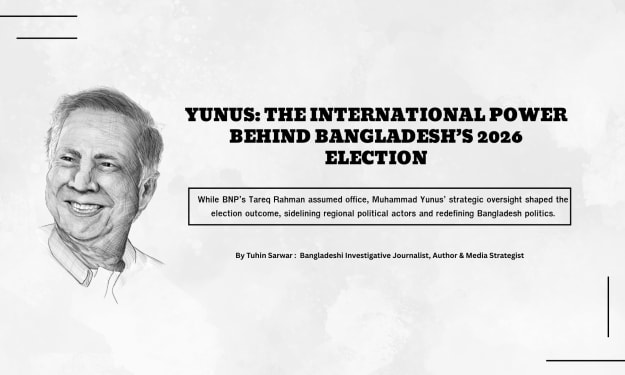
Yunus: The International Power Behind Bangladesh’s 2026 Election
By: Tuhin Sarwar। Dhaka । February 18, 2026 । Eight months after Bangladesh’s caretaker government assumed power following the collapse of the previous administration in August 2024, the nation experienced one of its most closely watched democratic transitions in recent memory. On 12 February 2026, the country concluded a general election that delivered a two-thirds parliamentary majority to the Bangladesh Nationalist Party (BNP), enabling Tarique Rahman to take office as Prime Minister. Yet an analysis by India Today reflected across global media outlets frames the story differently: the true strategic victor of Bangladesh’s 18‑month political transition was Muhammad Yunus, the Nobel laureate economist whose international stature and tactical maneuvering shaped the nation’s political landscape in ways no conventional politician has before.
By Tuhin Sarwar2 days ago in Journal


Comments
There are no comments for this story
Be the first to respond and start the conversation.