Latest Stories
Most recently published stories on Vocal.
Mindful Movement vs. Intense Exercise: Listening to the Body’s Real Needs. AI-Generated.
Modern fitness culture often celebrates intensity, speed, and visible results. However, many people feel disconnected from their bodies despite exercising regularly. Mindful movement offers a different path, one that values presence over pressure and responsiveness over force. Instead of asking how much the body can endure, this approach asks what the body needs today.
By Jose Morris18 days ago in Lifehack
The Audacity of Awakening
The reason many women lead such exhausting lives is not a lack of capability, but a surplus of patience. They spend years waiting—waiting for a partner to mature, waiting for someone to finally show they care, or waiting for a golden opportunity that is never destined to arrive. Eventually, a realization sets in: waiting is nothing more than slow exhaustion, while the "dare" is the act of turning around and walking away.
By Emily Chan - Life and love sharing18 days ago in Poets
How Family Relationships Influence Mental Health Beliefs And Coping Skills
Emotional development and beliefs of mental health depend on family relationships. Childhood experiences with parents and caregivers influence the way in which individuals perceive emotions, stress and their coping styles. Families that support and nurture their children teach children that they are normal in their feelings and they can handle them hence giving them confidence in the face of challenges. On the other hand, conflictual, neglected, or criticizing families may raise pessimistic thoughts regarding personal value and emotionality. This is because early experiences shape the ways in which people internalize stress, perceive challenges and the perceived presence of support that they may carry well into adulthood.
By Willian James18 days ago in Confessions
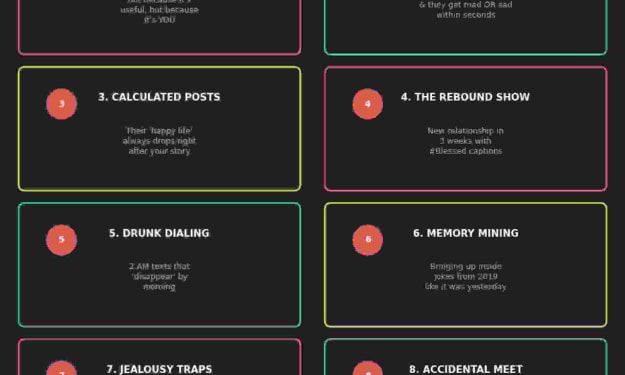
10 Clear Signs Your ex is not over you Psychology
It was a Tuesday. I remember because Tuesdays are garbage days in my building and I was already late for work. My phone buzzed. Instagram notification. From him. Not a message - those stopped six months ago. A story. I shouldn't have looked. I know better. But I looked.
By Understandshe.com18 days ago in Families
Developing Emotional Intelligence To Improve Relationships And Mental Health Skills
Emotional intelligence (EI) refers to the capacity to be aware of, know and be able to control and regulate personal emotions as well as ability to perceive and react to the emotions of other people. It is critical in ensuring that relations are healthy and also that mental health is enhanced. High-EI individuals are able to manage their emotions, cope with stress better and express themselves positively. The ability to grow emotionally enables individuals to cope with social life better, fit into other people, and avoid the pitfalls of misunderstandings, which may ruin any relationships. This is one of the basic skills that facilitate individual development as well as relationship peace.
By Willian James18 days ago in Confessions
Chewing Gum Market: Functional Ingredients, Flavor Innovation & Expansion. AI-Generated.
According to IMARC Group's latest research publication, The global chewing gum market size was valued at USD 28.69 Billion in 2024. Looking forward, IMARC Group estimates the market to reach USD 38.70 Billion by 2033, exhibiting a CAGR of 3.04% from 2025-2033.
By Faisal Al-Harbi18 days ago in Futurism
How Codependent Relationships Harm Mental Health And Emotional Independence Overtime
Characteristic of codependent relations is over dependence on a partner emotionally, which is usually done at the cost of the self and personal needs. One partner would assume ownership of the emotions of the other partner, and the other partner would go as far as to ensure that their emotions are always validated or supported. This relationship leads to an imbalance in which self-worth is regarded as being tied to the relationship as opposed to internal stability. The desire to please or control the feelings of the other person always affects one in the long run because of anxiety, stress and emotional exhaustion. The initial stage in learning the impacts of codependency on mental health is recognizing its existence.
By Willian James18 days ago in Confessions
A magical mess in the cyber city of Neonopolis
A magical mess in the cyber city In the not-so-distant future, where hoverboards zoomed alongside flying taxis and augmented reality was a common as a cup of coffee, the city of Neonopolis pulsed with an electric energy. It was a place where tech ruled supreme, and the only magic people believed in was the kind that came with a software update. But thanks to its tech-savvy citizens, the real magic was just a glitch away.
By Jazell carrasco18 days ago in Fiction
The Meaning of Xi’s Military Purge. AI-Generated.
A Purge That Speaks Without Words When Chinese President Xi Jinping removes senior military officials, the world often hears only fragments of the story: corruption allegations, disciplinary violations, or vague accusations of disloyalty. But in China’s political system, a military purge is never just about misconduct. It is a language of power—spoken quietly, interpreted carefully, and felt deeply within the ranks of the People’s Liberation Army (PLA). Xi’s recent military purges are not isolated incidents. They are signals. They reveal how China’s leadership views loyalty, control, and the future of its armed forces in an increasingly unstable global environment. Why the Military Matters So Much to Xi Jinping In China, the military does not serve the state—it serves the Communist Party. This distinction is crucial. Xi Jinping has repeatedly emphasized that “the Party commands the gun.” For him, the PLA is not just a defense institution but the ultimate guarantor of regime survival. Historically, Chinese leaders who lost control of the military lost power altogether. Xi understands this lesson deeply, which is why he has invested more time and political capital into military restructuring than any Chinese leader since Mao Zedong. Corruption or Control? The Official Narrative vs. Reality Officially, military purges are framed as part of China’s anti-corruption campaign. Bribery, influence peddling, and misuse of authority are cited as reasons for dismissals. But corruption in the PLA did not suddenly emerge. What has changed is Xi’s tolerance for independent power centers. Many purged officials were not merely corrupt; they were: Loyal to previous factions Embedded in old patronage networks Associated with rapid military modernization projects In this context, corruption charges function as a politically acceptable tool—a clean justification for removing figures who may challenge centralized authority. Loyalty Over Experience: A Strategic Trade-Off One of the most striking aspects of Xi’s military purge is who replaces the removed officers. Promotions increasingly favor: Personal loyalty to Xi Ideological alignment Political reliability This raises a critical question: Does loyalty come at the expense of competence? Some analysts argue that prioritizing political trust may weaken operational effectiveness. Others believe Xi is intentionally reshaping the military into a force that will never question civilian—and specifically, personal—authority. In Xi’s worldview, an obedient military is safer than a brilliant but autonomous one. The Shadow of History: Lessons from the Soviet Collapse Xi Jinping frequently references the collapse of the Soviet Union as a warning. In his view, the Soviet Communist Party fell not because of economic failure alone, but because: The military lost ideological discipline Party control eroded Loyalty fractured Xi’s military purges can be read as preventive medicine—an effort to eliminate the conditions that allowed the Soviet system to unravel. From this perspective, purges are not signs of weakness but acts of preemptive consolidation. Modernization Under Pressure China is in the middle of one of the largest military modernization programs in history: Advanced missile systems Expanded naval power Cyber and space warfare capabilities Purging senior leadership during such a transformation is risky. It disrupts command continuity and institutional memory. Yet Xi appears willing to accept short-term disruption for long-term control. The message to the PLA is clear: Modernize—but never independently. Fear as a Tool of Discipline Purges create uncertainty, and uncertainty creates fear. Within the PLA, fear serves a function: Officers self-censor Decision-making becomes cautious Loyalty is constantly signaled However, excessive fear can also produce paralysis. Commanders may avoid initiative, delay decisions, or focus more on political correctness than battlefield effectiveness. This tension—between discipline and dysfunction—is one of the most significant risks of Xi’s approach. What This Means for Taiwan and Global Security Many outside China ask a critical question: Do these purges make China more or less likely to act militarily, especially regarding Taiwan? There are two competing interpretations: More likely – A loyal military may execute political orders without hesitation. Less capable – A purged, cautious command structure may struggle with complex operations. Both can be true at the same time. Xi may be building a military that is politically reliable but operationally untested under stress. A Message to the World—and to China Internationally, Xi’s military purge signals resolve and centralization. Domestically, it reinforces a deeper narrative: Power flows upward, not outward Authority is personal, not institutional Loyalty outweighs legacy This is not merely a military adjustment—it is a redefinition of governance. Conclusion: Purge as Policy Xi Jinping’s military purges are not accidents, overreactions, or temporary cleanups. They are policy instruments—used to reshape the PLA into a force that mirrors his political philosophy. The true meaning of Xi’s military purge lies not in who was removed, but in what kind of military is being built: Centralized Ideologically disciplined Personally loyal Whether this strategy strengthens China or plants the seeds of future instability remains an open question. What is certain is that Xi is willing to gamble military tradition, institutional autonomy, and even short-term effectiveness in pursuit of absolute control. And in modern China, that may be the most powerful message of all.
By Zahid Hussain18 days ago in The Swamp
Navigating Mental Health Conversations With Partners In Romantic Relationships Calmly
Honest discussions about mental health are essential in romantic relationships since they help to understand and bring emotional closeness. Talking about mental health issues can enable spouses to be aware of needs, triggers, and coping mechanisms of each other. By not having such conversations misunderstandings, assumptions, and emotional distance may be created. When done with decision-making, mental health communication builds up the base of trust and self-care in the relationship, which enables both partners to help each other.
By Willian James18 days ago in Confessions