
Observability for LLM Applications: What Traditional Monitoring Misses
Why logging, metrics, and error tracking alone are no longer enough when building AI-driven systems powered by large language models

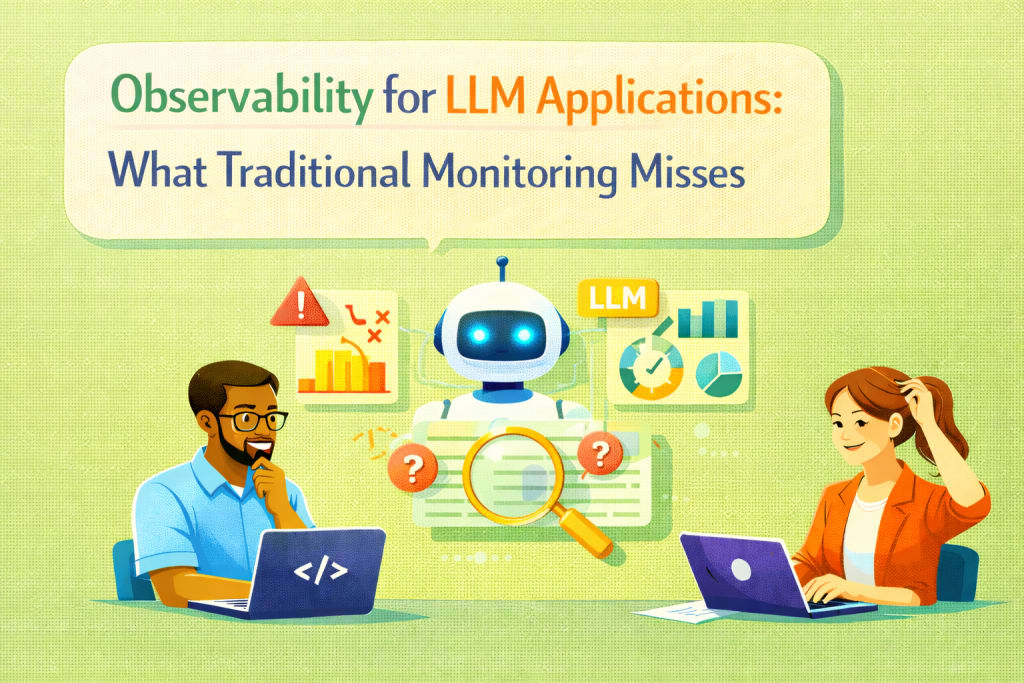
Traditional observability practices were built for deterministic systems. Developers monitored CPU usage, API latency, error rates, and infrastructure health to understand whether an application was working correctly. With large language model (LLM) applications, that approach no longer captures the full picture. Systems may appear healthy from a technical perspective while producing inaccurate, inconsistent, or harmful outputs.
Observability for LLM-driven applications introduces new challenges that require rethinking monitoring strategies beyond infrastructure metrics. Developers must now evaluate behavior, context, and model responses — areas that traditional monitoring tools were never designed to measure.
Why traditional monitoring falls short for LLM systems
Standard observability focuses on predictable system behavior:
- request-response latency
- server uptime
- database performance
- error codes
LLM-based applications introduce probabilistic outputs. A request may succeed technically but fail functionally because the generated output is irrelevant, incorrect, or inconsistent with expected formatting.
Examples of issues traditional monitoring may miss:
- hallucinated responses
- subtle inaccuracies
- inconsistent tone or structure
- prompt injection vulnerabilities
Monitoring must expand beyond infrastructure health to include output quality.
New dimensions of observability in AI-driven applications
LLM observability involves understanding how inputs, prompts, context, and models interact.
Key areas developers must track include:
- prompt performance
- retrieval quality
- token usage patterns
- output formatting consistency
- response confidence or reliability signals
These dimensions help teams identify when systems drift away from expected behavior even if no technical errors occur.
Prompt-level monitoring
Prompts influence how language models behave, making them critical components to observe.
Developers should monitor:
- changes in prompt versions
- performance differences across variations
- unexpected output patterns after prompt updates
Treating prompts as version-controlled assets allows teams to trace issues back to specific changes.
Evaluating output quality
Unlike traditional APIs, LLM outputs require evaluation beyond binary success or failure.
Common approaches include:
- automated evaluation metrics comparing output against expected patterns
- structured output schemas to validate responses
- human-in-the-loop review processes
Combining automated checks with manual review helps maintain accuracy over time.
Retrieval and context observability
Many modern AI systems rely on retrieval pipelines that provide context to models. Observability must include:
- which documents were retrieved
- ranking effectiveness
- relevance of contextual data
Without monitoring retrieval performance, developers may misdiagnose issues as model problems rather than context failures.
Tracking cost and token usage
LLM applications introduce operational costs tied to token consumption. Observability platforms must monitor:
- token usage trends
- average prompt size
- response length
- cost per request
Optimizing prompts and retrieval strategies can significantly reduce operational expenses.
Security considerations in LLM monitoring
AI systems face unique security challenges, including prompt injection attacks or data leakage through generated outputs.
Monitoring strategies should include:
- detecting suspicious prompt patterns
- validating input sources
- limiting sensitive data exposure
Security observability ensures that AI systems behave safely even when interacting with unpredictable user input.
Developer workflows for LLM observability
Building effective observability pipelines requires new workflows:
- logging structured prompts and outputs
- versioning prompt templates
- capturing retrieval context
- storing evaluation metrics
Developers must balance visibility with privacy, ensuring sensitive information is handled responsibly.
Implications for mobile app development
Mobile applications increasingly integrate LLM features such as conversational interfaces, automated content generation, and intelligent search. Teams working within mobile app development Denver ecosystems often need observability strategies that account for both mobile performance metrics and AI behavior monitoring.
Combining traditional monitoring tools with LLM-specific observability ensures consistent user experiences across devices.
Practical takeaways
- Expand observability beyond infrastructure metrics to include output quality.
- Track prompt versions and performance over time.
- Monitor retrieval pipelines to ensure relevant context.
- Implement structured output validation where possible.
- Analyze token usage to manage operational costs.
Final thoughts
Observability for LLM applications requires a shift in mindset. Traditional monitoring ensures systems run smoothly, but AI-driven applications demand visibility into behavior, context, and output quality. Developers who embrace this expanded approach gain deeper understanding of how their systems perform in real-world conditions, enabling more reliable and trustworthy AI-powered experiences.
About the Creator
Keep reading
More stories from Mary L. Rodriquez and writers in Lifehack and other communities.
Brickell vs. The Valley: Why Tech Founders Are Choosing Florida in 2026
I remember the first time I walked through Brickell City Centre in early 2026. For a moment, I had to remind myself I wasn't in downtown San Francisco or Manhattan. The air was different—thick with salt and a peculiar, high-octane energy that you only feel in a place that knows it’s on the rise.
By Mary L. Rodriquez13 days ago in Lifehack
How Programmatic Advertising Enhances Precision in Digital Ad Targeting
Digital advertising has experienced a quick transformation in the last 10 years and has transformed into a far less general, more manual, and more data-driven approach to target the right audience at the right time. With the competition for consumer attention increasing, companies are exploring smarter alternatives to provide consumers with relevant messages without spending the budget. It is here that automation and data are central to the current advertising approaches.
By Jane Smithh6 days ago in Lifehack
Craft Over Catharsis Challenge Winners
Craft Over Catharsis? What the hell does that even mean? The phrase came out of a curation meeting as a genuine question. We had been noticing that many challenge entries, across prompts, naturally gravitate toward trauma, grief, and personal reckoning. That makes sense. Writing is often cathartic. It's one of the ways we process what we've lived through.
By Vocal Curation Teamabout 3 hours ago in Resources




Comments
There are no comments for this story
Be the first to respond and start the conversation.