
Top 7 Mistakes to Avoid When Buying an Emerald Cut Engagement Ring
Expert Tips to Help You Shop Smart and Confidently
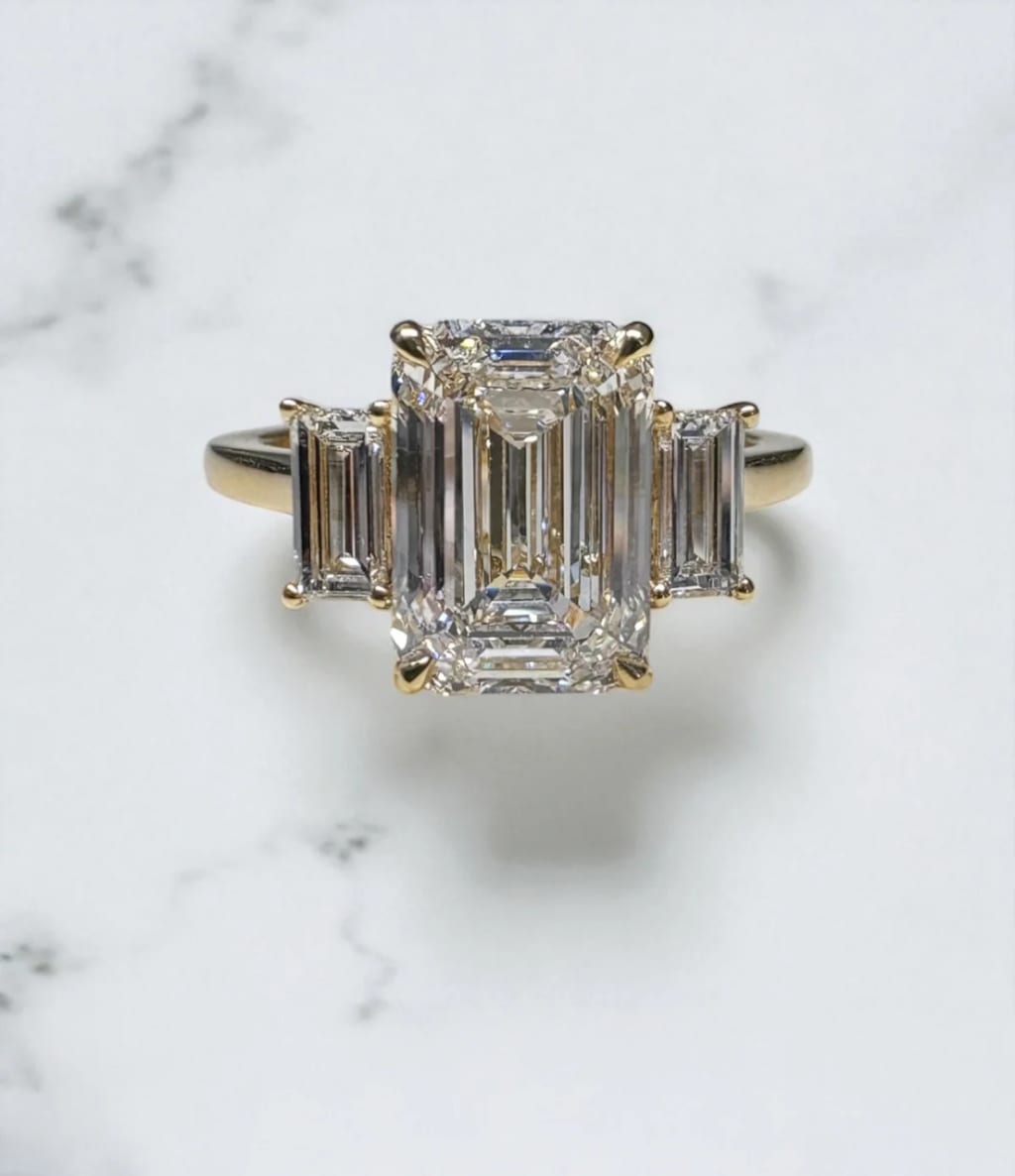
If you want sophisticated elegance, you cannot go wrong with an emerald cut engagement ring. Its design with an unusual step cut and hall of mirrors effect has captured the best of vintage and modern fashion style. With the emerald cut, instead of the subtle shine you would see with a round cut, you would see bold dramatic reflections of light with clean lines.
But because the emerald cut design is noticeable, that mighty clarity design has made the diamond a bit harder to choose. Because of the diamond's wide table and long, parallel step cut sides, there is an invisible error. To avoid making some of the most common missteps when selecting an engagement ring with an emerald cut diamond, keep reading for the 7 most common mistakes you should avoid.
Mistake 1: Prioritizing Carat Weight Over Clarity (The Biggest Error)
The Problem: Clarity is King for the Emerald Cut
Most brilliant cuts are strong enough to hide inclusions and flaws. That includes faceted rounds and princess cuts where the sparkle hides the depth of the gem. Emerald cuts are the complete inverse; flaws in the gemstone are stark and transparent because the table is a huge, open window. The gem's facets are columned and give it the look of a stairway, but they're unobstructed themselves obviously, going straight down to the depth of the crystal.
Most engagement rings with emerald cuts have a higher demand, which means the buyers have to look in more detail. Therefore, one should look at inclusions of a diamond. When the diamond is viewed in the round it will hide inclusions, but in an emerald cut those inclusions will be glaringly visible.
Aim for at least VS2 Clarity or better if you want to have the fix for that at least.
An engagement ring with a diamond that embodies the faceted and polished beauty of an emerald cut from a reputable jeweler is going to be inspiring attention, but those who hold the ring will do so with sketches of the crystal in their mind repeatedly until the diamond is polished and others need to see it, and in that case, a vortex cut that is a cut down to the pavilion or a brilliant cut and one should be higher diamond to be eye-clean with the round brilliant in mind. If the diamond is to have an impactful emerald cut, be sure to have that eye-cleaned fast so others can see it and ensure that the diamond's table where the upper surface is polished. If the diamond is in a pretty ring, look for details at the diamond's certificate and where you bought the diamond from.
Mistake 2: Skimping on Color Grade
The Problem: Color is Magnified
Embodied a cut diamond is clarity, and any subtle yellow or brown will show more than the other cuts, especially the rectangular shapes. These stones have long, flat planes that hold and reflect the body color more, especially on the corners and edges.
The Fix: Stay Within the Near-Colorless Range (G to I)
If you want a nice white appearance, H is best. When placing the emerald-cut engagement ring on white gold or platinum, G or H is best. If yellow or rose gold is chosen, you can easily go down to an I and even a J, as the warmer setting will go well with the tint of the stone. If setting a ring on white gold, do not go with an I or J color—you’ll have a more warmer appearance.
Mistake 3: Ignoring the Length-to-Width (L/W) Ratio
The Problem: Not All Emerald Cuts Look the Same
How long and skinny your emerald cut engagement ring looks is determined by the length to width ratio. A common mistake made by ring-buyers is going with a stone that looks too square or too skinny, but they're okay with that because the price is good. This ratio is nothing but preference, but going out of line can lead to some disappointment.
The Solution is to find your perfect ratio.
For the classic elongated look that is very popular, try to look for a length to width ratio that is between 1.40 and 1.50. This shape ring will look very flattering on the finger.
If you want a more square shape ring that looks a little more subtle, look for a ratio closer to 1.25.
If you want a very slim and dramatically elongated look, find a ratio that is more than 1.60.
Compare each of these ratios side by side to figure out which shape most appeals to you when you are looking for emerald cut engagement rings.
Mistake 4: Choosing a Setting That Doesn't Complement the Lines
The Problem: Mismatched Aesthetics
Emerald cuts are very linear and architectural looking. Putting them in ornate and stylized settings that are scalloped or very round might clash with that style and oversimplify the look. A weak setting might expose the corners of the stone and leave them vulnerable.
The Fix: Stick to Clean, Linear Designs
Emerald cuts look best in settings that also highlight the geometry.
Classic Solitaire: Simple, thin bands tend to look best with emeralds and have prongs of v-shape to protect the corners.
Tapered Baguettes: These have small, step-cut side stoned that mimic the center stone shape.
Trapezoid Halos/Side Stones: These are highly geometric side stones that look like they are growing from the lines of the center stone.
Try to avoid pavé bands with too much of a curve or traditional halos that would cover the beautiful outline of the emerald cut.
Mistake 5: Failing to Check the Depth and Table Percentages
The Problem: Poor Proportions Reduce the "Hall of Mirrors" Effect
The parading lights (hall of mirrors) and other stunning light shows of an emerald cut depend greatly on the sharp cut angles. If there’s too much of a table percentage (cut too shallow) or depth percentage (cut too deep) the reflection from the stone will appear dead or dull.
The Fix: Target the Ideal Cut Range.
For the best brilliance in engagement rings in emerald cuts, look for:
Table Percentage: 61%-69%
Depth Percentage: 60%-67%.
These numbers ensure the best balance for light reflection and the stone’s cut clarity.
Mistake 6: Forgetting About Corner Protection
The Problem: Vulnerable Edges
The edges on the corners of the diamonds on the emerald cuts help with the design, but they also may break if they get bumped on something and the corners show and don't have protection. Getting these edges on prongs that don't show is an expensive disaster waiting to happen with an emerald cut engagement ring.
How to Avoid It: V-Corner or Fully Bezel Set Engagement Rings.
Make Sure to Choose Settings that Have Some Type of Coverage:
V Corner: Prongs that are formed on the tip of the corners into a V or rounded shape.
Bezel Set: This is a ring design that has a smooth border made of a full ring of metal that extends around the stone. This also has the most protection available for an emerald cut engagement ring.
Mistake 7: Overlooking Fluorescence and Girdle Thickness
The Problem: Too Much or Too Little Can Cause Issues
Fluorescence: Sunlight can make stronger diamonds shin, but because some blue stronger diamonds have a blue oily and hazy effect, it is best to avoid these.
Girdle: Girdle width is important because a Girdle that is too thick adds a lot of extra weight to the diamond without adding extra size, and a girdle that is too thin is riskier because it can chip very easily.
The Fix: Balance and Inspect
Faint, None and Medium are the best options for a fluorescence grade and for the girdle, a grade of Medium to Slightly Thick is best as it will not compromise the durability of the diamond and will make a visually large and brilliant emerald cut engagement ring.
The emerald cut engagement ring is a statement piece that exudes refined taste and by being as careful as possible to avoid these seven common mistakes because of their focus on clarity and color, especially, you will have a perfect and timeless jewelry piece selected to last for a very long time.
About the Creator
Keep reading
More stories from layladiamondsadarsh diamonds and writers in Marriage and other communities.
The Definitive Guide: Top 5 Best-Selling Engagement Rings of 2025
A couple's search for the ideal engagement ring can be an unforgettable experience. Starting in 2025, the jewelry industry is characterized by an intricate combination of personalized value, ethically sourced materials, and designs that perfectly hone in on both sparkle and an elegant, flattering wearability. Rather than momentary trends, the industry is showcasing timeless designs that characterized a love that is truly special and built to last. For those ready to dive into the most popular designs of the year, here are the top five most popular engagement ring styles that are setting the bar for timeless elegance.
By layladiamondsadarsh diamonds2 months ago in Marriage
The Devil's Triangle
The sails ruffled in the breeze as we cruised along. The Sea Breeze was a mid-size catamaran that sailed out of Royal Naval Dockyard in Bermuda. We had booked this trip weeks in advance and were now looking at our Captain, Spike and two boat hands. Paddy and Wilson seemed like nice guys, joking around with the passengers and telling us some stories about Bermuda that only locals would know. Their island accents sounded almost British but they were pleasant to listen to.
By Barbara Gode Wiles5 days ago in Fiction


Comments
There are no comments for this story
Be the first to respond and start the conversation.