
The Blueprint of Survival: How Jay-Z Turned Rejection into a Billion-Dollar Empire
The music industry told him he wasn't marketable. The streets told him he wouldn't live past 25. He didn't just beat the odds; he bought the casino

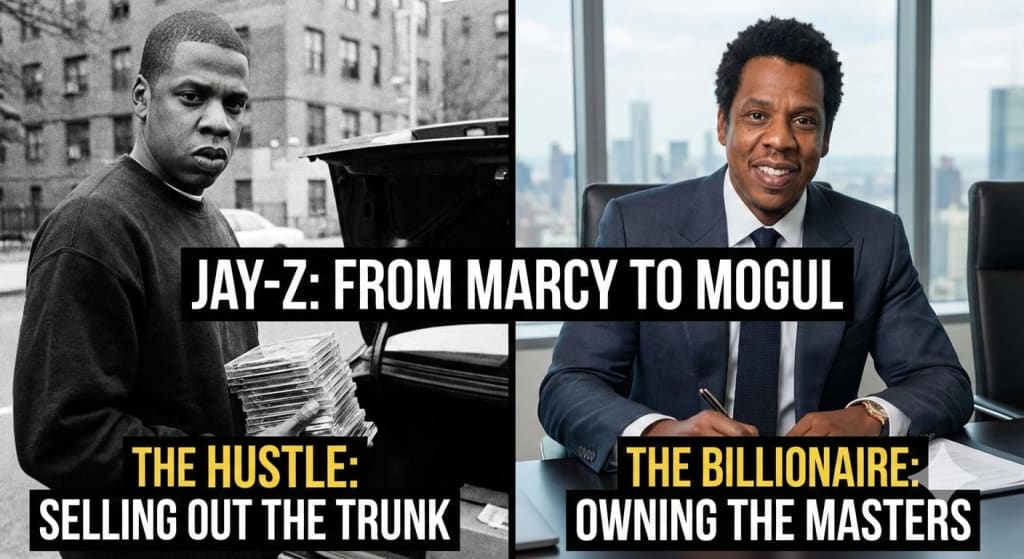
The raw, true story of Jay-Z. From dropping out of high school in the Marcy Projects and selling CDs out of his car, to becoming hip-hop's first billionaire through the power of ownership.
Introduction: The Concrete Trap
If you stood in the courtyard of the Marcy Houses in Bedford-Stuyvesant, Brooklyn, in the 1980s, you weren't looking at a neighborhood. You were looking at a trap.
It was an environment designed to keep you exactly where you were.
The elevators smelled of urine. The stairwells were offices for drug dealers. The sound of sirens was the neighborhood lullaby.
This is where Shawn Carter was born.
When your father leaves when you are 11 years old, and your mother is working double shifts just to keep the lights on, survival becomes your primary education. You don't think about 401(k)s. You don't think about real estate. You think about tomorrow.
There is a myth that floats around the internet—one that says Jay-Z couldn't read until he was 18.
Let’s correct that, because the truth is actually much more powerful.
Shawn Carter could read. In fact, a sixth-grade teacher named Renee Foster sparked a deep love of language in him. But the formal education system around him was crumbling. It wasn't built to nurture young Black boys in the projects; it was built to warehouse them.
So, he dropped out of high school. He didn't get a diploma. He didn't get groomed for the boardroom. He didn't have mentors in tailored suits teaching him about compound interest or corporate leverage.
His education came from the pavement.
He carried a green notebook everywhere he went, writing down lyrics, rhyming words, secretly reading the dictionary to expand his vocabulary. When he lost the notebook, he learned to memorize the lyrics in his head—a skill that would later make him a legend in the recording booth.
But talent in the projects is cheap.
Every block had a guy who could rap. Every corner had a guy with a dream.
The difference wasn't just the voice. It was the vision.
Part I: The Rejection of Shawn Carter
By the mid-1990s, Jay-Z was trying to get out of the street life. He had seen friends go to prison. He had seen friends go to the graveyard. Music was his only parachute.
But the music industry is a machine, and in 1995, Jay-Z didn't fit the gears.
He was 26 years old—which, in the music business, is considered ancient for a debut artist. He didn't have the commercial, radio-friendly sound that the major labels were looking for. He rapped about the grim, unglamorous reality of the hustler's life with a cold, detached precision.
He knocked on the doors of every major record label in New York City.
Sony. Def Jam. Columbia.
They all sat in their air-conditioned offices, listened to his demo, and said the exact same thing:
"No."
"Too old."
"Not marketable."
"We don't know what to do with you."
It is one thing to be rejected when you have a safety net. It is another thing entirely to be rejected when your alternative is going back to a life that might kill you.
Most artists at this point would beg. They would change their style. They would agree to terrible, exploitative contracts just to get their foot in the door.
Jay-Z didn't beg.
He observed.
Part II: The Trunk of the Car
He looked at the music industry and realized a fundamental truth: The people saying "no" didn't actually create the value. They just controlled the distribution.
If he could control his own distribution, he didn't need their permission.
Along with his partners Damon Dash and Kareem "Biggs" Burke, Jay-Z made the boldest move of his life. They pooled their street money. They pressed their own CDs.
They founded Roc-A-Fella Records.
No corporate backing. No multi-million dollar marketing budget. No PR team.
Jay-Z put the CDs in the trunk of his car, and they drove up and down the East Coast. They sold them out of the trunk to mom-and-pop record stores. They hand-to-hand hustled their own music.
They created their own demand. They made the streets buzz so loud that the corporate towers had no choice but to look down and listen.
Eventually, Priority Records offered them a distribution deal. But Jay-Z and his partners did something almost unheard of for new, desperate artists:
They kept their ownership.
They didn't sell their souls for a quick advance. They negotiated a deal where they owned the master recordings.
That one decision changed the trajectory of hip-hop history.
Part III: The Boardroom Predator
When Jay-Z finally released his debut album, Reasonable Doubt, in 1996, it wasn't just an album. It was an auditory business card.
He had broken into the industry, but he quickly realized the industry was a trap just like the Marcy Projects.
He saw legendary artists—people who had sold millions of records—dying broke. He saw musicians who didn't own their own names, their own publishing, or their own masters. They were celebrated in public, but exploited in private.
Jay-Z decided he wasn't going to be an employee of hip-hop. He was going to be the landlord.
He didn't just spend his time in the recording studio. He spent it in the boardroom.
He read the contracts.
He learned what "recoupable" meant.
He learned about equity, licensing, and merchandising.
"I'm not a businessman / I'm a business, man."
That wasn't just a clever lyric. It was a declaration of independence.
Part IV: The Evolution of Leverage
The genius of Jay-Z isn't just that he became a great rapper. It's that he used his talent as a Trojan Horse to infiltrate rooms where people who looked like him were historically denied entry.
He built leverage step by brutal step:
* From Artist to Executive: In 2004, he didn't just sign to Def Jam; he became the President and CEO of Def Jam, sitting in the very office that had once rejected him.
* From Endorser to Owner: When a popular champagne executive made disparaging remarks about the hip-hop community drinking their product, Jay-Z didn't just boycott them. He bought a rival champagne company, Armand de Brignac (Ace of Spades), and made it the hottest brand in the world.
* From Entertainer to Agency: He realized athletes were being exploited the same way musicians were. So he founded Roc Nation Sports, negotiating hundreds of millions of dollars for players, ensuring they kept their wealth.
He took the survival instincts he learned in the Marcy Projects—the hyper-vigilance, the risk assessment, the understanding of supply and demand—and applied them to corporate America.
He went from a high school dropout selling CDs in a parking lot to a man sitting across from Warren Buffett, discussing global economics.
Part V: The Master of Masters
In the music industry, your "masters" are the original recordings of your music. Whoever owns the masters owns the financial legacy of the art.
For decades, labels held artists hostage by owning their masters.
When Jay-Z was negotiating his return to Def Jam, he made a demand that shocked the industry. He wanted his masters back. All of them.
It was a grueling negotiation. It took years. But he got them.
He reclaimed the rights to his own voice. He ensured that his children, and his children's children, would profit from the pain and poetry he recorded in his twenties.
In 2019, Forbes officially declared Jay-Z a billionaire. He was the first hip-hop artist to achieve the milestone.
Not because he had the best voice. Not because he was the luckiest.
Because he refused to rent his life. He demanded to own it.
Part VI: The Real Motivation
We look at billionaires and assume they had a head start. We assume they had Ivy League educations, trust funds, and powerful uncles.
Jay-Z had none of that. He had the opposite of that.
His story is the ultimate counter-argument to the excuse of circumstances.
He didn't say, "Look at my environment. The system is broken. I can't win."
He said, "The system is broken. So I will build my own."
It is a harsh, uncomfortable truth: The world does not care where you start.
The world will not hand you a discount because your childhood was hard. The market will not lower the barrier to entry because your education was lacking.
You have to force the market to respect you.
If you don't have the formal education, you have to read the contracts twice as hard.
If you don't have the corporate backing, you have to sell out of your own trunk.
If the gatekeepers won't let you in the building, you have to buy the brick factory and build your own tower.
Conclusion: The Architecture of Your Own Life
Talent makes noise. Ownership builds legacy.
You can be the most talented person in the room, but if you don't own the room, you are just entertainment for the people who do.
Jay-Z’s life proves that your beginning does not have to be your identity. Poverty, lack of formal education, and systemic rejection are devastating hurdles, but they are not permanent labels.
You do not have to start ahead.
You just have to start aware.
The next time you face a "No," the next time you feel like you lack the credentials, the connections, or the pedigree, remember the kid from the Marcy Projects.
He didn't wait for a seat at the table.
He brought his own chair. And then he bought the restaurant.
This one has an incredibly strong narrative arc for video. Would you like me to adapt this specifically into a high-retention script format optimized for your Massey USA channel, complete with visual cues and pacing notes for the edit?
About the Creator
Frank Massey
Tech, AI, and social media writer with a passion for storytelling. I turn complex trends into engaging, relatable content. Exploring the future, one story at a time
Keep reading
More stories from Frank Massey and writers in Motivation and other communities.
The Galaxy’s Unlikely Guardian: How Chris Pratt Went from Van Life to the A-List
The incredible true story of Chris Pratt, who went from being homeless in Hawaii to starring in Guardians of the Galaxy and Jurassic World, proving that your current situation is not your final destination.
By Frank Massey a day ago in Motivation
One Hard Thing
Stop me if you’ve heard this one before: You have the number, you know your schedule- you’ve even picked out the perfect day and time to make this appointment. Shoot, you’ve even picked out alternative days and times just in case their schedules can’t accommodate you!
By Taylor Rigsby25 days ago in Motivation
The Price Of Everything
In today’s world, money speaks louder than words. It opens doors, builds houses, creates opportunities, and commands attention. But sometimes, without realizing it, we allow money to rise higher than everything else — higher than love, higher than friends, higher than happiness, and even higher than self-respect.
By Active USA 6 days ago in Motivation
At My Wits’ End
Life is about taking out the trash and calling it trash because you have every reason to. It wasn't meant to be linear, they say. But the times you tried to make it straight led to problems, and you didn’t have the tools to put any of it to use. You don't put your right shoes on the right feet; you put the left shoes on the left feet. The grey hardened slab will trip you up anyway.
By Caitlin Charltonabout 16 hours ago in Psyche


Comments
There are no comments for this story
Be the first to respond and start the conversation.