
The Galaxy’s Unlikely Guardian: How Chris Pratt Went from Van Life to the A-List
He was a coupon salesman, a stripper, and a homeless waiter living in a van with a Scooby-Doo sticker on the side. This is the story of how Hollywood’s biggest goofball became its biggest action hero

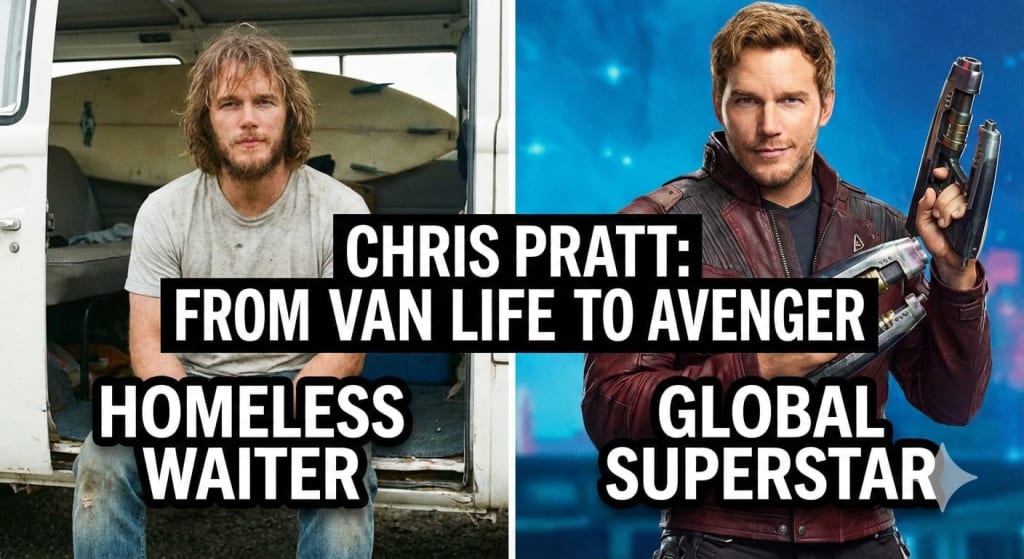
The incredible true story of Chris Pratt, who went from being homeless in Hawaii to starring in Guardians of the Galaxy and Jurassic World, proving that your current situation is not your final destination.
Introduction: The Van Down by the River
If you visited Maui, Hawaii, in the year 2000, you might have seen a white van parked near the beach. It was a beat-up vehicle with a decal of Shaggy and Scooby-Doo on the side.
Inside lived a 19-year-old kid named Chris.
He had no money. He had no acting credits. He had no plan.
He spent his days sleeping in a tent on the beach or in the back of the van. He spent his nights partying. He showered at the beach showers. He ate whatever he could afford, which wasn't much.
To the tourists walking by, he was just another beach bum. A dropout. A statistic of wasted potential.
If you had told anyone on that beach that this kid—shaggy-haired, sunburned, and smelling of salt water and weed—would one day be the face of a multi-billion dollar Disney franchise, they would have laughed in your face.
They would have said, "That guy? He’s going nowhere."
And for a long time, they were right.
Chris Pratt was living the definition of a dead-end life. But hidden beneath the aimlessness was a spark of charisma that was just waiting for a breeze to turn it into a fire.
Part I: The Coupon Salesman
Before the van, there was the struggle.
Chris Pratt grew up in Lake Stevens, Washington. His family was working-class. His father was a miner and a contractor; his mother worked at a supermarket. Money was tight.
Chris was a wrestler in high school. He was good. He placed fifth in the state tournament. Wrestling taught him discipline, but it didn't give him a direction.
After graduating, he enrolled in community college. He lasted half a semester.
He dropped out.
Then came the "lost years."
He worked as a discount ticket salesman. He sold coupons door-to-door. It was a grueling job. You have to handle rejection constantly. You have to be charming to people who are annoyed you are on their porch.
Chris discovered something: He was good at it.
He could make people smile. He could sell ice to an Eskimo.
But selling coupons wasn't a life.
He worked as a stripper for a brief period. He did odd jobs. He was drifting.
One day, a friend bought him a one-way ticket to Maui.
"Come live in paradise," the friend said.
Chris packed a bag and left. He had nothing to lose.
Part II: The Bubba Gump Miracle
In Maui, homelessness wasn't a tragedy for Chris; it was an adventure.
He and his friends fished for their dinner. They smoked weed. They listened to Dr. Dre's 2001 album on repeat in the van.
It was a life of zero responsibility.
But you can't eat sunshine. So, Chris got a job at the Bubba Gump Shrimp Co. restaurant.
He was a terrible waiter. He ate the customers' leftover food. He broke plates. He forgot orders.
But the customers loved him.
He was funny. He was charming. He treated every table like an audience.
One day, a woman walked in. She was Rae Dawn Chong, a director and actress (known for Commando).
Chris didn't know who she was. He just saw a customer. But something in his gut told him to turn up the charm.
He served her table. He joked. He smiled. He made her laugh.
At the end of the meal, she looked at him.
"You're cute," she said. "Do you act?"
"Absolutely," Chris lied. He had never acted in his life, unless you counted high school plays.
"I'm directing a horror movie in Los Angeles," she said. "I need a guy. You want to come audition?"
Most people would have hesitated. LA is expensive. I have no car. I have no money.
Chris didn't hesitate.
"Yes."
He used the last of his money to fly to LA. The movie was a terrible, low-budget horror film called Cursed Part 3. It was never released in theaters.
But it was a ticket out of the van.
Part III: The Funny Fat Guy
Chris Pratt arrived in Hollywood with $700 and a dream.
He started getting work. Not because he was a great actor, but because he was likable.
He landed a role on the TV show Everwood. He played the "jock's friend." It was a steady paycheck.
Then came the role that defined him: Andy Dwyer on Parks and Recreation.
Andy was supposed to be a temporary character. He was the lazy, annoying boyfriend of Rashida Jones’s character. He was supposed to be in six episodes and then disappear.
But Chris made a choice. He decided to make Andy lovable.
He improvised. He fell over furniture. He played the "human golden retriever."
The writers loved him so much they rewrote the show. They made Andy a main character. They kept him for seven seasons.
But there was a catch.
To play Andy Dwyer, Chris had to be "The Funny Fat Guy."
He gained weight. He stopped working out. He drank beer. He ate burgers.
He was successful, yes. He was on a hit TV show. He was married to Anna Faris.
But in Hollywood, being the "funny fat guy" is a box. It’s a comfortable box, but it has a low ceiling. You are the sidekick. You are the comic relief. You are never the hero.
Chris looked in the mirror. He saw a guy who was funny, but he didn't see a movie star.
He tried to audition for serious roles.
He auditioned for Avatar. Rejected.
He auditioned for Star Trek. Rejected.
They looked at his physique, heard his goofy laugh, and said, "Stick to comedy, kid."
Part IV: The Moneyball Moment
The turning point came when he auditioned for the baseball movie Moneyball.
The role was Scott Hatteberg, a baseball player. It was a serious, dramatic role alongside Brad Pitt.
The casting director looked at Chris.
"You're too fat," she said. "Hatteberg is an athlete. You look like a teddy bear."
It was the first time someone had been that blunt.
Chris went home. Most actors would have eaten a pint of ice cream to comfort themselves.
Chris didn't. He went to the gym.
He worked out for three months. He stopped drinking. He dropped 30 pounds.
He went back to the casting director. She didn't recognize him.
He got the part.
It was a small victory. But it planted a seed. I can change.
Part V: The Impossible Audition
Then came the script for Guardians of the Galaxy.
Marvel was taking a huge risk. They were making a movie about a talking raccoon and a walking tree. They needed a lead actor who could carry the insanity—someone funny, but also an action hero.
They needed Star-Lord.
The casting director suggested Chris Pratt.
James Gunn, the director, laughed.
" The chubby guy from Parks and Rec?" Gunn said. " absolutely not. I don't even want to see him."
Chris didn't want to do it either. He was terrified of another rejection. He thought he wasn't "Marvel material."
But the casting director tricked them both. She invited Chris to the studio when James Gunn was there.
Chris walked in. He was still a bit heavy. He was sweaty.
James Gunn sighed. "Fine. I'll read with him."
Within 20 seconds, James Gunn knew.
"He's the guy," Gunn whispered. "We just have to get the weight off him."
Chris got the role. But he had a condition.
"You have six months," Marvel told him. "You need to look like a superhero."
Part VI: The Torture Chamber
This is the part of the story that separates the dreamers from the doers.
Everyone wants to be a superhero. Nobody wants to eat boiled chicken and broccoli for six months straight.
Chris Pratt entered what he calls "The Torture Chamber."
He worked out four hours a day.
He gave up beer (his favorite thing).
He drank gallons of water.
He lifted weights until he puked.
He stripped away the "funny fat guy."
He lost 60 pounds. He gained layers of muscle. He carved out a six-pack.
He posted a selfie on Instagram. The caption was: "Six months no beer. #GOTG Kinda douchey to post this but my brother made me."
The internet exploded.
The "funny fat guy" was gone. In his place was a legitimate action star.
But he didn't lose the one thing that mattered: his sense of humor.
Part VII: The Global explosion
Guardians of the Galaxy premiered in 2014.
Critics expected it to flop. "Who cares about a raccoon?" they said.
The movie made $773 million.
Chris Pratt was a revelation. He was funny, yes. But he was also cool. He had swagger. He looked like Han Solo and Indiana Jones rolled into one.
Then came Jurassic World.
Then came The LEGO Movie.
Then Avengers.
Within two years, the guy living in a van was the highest-grossing actor in the world.
He was hosting Saturday Night Live. He was on the cover of Men's Health.
He had done the impossible. He had crossed the chasm from "TV sidekick" to "Global Movie Star."
Part VIII: The Real Motivation
What makes Chris Pratt’s story so powerful isn't the weight loss. It's the attitude.
When he was living in a van in Maui, he wasn't miserable. He was happy.
When he was a waiter eating leftovers, he wasn't bitter. He was charming.
When he was the chubby sidekick, he wasn't jealous. He was stealing the scene.
He didn't wait until he was famous to be confident.
He brought confidence to every single level of his life, and that confidence is what leveled him up.
He proved that readiness is a state of mind.
He didn't have a plan. He had a posture. He was standing up, eyes open, ready for the ball to be thrown his way.
Conclusion: The Van Was the Incubator
Today, Chris Pratt owns a farm. He raises sheep. He is a father. He is a superstar.
But he still keeps the van in his heart.
He often talks about that time in Maui. He doesn't talk about it with shame. He talks about it with nostalgia.
"It was a charming time," he says.
The van wasn't a failure. It was an incubator.
It was the place where he learned to be comfortable with himself. It was the place where he learned that money doesn't define happiness.
And because he learned that lesson before he got the money, the money didn't ruin him.
The Lesson
There are people reading this right now who feel like they are "in the van."
You might be working a job you hate. You might be broke. You might feel like you are miles away from your dream.
Chris Pratt is the proof that you are not "behind." You are just in the prologue.
Your current situation is not your identity. It is just your location.
You can be a waiter and have the soul of a movie star.
You can be homeless and have the spirit of a king.
The only difference between the guy in the van and Star-Lord was opportunity and preparation.
Opportunity is luck. You can't control it. (Rae Dawn Chong might walk into your restaurant, or she might not).
But preparation? That is 100% on you.
Are you funny enough? Are you charming enough? Are you willing to work out for 6 months without beer?
Are you ready?
Because when the door opens—and it will open—it won't wait for you to get ready.
You have to be ready now.
So, serve the shrimp. Sell the coupons. Sleep in the van if you have to.
But keep your eyes on the door.
Because your galaxy is waiting.
About the Creator
Frank Massey
Tech, AI, and social media writer with a passion for storytelling. I turn complex trends into engaging, relatable content. Exploring the future, one story at a time
Keep reading
More stories from Frank Massey and writers in Motivation and other communities.
The Ghost of the Varsity List: How Michael Jordan Turned a "No" into a Dynasty
The definitive story of Michael Jordan being cut from his high school basketball team, and how that single moment of rejection created the most dominant athlete the world has ever seen.
By Frank Massey 2 days ago in Motivation
One Hard Thing
Stop me if you’ve heard this one before: You have the number, you know your schedule- you’ve even picked out the perfect day and time to make this appointment. Shoot, you’ve even picked out alternative days and times just in case their schedules can’t accommodate you!
By Taylor Rigsby24 days ago in Motivation
The Nightingale and the Rose
A young student sat in his dimly lit room, clutching a book he could not read. He was heartbroken because the professor’s daughter had told him she would dance with him at the ball only if he brought her a red rose. His garden held no red roses, only white and yellow blooms, and he felt powerless and defeated. The student lamented that true love often demanded impossible sacrifices.
By Malak Faisalless than a minute ago in Motivation



Comments
There are no comments for this story
Be the first to respond and start the conversation.