
The Boy Who Became the Bolt: Jordan Reyes and the Burning Bus
In 2018, on a California highway, a school bus became a fire trap. With the exit jammed and forty-three students trapped inside, a quiet thirteen-year-old boy made a decision that would scar him for life, but save every soul on board.

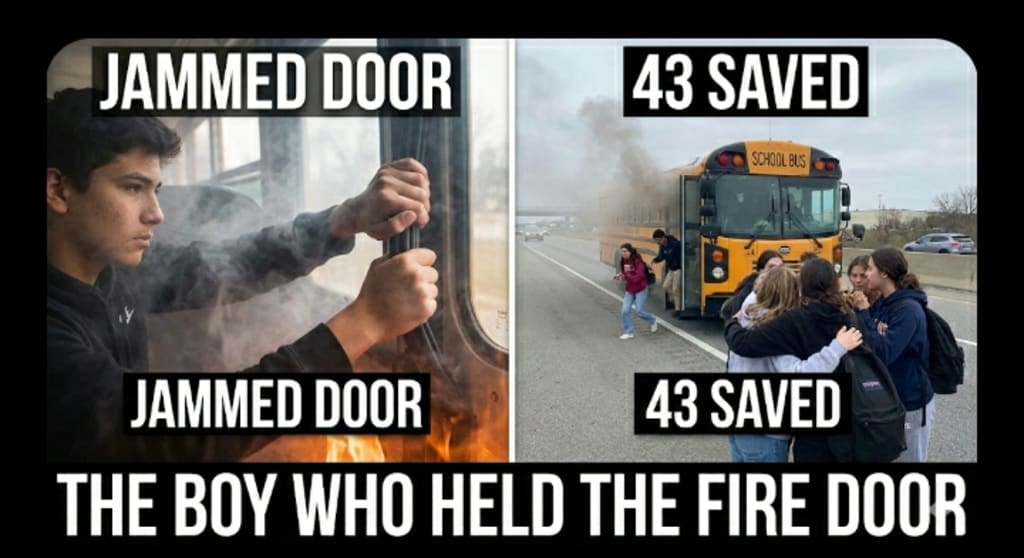
The harrowing true story of Jordan Reyes, the 13-year-old student who suffered severe burns holding open a jammed bus door during a fire, ensuring his classmates escaped.
Introduction: The Yellow Capsule
To a middle schooler, a school bus is a social ecosystem. It is a yellow capsule of noise, hierarchy, and exhaust fumes. The cool kids sit in the back, the studious ones in the middle, and the invisible ones in the front.
In 2018, Jordan Reyes sat in the front.
He was thirteen years old. He was small for his age, with a frame that looked like a strong wind could knock him over. He was the kind of kid who moved through the hallways of his Oakland middle school like a ghost—quiet, polite, keeping his head down. He wasn't an athlete. He wasn't a class clown. He was just Jordan.
On a warm afternoon, the bus was merging onto the highway overpass. It was carrying forty-three students. The air inside smelled of stale lunches, floor wax, and teenage sweat.
Jordan was looking out the window, watching the concrete barriers blur by. He was thinking about homework, or video games, or just waiting for the ride to be over.
He didn't know that the machine beneath him was already dying.
Deep in the engine block, a seal had failed. Oil was leaking onto the hot manifold. A spark had ignited.
The fire didn't announce itself with an explosion. It started as a smell.
Part I: The Malfunction
The first sign was the smoke.
It curled up from the dashboard, acrid and black. It smelled like burning rubber and melting plastic.
The bus driver, a veteran of the district, knew immediately that this wasn't a simple overheat. He looked in his rearview mirror and saw the smoke beginning to seep through the floorboards near the rear emergency exit.
"Everybody sit down!" he shouted, wrestling the heavy steering wheel.
He slammed on the brakes. The bus shuddered and skidded to a halt on the shoulder of the overpass. The sudden stop threw backpacks to the floor. The chatter died instantly, replaced by a confused silence.
Then, the flames appeared.
They weren't inside yet, but they were licking up the sides of the windows. The heat radiated through the metal skin of the bus.
"Evacuate!" the driver screamed. "Get out! Now!"
He hit the lever to open the main door.
The hydraulic system engaged. Hiss. The door began to fold outward.
But the heat from the engine fire had already melted the hydraulic lines. The pressure failed.
The door opened six inches. Then it stopped. Then, the safety mechanism kicked in, and it tried to slide shut.
Part II: The Bottleneck
Panic is a contagion. It spreads faster than fire.
When the kids in the back saw the flames, they surged forward. Forty-three students, screaming, pushing, climbing over seats. The aisle became a crush of bodies.
The rear emergency exit was blocked by the fire’s origin point. The only way out was the front.
And the front was jammed.
The driver was frantically pulling on the manual release lever, but the heat had warped the frame. The door was stuck in a limbo between open and closed. It would slide open a foot, then the dying hydraulics would force it back.
It was a guillotine.
Jordan Reyes was right there. He was in the first row. He could have been the first one off. He could have squeezed through the gap, jumped to the asphalt, and run to safety.
He stood up. The smoke was filling the cabin now, a thick, toxic gray cloud that burned the eyes and throat.
Jordan looked at the door. He saw the driver struggling with the lever. He saw the wall of terrified classmates behind him.
He saw the gap closing.
If the door shut, it might seal. And if it sealed, the bus would become an oven.
Jordan didn't calculate. He didn't weigh the pros and cons. He simply reacted.
He wedged his body into the gap.
Part III: The Human Wedge
He placed his hands on the rubber seals of the folding doors. He planted his feet on the steps.
He pushed.
"Go!" he screamed. "Go!"
He forced the doors apart, creating an opening just wide enough for a student to pass.
The hydraulics fought him. The machine wanted to close. It pressed against him with the relentless, unthinking force of pressurized fluid.
But Jordan locked his elbows.
The first student scrambled through. Then the second. Then the third.
The fire was growing. The floorboards beneath Jordan’s feet were getting hot. The dashboard plastic was bubbling.
But the real pain wasn't in his feet. It was in his hands.
The metal frame of the door was heating up. It was conducting the fire from the engine bay directly into Jordan’s palms.
Part IV: The Crucible
To hold a piece of hot metal is an agony that bypasses the brain and goes straight to the spine. Every instinct in the human body screams: Let go. Pull away.
Jordan felt his skin blistering. He felt the searing heat traveling up his wrists.
Tears streamed down his face. He was coughing from the smoke. He was screaming in pain.
But he didn't let go.
Because every time he felt his grip loosen, another kid appeared in the smoke. A face he knew from algebra. A girl he knew from the cafeteria.
If he let go, the door would slam on them.
"Hurry up!" the driver yelled, coughing, trying to direct the kids while Jordan held the portal open.
They tumbled out, one by one. Coughing, crying, landing on the pavement and running away from the vehicle.
Jordan became a statue of pain. He was the anchor. He counted them as they passed. Ten. Twenty. Thirty.
The smoke was so thick now he could barely see the back of the bus. The heat was scorching his eyebrows. The rubber of his sneakers was tacky, sticking to the melting step treads.
His hands were numb, then sharp, then numb again. The nerves were being overwhelmed.
Part V: The Last Passenger
The flow of students stopped.
"Is that everyone?" Jordan choked out.
The driver scanned the dark, smoky tunnel of the bus. "I think so! Jordan, let go! Get out!"
Jordan prepared to jump.
But then, a sound.
A low whimper from the floor, halfway back.
Jordan looked through the haze. He saw a shape.
A girl. A sixth grader. In the panic, she had been shoved. She had fallen and twisted her ankle. She was on the floor, disoriented, terrified, unable to stand.
The flames had breached the floor in the back. The seats were catching fire.
Jordan looked at his hands. They were raw, red, and shaking.
He looked at the open door. If he left it, it would close.
He looked at the driver. The driver was already moving toward the girl, but the smoke knocked him back.
Jordan didn't leave the door. He couldn't. If the door shut, they were all trapped.
"Get her!" Jordan screamed at the driver. "I've got the door!"
The driver dove into the smoke, grabbed the girl by the backpack straps, and dragged her down the aisle.
The heat was unbearable. The windshield shattered from the thermal stress.
The driver reached the front. He threw the girl through the gap. He tumbled out after her.
"Jordan! Now!"
Part VI: The Jump
Jordan Reyes was the last soul on the bus.
He looked at his hands one last time. They were fused to the task.
He released the pressure.
The hydraulic door slammed shut instantly, snapping like a trap.
But Jordan was already moving. He threw himself through the narrowing gap, diving out onto the hot asphalt of the highway.
He hit the ground and rolled.
Five seconds later—literally five seconds—the fuel tank ignited.
WHOOSH.
The bus was engulfed. A fireball consumed the front entrance where Jordan had been standing. The windows blew out. The tires exploded.
Forty-three students and one driver stood on the side of the highway, watching their backpacks and their instruments and their homework turn to ash.
They were coughing. They were crying. But they were standing.
Jordan was on his knees, holding his hands to his chest. He was rocking back and forth. He wasn't crying anymore. He was in shock.
Part VII: The Hands
The paramedics arrived in a swarm of sirens.
They triaged the students. Smoke inhalation. Bruises. Sprained ankles.
Then they got to Jordan.
The medic took Jordan’s wrists and gently turned his palms up.
He hissed a breath through his teeth.
Jordan’s hands were a map of the trauma. Second-degree burns covered his palms and fingers. The skin was blistered and peeling. The imprint of the door frame was burned into his flesh.
"Son," the medic said quietly. "How long did you hold that door?"
Jordan didn't answer. He just stared at the burning bus skeleton.
They wrapped his hands in cooling gel and sterile bandages. They loaded him into the ambulance.
As they closed the ambulance doors, Jordan saw his classmates. They were huddled in a group, watching him.
They knew.
They knew that the only reason they were standing there, feeling the wind on their faces, was because the skinny kid from the front row had decided to use his hands as a shield.
Part VIII: The Quiet Recovery
The recovery was slow.
Burns are a cruel injury. They heal slowly. The dressing changes are excruciating.
Jordan missed school for weeks. He couldn't hold a fork. He couldn't play video games. He couldn't button his shirt.
His mother had to feed him.
In the weeks that followed, there was no parade. There was no key to the city. No talk show flew him to New York.
The local newspaper ran a story. It was on page B4.
LOCAL STUDENTS ESCAPE BUS FIRE.
One student assisted with evacuation.
That was it. "Assisted."
The school held an assembly to discuss fire safety. The principal thanked the driver for his quick thinking. He thanked the first responders.
He mentioned Jordan, briefly. Jordan stood up, his hands still wrapped in white gauze. The students clapped.
Then they went to lunch.
Life moved on. The bus was scrapped. The asphalt was repaved.
Conclusion: The Anatomy of a Hero
We are conditioned to believe that heroes are larger than life. We expect them to be strong, invulnerable, and recognized.
But real heroism is often small, painful, and quiet.
It is a 13-year-old boy whose arms are shaking. It is a boy who is scared out of his mind, but who understands the brutal math of the situation: If I let go, they die.
Jordan Reyes didn't save the world. He didn't stop a war.
He just held a door.
But to the parents of those forty-two other children, those damaged hands are the most beautiful things in the world.
Jordan’s scars eventually faded, but they never completely disappeared. When he shakes hands today, people might notice the texture of his palms is a little different. A little tougher.
They don't know that they are shaking hands with a living deadbolt.
They don't know that those hands once held back the fire so that the future could walk through.
Jordan Reyes teaches us that you don't need to be the strongest person in the room to save it. You just need to be the one who refuses to fold when the heat turns up.
You just need to be the one who stays.
About the Creator
Frank Massey
Tech, AI, and social media writer with a passion for storytelling. I turn complex trends into engaging, relatable content. Exploring the future, one story at a time
Keep reading
More stories from Frank Massey and writers in Motivation and other communities.
The Checkout Line Sentinel: Denise Walker and the Customer Who Wasn’t Shopping
The true story of Denise Walker, a grocery store night manager who prevented a potential hostage situation in 2020 by recognizing subtle behavioral cues and locking down the store before violence could begin.
By Frank Massey 29 days ago in Motivation
One Hard Thing
Stop me if you’ve heard this one before: You have the number, you know your schedule- you’ve even picked out the perfect day and time to make this appointment. Shoot, you’ve even picked out alternative days and times just in case their schedules can’t accommodate you!
By Taylor Rigsby22 days ago in Motivation


Comments
There are no comments for this story
Be the first to respond and start the conversation.