
The Jobs Report Just Dropped
Why It Doesn’t Feel Like “Good News” Even When the Numbers Look Fine

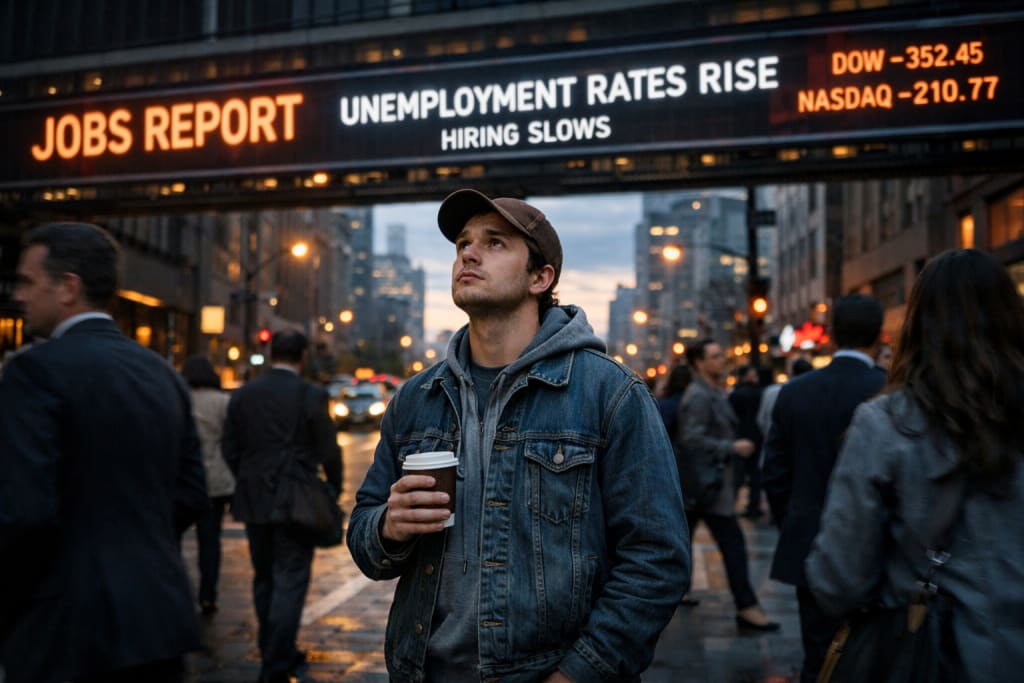
The new USA employment numbers say we’re okay. So why does it feel like so many of us are barely hanging on?
The morning the latest USA jobs report came out, I watched the headlines load like a heartbeat monitor.
“Solid job growth.” “Unemployment remains low.” “Soft landing still on track.”
On paper, that’s the kind of thing we’re supposed to celebrate. A “resilient labor market.” A “healthy economy.” The kind of phrases economists say on TV with a half-smile.
But my phone was buzzing with very different news.
A friend in tech who just survived another round of layoffs, but with their role quietly downgraded. A cousin picking up a third gig because rent went up more than their hourly rate. A coworker’s kid graduating into a job market that’s “great” until you notice every “entry level” posting wants three years of experience.
So when the new employment numbers came out today, I didn’t just see “jobs added” and “unemployment rate.”
I saw this awkward split-screen we’re all living in:
Headline: The economy is doing well.
Reality: Then why does it feel this hard to stay afloat?
That’s the tension inside today’s jobs report.
Not just what the numbers say—but what they fail to explain about how it feels to work, earn, and survive in America right now.
What the new jobs report actually says (without the jargon)
Underneath the headlines and the economist-speak, a few key numbers quietly shape the story of the American economy.
They usually look something like this:
How many jobs were added (or lost) last month
The unemployment rate (the famous percentage you hear everywhere)
Wage growth (how fast pay is rising)
Labor force participation (how many people are actually working or looking for work)
Put plainly, today’s report is telling us:
We’re still adding jobs, just not at a wild, explosive pace
Unemployment is still low by historical standards
Wages are up compared to a few years ago, but that pay boost fades quickly when stacked against housing, food, and everything else that’s gone up
Some folks have quietly stepped out of the game—retired early, stopped looking, burned out, sidelined
So the official story is:
The job market is cooling, but not crashing. Growing, but slower. Not a disaster, not a boom.
Economists have a comforting phrase for this: “a soft landing.”
Inflation eased without crushing the job market. In theory, that’s the ideal.
But if this is a “soft landing,” why does it feel, for so many people, like they’re still bracing for impact?
The part of the labor market that doesn’t show up in the headline
When I hear “X thousand jobs added,” I always want to ask a very simple follow-up:
Okay, but what kind of jobs?
Because “you have a job” and “you have a life you can actually afford” are not the same thing.
Today’s jobs report quietly hints at a few things hiding under that neat headline number:
A lot of growth is still in services: hospitality, healthcare support, retail, logistics
Some higher-paying sectors, like tech and certain parts of finance, are still choppy—one month hiring, next month cutting
Government and healthcare keep propping up the numbers, while parts of the private sector feel cautious, almost skittish
And then there’s the “multiple jobholders” line—people working more than one job.
That number has climbed over the last few years, and it never gets a flashy graphic on cable news.
But it should.
Because if the economy is so solid, why are so many people stitching together two or three roles just to approximate one livable income?
We’ve entered this strange era where “jobs added” doesn’t necessarily mean “security added.”
The report counts positions, not peace of mind.
“Low unemployment” doesn’t mean what we think it means
There’s this moment that hits every time I see the unemployment rate.
I think of my friend who left the workforce to care for an aging parent.
He’s not counted as unemployed. He’s just… not there.
Or the woman working twenty hours at one coffee shop, fifteen at another, and babysitting on weekends.
She’s “employed.” The job market, technically, is “working” for her.
If you’re working part-time and want full-time, you’re still considered employed.
If you’ve stopped looking because you’re exhausted or discouraged, you disappear from the stats altogether.
That’s one of the biggest disconnects between the jobs report and lived reality:
The unemployment rate only counts people actively looking for work
It doesn’t capture underemployment—the “I have a job, but not enough hours, pay, or stability” crowd
It doesn’t capture burnout, fear, or the mental cost of constant financial uncertainty
So when the report says “unemployment remains historically low,” that’s technically true.
But the more revealing question might be:
How many people are working like hell and still feel one bad week away from disaster?
You don’t see that in a neat decimal point. You hear it in conversations at kitchen tables, at bar counters after a late shift, in texts that start with, “Do you know if anyone’s hiring?”
Wages, inflation, and why a “raise” doesn’t feel like progress
Buried in every jobs report is one line that quietly stings: average hourly earnings.
On TV, you’ll hear a sentence like, “Wage growth remains solid.”
Sounds nice enough. Until you step into a grocery store.
Here’s the rough translation of where we are:
Wages have risen since the pandemic lows
Inflation, especially for essentials like housing and food, jumped faster
The last year or so, inflation has cooled, but the prices didn’t magically roll back
So yes, the new report might show you’re “making more.”
But your rent is more.
Your groceries are more.
Your utilities, childcare, car insurance, medical bills—all more.
It’s like running on a treadmill that keeps quietly speeding up while someone says, “You’re doing great, look how far you’ve come,” even though you haven’t moved an inch.
The jobs report is good at counting how much money is being paid per hour.
It’s not as good at showing whether that hour buys a sense of stability, or just postpones panic for another month.
Layoffs, hiring freezes, and the quiet fear in “strong” job markets
Something strange is happening in the American workplace.
We have a supposedly strong labor market, but the emotional weather inside a lot of companies feels chilly and unstable.
You probably know someone who’s seen some version of this over the past year:
A hiring freeze that no one wants to talk about publicly
Layoffs announced in upbeat language about “strategic realignment”
Roles quietly consolidated—three people’s responsibilities folded into one “lucky” survivor
Contract workers let go first, then the “non-essential” teams
Meanwhile, the jobs report says the labor market is still holding up.
And it is, broadly. The floor hasn’t dropped out.
But that doesn’t stop the weird, low-level anxiety:
The feeling that you should be grateful to have a job, even if you’re exhausted.
The voice in the back of your head whispering, “Don’t make waves, they’re cutting people.”
It’s hard to celebrate a “solid jobs report” when you’re working through lunch, checking Slack at 10 p.m., and wondering what happens if your name shows up in the next email titled “Organizational Changes.”
The numbers tell one story: the system is intact.
The people inside that system tell another: it feels fragile.
What the jobs report reveals about power, not just employment
One thing jobs data never says out loud, but always hints at, is power.
Who gets to say “no”?
Who can walk away?
Who can push back on a lowball offer, or a schedule change, or a toxic boss?
When unemployment is high, employers hold more power. Workers feel replaceable.
When unemployment is low, workers theoretically have more leverage.
The last couple of years gave us a glimpse of that shift:
People quitting jobs that treated them like they were disposable
Workers unionizing at coffee shops, warehouses, media companies
Companies offering sign-on bonuses and flexible hours for roles they used to take for granted
Today’s report suggests we’re in this delicate middle ground.
The labor market is still relatively tight, but not as wild as it was when restaurants literally couldn’t find staff and “help wanted” signs were taped to every window.
So we’re left with this uneasy balance:
You have more power than you did a decade ago.
You probably still don’t feel like you can truly relax.
Because power isn’t just “Can I get a job?”
It’s “Can I walk away from a bad one without risking everything?”
The jobs report measures whether you’re employed.
It doesn’t measure whether you’re trapped.
How to read the jobs report like a human being, not a headline
I used to read the jobs report the way most of us do: through whatever headline floated across my feed.
“Beat expectations.”
“Missed forecasts.”
“Market reacts.”
None of that helped me understand how it connected to my life or the lives of people around me.
So over time, I started asking a different set of questions whenever the new numbers came out:
Are the jobs being added in fields that pay enough to live on where people actually live?
Are full-time roles growing, or is the gig/part-time world doing the heavy lifting?
Are wages rising faster than the costs that matter most—housing, food, healthcare, childcare?
Are more people joining the labor force, or quietly stepping out of it?
Do these numbers line up with what I’m seeing in my own circle—layoffs, hiring, burnout, pay changes?
Once you look at the report through those questions, the tone shifts.
You stop treating it like a scoreboard for “the economy” and start seeing it as a blurry photograph of how people are living and working right now.
Not a perfect picture. More like a hint.
The jobs report is a starting point, not a verdict.
The invisible cost behind every “good” number
At some point, we have to talk about something the jobs report will never write down:
What it costs people emotionally to keep these numbers looking “good.”
Behind every chart of job gains, there’s:
A teacher doing unpaid emotional labor that no line on a spreadsheet captures
A nurse staying over an extra shift because there aren’t enough staff
A warehouse worker pushing through back pain because missing a day could mean missing rent
An overworked manager pretending everything is “fine” while privately scrolling through job boards at midnight
The report doesn’t see the panic attack in the bathroom stall.
It doesn’t hear the argument at the kitchen table about whether to pay the credit card or the electric bill this month.
So when today’s report says the labor market is still “resilient,” I believe it.
But resilience isn’t free.
It’s built on people absorbing shock after shock, change after change, uncertainty stacked on uncertainty.
The real question isn’t just, “Is the jobs market strong?”
It’s: “How much more can people absorb before the strength comes with a breaking point?”
What this all means for you, me, and the next report that’s coming
The jobs report comes out once a month, like a recurring appointment we didn’t ask for but can’t ignore.
Markets react. Politicians spin it. Economists dissect it.
Most of us just want to know:
Does this mean anything for my actual life?
Here’s what I’ve come to believe, watching these numbers roll in month after month:
The jobs report won’t tell you whether you’re safe.
It won’t tell you what you deserve.
It won’t show you how hard you’ve worked just to stand still.
But it does quietly reveal what kind of economy we’ve built:
One where we can add jobs and still feel insecure.
Where unemployment can be low, but anxiety is high.
Where wage growth can be “solid,” but your savings account still feels like a joke.
If there’s any takeaway worth carrying, it’s this:
You’re not crazy for feeling uneasy when the news says everything is “fine.”
You’re not failing because the numbers say the economy is strong and you still feel like you’re scrambling.
The truth is more complicated than a headline.
The USA jobs report today says we’re not in freefall.
It says the labor market is bending, not breaking—at least not yet.
But the feeling that something is off?
That maybe “stability” shouldn’t feel this exhausting?
That’s real.
And until the stories inside our paychecks, our schedules, and our Sunday-night dread change, no monthly report—no matter how “strong”—is going to make this feel like a thriving economy.
The numbers tell us we still have jobs.
How it feels to live inside those jobs—that part is still being written, every tired morning, every late-night shift, every quiet moment where you look at your bank account and wonder how this can be what “doing okay” looks like.
About the Creator
abualyaanart
I write thoughtful, experience-driven stories about technology, digital life, and how modern tools quietly shape the way we think, work, and live.
I believe good technology should support life
Abualyaanart
Keep reading
More stories from abualyaanart and writers in Motivation and other communities.
One Hard Thing
Stop me if you’ve heard this one before: You have the number, you know your schedule- you’ve even picked out the perfect day and time to make this appointment. Shoot, you’ve even picked out alternative days and times just in case their schedules can’t accommodate you!
By Taylor Rigsby30 days ago in Motivation
Live for Yourself, Not for Society
From the moment we are born, the world starts shaping our lives. Family, friends, teachers, and society at large all wishper-sometimes loudly, sometimes subtly-how we should live, what we should aspire to, and who we should become. "Be this, do that, follow the rules, fit in"-these messages pile up, one after another. And often, we spend years chasing a version of ourselves that isn't truly ours, simply to satisfy everyone else's expectations.
By Binisa Chaudharyabout 23 hours ago in Motivation




Comments
There are no comments for this story
Be the first to respond and start the conversation.