
“What Did Trump Post Now?”
Trying to Make Sense of His Latest Social Media Barrage

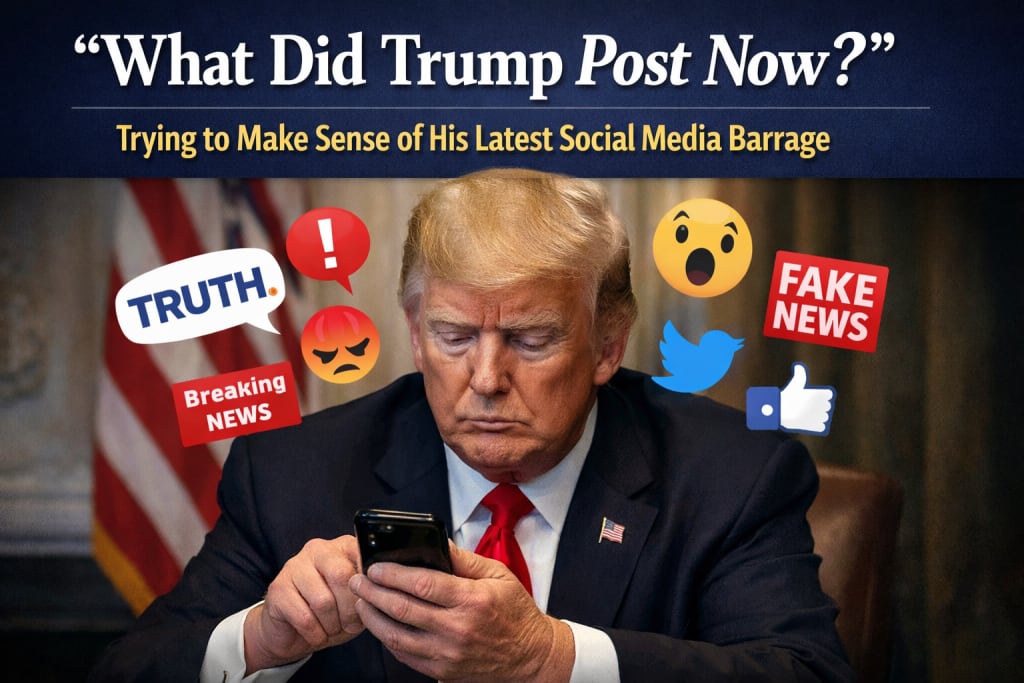
Every Time He Posts, Something in the Room Tightens
The notification buzzed on my phone before I’d even finished my first coffee.
One of those screen previews that’s too short to show the whole sentence, but long enough to make your stomach clinch:
“Donald J. Trump · 7m · This WITCH HUNT is—”
I didn’t even have to open it to know the rest.
The capital letters.
The accusation.
The sense that, once again, the country was about to get dragged into whatever battlefield he had chosen for the day.
I opened the app anyway.
Even after all these years, I still feel that strange mix of curiosity and dread every time I see, “What Donald Trump posted today.”
It’s like watching a storm rolling in over a town you know too well. You recognize every street, every roofline, every person who’s about to get soaked—maybe even hit by lightning—yet you can’t look away.
And that’s the part I keep circling back to.
We know his patterns.
We know the rhythm of the outrage.
We know it’s a performance and a weapon at the same time.
So why do his posts still land like a punch in the gut?
The Daily Ritual of Waiting for the Next Hit
There’s a strange ritual that’s formed around Trump’s social media.
You might know it.
You wake up, check the news, then search his name almost on autopilot, just to see what he’s fired off overnight.
Some people do it because they support him.
Some do it because they can’t stand him.
Some, like me, do it out of this uneasy sense that his posts are less like personal thoughts and more like public detonations.
When he attacks a judge, that judge’s family has to walk past cameras and threats.
When he calls prosecutors “thugs” or “enemies,” regular people who work in those offices get messages in their inboxes that feel a lot less like political discourse and a lot more like intimidation.
And when he uses phrases like “rigged,” “stolen,” or “witch hunt,” millions of people hear it as permission—permission to distrust, to rage, sometimes to act.
It’s not just a post.
It’s a signal.
You can almost feel the country brace itself.
The Anatomy of a Trump Post: Not Random, Even When It Looks Unhinged
If you scroll through his feed on any given day, it looks chaotic.
There’s the all-caps rant about a judge.
Then a meme mocking an opponent.
Then a fundraising link.
Then a doctored video.
Then a “THANK YOU TO THE GREAT PATRIOTS!!!”
At first glance, it feels scattered, almost unhinged.
But underneath all that noise, there’s a pattern—and once you see it, it’s hard to unsee.
Most of his posts usually fall into a few categories:
Attack and discredit:
Judges, prosecutors, journalists, other Republicans who won’t bend the knee—he goes after anyone who can say “no” to him. He doesn’t just argue with them; he brands them. “Deranged.” “Crooked.” “RINO.” “Enemy of the people.”
Play the victim:
He’s always under siege. It’s always a “witch hunt,” a “two-tiered system of justice,” a “weaponized government out to get him.” He’s the most powerful victim in history, and he leans on that role like it’s armor.
Rewrite reality in real time:
If a poll looks bad, it’s fake.
If a court ruling goes against him, it’s corrupt.
If an ally flips on him, they were never loyal.
The story always shifts so that he ends up the hero or the martyr—sometimes both on the same day.
Feed the base what it already believes:
He doesn’t just predict what his supporters think; he reflects it back at them, louder. Immigration, crime, the “deep state,” media bias—he amplifies the fears and resentments that are already simmering, then calls it truth.
It might look impulsive, but it’s not pointless.
Every post pushes on a bruise.
The Hidden Message Behind the Outrage
If you strip away the capital letters and the insults, there’s usually a quieter message baked into every rant.
Not quiet in tone—quiet in purpose.
When he attacks a judge overseeing his case, the public message is:
“This judge is biased and unfair.”
But the underlying message to his followers is:
“If I lose, it’s because of corruption, not because I did anything wrong.”
When he accuses prosecutors of “election interference,” he’s not just complaining.
He’s laying the groundwork:
“If they convict me, they stole it from us.”
It’s a preloaded excuse.
The same pattern shows up in posts about the media (“fake”), law enforcement (“corrupt”), and even elections (“rigged before they even begin”).
If everything is rigged against him, then nothing is ever his fault.
And if nothing is ever his fault, then any outcome that hurts him must be illegitimate.
He tells that story over and over until it settles in people’s minds like fact.
So when you read his latest post, it’s not just about what he’s saying.
It’s about what he’s preparing people to believe tomorrow.
When Politics Follows You Into the Living Room
I remember the first time I realized one of his posts had slipped into my actual life, not just my news feed.
It wasn’t a headline or a TV clip.
It was a family dinner.
Someone brought up one of his rants about “radical left prosecutors.”
Someone else countered with facts from the case.
Voices raised. Forks stopped. The air got heavy.
And then, suddenly, the words coming out of my relative’s mouth weren’t their words anymore—they were his.
The same phrases.
The same rhythm.
The same dismissal of any source that didn’t support his version.
It hit me: he wasn’t just posting to shout into the void.
He was posting to script people.
He gave them lines to repeat at the dinner table, at work, on Facebook comments, in group chats.
His social media attacks don’t stay on his timeline. They get carried into homes, offices, school pick-up lines. They become the language people use to talk about judges, journalists, neighbors, even their own relatives.
That’s what makes “What did Trump post today?” feel heavier than just political gossip.
It’s not content.
It’s a contagion.
The Emotional Whiplash of Watching This Every Day
If you’re someone who checks his posts regularly—whether in horror or support—you probably feel it too: the emotional whiplash.
One moment you’re laughing because the meme is so over-the-top it borders on absurd.
The next moment, you remember that millions of people are taking the same post dead seriously.
You scroll past a rant accusing specific people by name of treason or corruption, and your brain has to hold two truths at the same time:
This looks kind of ridiculous.
This could get someone hurt.
That split-screen feeling is exhausting.
The repetitive nature of it all wears you down too. The same themes. The same enemies. The same claims. It’s a carousel of outrage that never stops turning.
You start predicting the posts before you see them:
Indictment news breaks? Attack the “corrupt” system.
A bad headline comes out? Blame the “fake news.”
An ally distances themselves? Call them “weak” or “disloyal.”
And yet, even knowing the script, each new post still twists something inside you.
Because you know it’s not just noise.
It shapes how people vote, how they argue, how they justify things they never would have accepted ten years ago.
We like to pretend social media is a game, some separate ecosystem.
It isn’t.
Not when the stakes are this high.
Why His Posts Work on People Who Should Know Better
It’s easy to roll your eyes and say, “Only his hardcore fans believe this stuff.”
But that’s not quite true.
People who normally double-check sources, people who know how propaganda works, people who never considered themselves political at all—they still get pulled into his gravity.
Here’s why his messaging hits so hard:
He makes everything personal.
It’s not “the economy is bad.” It’s “they are trying to destroy YOU.”
Not “I’m in legal trouble.” It’s “they’re coming after ME because I stand in the way of what they want to do to YOU.”
He uses emotion, not nuance.
Anger. Fear. Pride. Betrayal. He doesn’t try to explain complex systems; he points at villains. And the brain, wired for shortcuts, loves that simplicity.
He repeats until it becomes familiar—and familiar feels true.
“Witch hunt.” “Deep state.” “Fake news.” Say it enough times, and it settles into the background noise, like a jingle you never meant to memorize but somehow know by heart.
He offers identity, not just opinions.
Supporting him isn’t just a political choice; for many, it’s become who they are. Rejecting his narrative starts to feel like rejecting themselves or their community.
So when he posts another all-caps tirade about a “corrupt judge,” it doesn’t land as a random rant; it lands as confirmation.
“See? What I believed all along is true.”
And anyone who disagrees doesn’t just have a different viewpoint—they’re on the other side.
The Cost of Living in His Timeline
Even if you don’t support him, being exposed to his posts regularly does something to you.
You start to expect the worst from institutions.
You start to feel like everything is on fire all the time.
You start to measure days not by what you did, but by what he said.
That level of constant tension isn’t normal, and it’s definitely not healthy.
It’s a steady drip of adrenaline.
Anger for his fans.
Fear or despair for his critics.
Resignation for everyone stuck in the middle.
Social media platforms amplify it, because outrage is engagement and engagement is money. News outlets amplify it, because his posts are easy headlines. We amplify it when we quote, screenshot, argue, and react.
I’m not saying we shouldn’t pay attention.
Powerful people should be watched closely, especially when they’re lashing out at judges and undermining elections with a few taps on a phone.
But we also have to admit this:
Living in a constant state of “What did he post now?” comes with a cost.
It shrinks our sense of what is possible.
It makes us forget that politics and public life existed before this constant circus—and will exist after it.
Decoding the Posts Without Losing Yourself
So how do you look at his latest social media attacks and messages without being swallowed by them?
I don’t have a neat answer.
But I’ve started doing a few quiet things that help.
When I see a new post of his, I ask myself:
Who is he trying to discredit right now?
What’s happening in his world that he doesn’t control?
What excuse is he building for the future?
Who might be harmed by the story he’s telling today?
Just those questions create a bit of distance.
The post becomes less of a shock and more of a move on a board.
It doesn’t make it less dangerous, but it makes it easier to see.
I also try to notice what his posts are doing to me.
If I feel my jaw clench, my shoulders lift, my brain start to spin, I take that seriously.
Not as a sign to look away forever, but as a reminder that my nervous system is not designed to live in a permanent state of emergency.
Sometimes that means closing the app and reading the actual court document or news report instead of his interpretation.
Sometimes it means not sharing his post at all, even to mock it.
He doesn’t care why you spread his message—only that you do.
And sometimes it means sitting with the uncomfortable truth that this isn’t a phase that ends with one election or one trial.
The damage has already seeped into how we talk to each other.
Repairing that will take more than hitting “log out.”
The Question His Posts Keep Asking Us
Every time he unleashes another social media attack or all-caps message, it feels like he’s asking the same question over and over, whether he realizes it or not:
“How much of this will you accept?”
Not just from him, but from anyone who learns the same tactics.
How much will we accept from leaders who call judges corrupt for doing their jobs?
From politicians who preemptively claim any loss is fraud?
From public figures who turn millions of followers into a pressure campaign against anyone who stands in their way?
His posts are training wheels for future demagogues.
If we normalize this now, someone smarter, calmer, and more disciplined could use the same strategies later—with less chaos and more precision.
So yes, it matters what Donald Trump posted today.
Not just because of the names he called or the institutions he attacked in that particular post, but because every one of those messages is part of a larger test:
What kind of country are we willing to be?
A place where power means you can publicly smear judges, prosecutors, and anyone who challenges you—and half the country shrugs?
Or a place where we recognize that words sent into the world from platforms that large are not just opinions; they are forces.
Maybe the real decoding isn’t about understanding his strategy.
Maybe it’s about understanding our threshold.
The point at which we decide that “this is just how it is now”
or the point at which we finally say, quietly but firmly,
“No. This is not who we are, and I won’t let your posts tell me otherwise.”
About the Creator
abualyaanart
I write thoughtful, experience-driven stories about technology, digital life, and how modern tools quietly shape the way we think, work, and live.
I believe good technology should support life
Abualyaanart
Keep reading
More stories from abualyaanart and writers in Motivation and other communities.
One Hard Thing
Stop me if you’ve heard this one before: You have the number, you know your schedule- you’ve even picked out the perfect day and time to make this appointment. Shoot, you’ve even picked out alternative days and times just in case their schedules can’t accommodate you!
By Taylor Rigsby30 days ago in Motivation
The Road Between Two Mornings
In a quiet town tucked between low green hills and a winding river, there lived a young man named Tomas who believed that his life had already chosen him. Every morning at six, he unlocked the wooden door of his uncle’s bakery, tied on a flour-dusted apron, and baked bread for people who rarely looked up from their newspapers. His hands worked quickly, but his thoughts always moved faster—toward places he had never seen and dreams he had never dared to touch.
By Iazaz hussain3 days ago in Motivation




Comments
There are no comments for this story
Be the first to respond and start the conversation.