
The Teddy Bear and the Cure: How Katalin Karikó Endured 30 Years of Invisibility to Save the World
She hid her money in a child's toy to escape a dying regime. She spent decades being mocked, unfunded, and literally demoted by her university. This is the story of the stubborn, quiet genius who built the COVID-19 vaccine in the dark

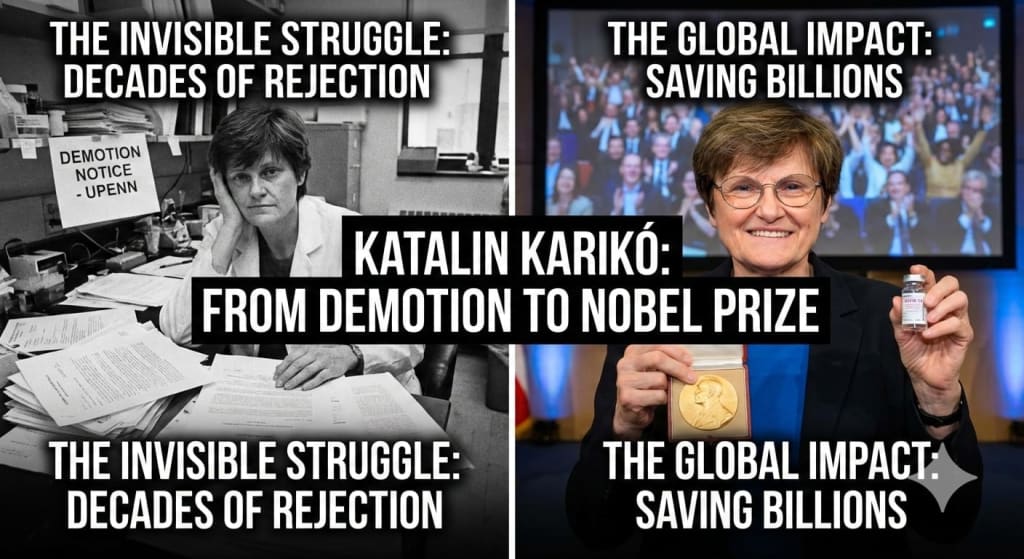
The untold, raw story of Katalin Karikó, the Nobel Prize-winning scientist who endured decades of academic rejection, demotions, and obscurity to pioneer the mRNA technology that saved millions of lives.
Introduction: The Smuggler's Bet
It is 1985. The Cold War is still breathing its heavy, metallic breath over Eastern Europe.
In Hungary, a young biochemist named Katalin Karikó is out of options. The biological research center where she works has lost its funding. She is 30 years old, brilliant, and entirely unemployed. She has a husband, a two-year-old daughter named Susan, and a radical idea in her head that no one believes in.
She lands a post-doctoral position at Temple University in Philadelphia. But there is a problem: the Hungarian government strictly limits how much money citizens can take out of the country. If she leaves, she leaves with nothing.
So, Katalin and her husband sell their car on the black market for £900. It is their entire life savings.
They take their daughter’s teddy bear, carefully open the stitching on the back, stuff the £900 inside the synthetic stuffing, and sew it back up.
When they board the plane to America, little Susan is holding her bear. She doesn't know she is holding her family's survival. And the world doesn't know that the woman sitting next to her is carrying the blueprint to save millions of lives three decades later.
This is not a story of overnight success.
This is a story of a woman who stepped into the darkness and decided to stay there until the world caught up to her.
Part I: The Heretic of Biology
To understand the sheer magnitude of Katalin Karikó’s stubbornness, you have to understand what she was obsessed with: mRNA (messenger RNA).
In the simplest terms, if your DNA is the secure hard drive that holds all the information about how to build "you," mRNA is the temporary printout. It carries the instructions from the hard drive to the cellular factories, telling them to print proteins.
Karikó looked at this and had a visionary thought: If we can artificially create our own mRNA, we can write our own code. We can send instructions into the human body telling it to fix its own heart, fight its own cancer, or destroy a virus.
It was the biological equivalent of hacking the matrix.
But the scientific community in the 1980s and 90s hated the idea.
Why? Because mRNA is incredibly fragile. If you inject it into a living creature, the body’s immune system recognizes it as a foreign invader. The body panics, mounts a massive inflammatory defense, destroys the mRNA instantly, and often makes the patient violently ill.
"It’s a dead end," the scientific consensus declared. "It's too unstable. Stop wasting time and money on it."
But Katalin Karikó didn't stop. She believed the problem wasn't the molecule; the problem was that they just hadn't found the right disguise for it yet.
She became a heretic in a lab coat.
Part II: The Valley of Death (The Demotion)
Science in the academic world is a brutal, corporate enterprise. It is driven by one thing: grants.
If you don't bring in grant money, you don't get a lab. You don't get a team. You don't get respect.
Throughout the early 1990s at the University of Pennsylvania, Karikó wrote grant proposal after grant proposal asking for money to study mRNA.
Rejected.
Rejected.
Rejected.
Her peers were getting published. They were getting tenure. They were chasing "safe" science. Karikó was chasing a ghost.
By 1995, the university had had enough. She had failed to secure the necessary funding. She was called into an office and given an ultimatum.
She was on the track to becoming a full professor. The university told her she was being pulled off that track. She was being demoted. Her salary would be slashed. She would lose her dedicated lab space. She would be bumped down to the lowest rungs of the scientific ladder.
Imagine the psychological devastation.
She was 40 years old. She was an immigrant who had sacrificed everything. She was working 60 to 80 hours a week, and her employer had just looked her in the eye and said, "Your life's work is worthless."
Most people quit here. Most people pivot. They change their major, they change their niche, they chase the algorithm, they write what the market wants them to write.
Katalin Karikó swallowed her pride. She accepted the demotion. She took the pay cut.
She didn't care about the title. She just needed a workbench.
"I thought of going somewhere else, or doing something else," she later said. "I also thought maybe I’m not good enough, not smart enough. I tried to imagine: Everything is here, and I just have to do better experiments."
She went back to the basement.
Part III: The Copy Machine Meeting
For two more years, she worked in the shadows. She survived by attaching herself to the labs of senior scientists who had funding, quietly doing her mRNA experiments on the side.
Then came a mundane moment of serendipity.
In 1997, there was a photocopier in the hallway of her building. Karikó was copying research papers. Another scientist was there doing the same.
His name was Drew Weissman. He was an immunologist who had recently arrived at UPenn after working under Dr. Anthony Fauci. Weissman had funding. He had a lab. He was trying to create a vaccine for HIV.
As they waited for the copier, they started chatting.
"I can make any mRNA," Karikó bragged.
Weissman was intrigued. He needed a way to deliver instructions to the immune system to recognize HIV. They decided to team up. Weissman provided the resources; Karikó provided the obsessive, decades-deep knowledge of the molecule.
It was the beginning of one of the most important partnerships in the history of human medicine. But they were about to hit the same wall everyone else had hit.
Part IV: The Heist
Weissman and Karikó synthesized their mRNA and injected it into mice.
The mice got sick. Their immune systems went crazy. The body was treating the synthetic mRNA like a deadly pathogen.
They were stuck. For years, they ran experiments trying to figure out how to sneak the mRNA past the body’s security guards.
Then, Karikó looked closer at the chemical makeup of RNA. RNA is made of four building blocks: adenine (A), cytosine (C), guanine (G), and uridine (U).
She realized that the immune system’s "alarm bells" were specifically reacting to the uridine (U).
What if they swapped it out?
Karikó found a naturally occurring, slightly altered version of uridine called pseudouridine. It was like putting a fake mustache on a bank robber.
They synthesized a new batch of mRNA, replacing all the uridine with pseudouridine.
They injected it into the cells.
They held their breath.
No alarms went off. No inflammation. The cells calmly accepted the mRNA, read the instructions, and printed the desired proteins.
They had done it. They had hacked the human body. They had figured out how to write biological software without crashing the system.
Part V: The Sound of Silence
In 2005, Karikó and Weissman published their breakthrough paper in the journal Immunity.
They thought the world would explode. They thought the phones would ring off the hook. They had just cured the core problem of a technology that could theoretically eradicate cancer, genetic disorders, and viral infections.
The reaction?
Absolute silence.
The media didn't care. The big pharmaceutical companies didn't care. The scientific community, which had spent 20 years deciding mRNA was useless, couldn't be bothered to change its mind.
When you create something revolutionary, you expect applause. But the reality of true innovation is that it is often met with a yawn.
Karikó was a woman in her 50s. She was still underfunded. She was still struggling for respect at UPenn.
Eventually, realizing that academia would never fully support her, she left the university in 2013. She took a job as a senior vice president at an obscure, relatively unknown German company.
The company's name was BioNTech.
Part VI: The Moment the World Stopped
Fast forward to January 2020.
A mysterious virus emerges in Wuhan, China. Within weeks, it begins to spread across the globe. Borders close. Economies freeze. Morgues fill up.
The SARS-CoV-2 virus (COVID-19) is bringing human civilization to a grinding halt.
The traditional method of making a vaccine involves growing the virus in chicken eggs, weakening it, and injecting it. It takes years. Sometimes decades. The world didn't have years.
But BioNTech, and an American company called Moderna, didn't need eggs. They needed code.
When Chinese scientists published the genetic sequence of the coronavirus online, BioNTech and Moderna downloaded it. They looked at the code for the virus's "spike protein."
Using the exact pseudouridine hack that Katalin Karikó had discovered 15 years earlier—the hack that got her demoted, the hack that nobody cared about—they wrote a synthetic mRNA instruction manual.
“Hey immune system, here is what the spike protein looks like. Practice fighting this.”
They designed the vaccine on a computer in a matter of days.
By the end of 2020, Pfizer (partnering with BioNTech) and Moderna rolled out the mRNA vaccines. They were 95% effective.
Billions of doses were manufactured. Millions of lives were saved. The lockdowns ended. The world woke back up.
The technology that was called a "dead end" became the only door out of the burning building.
Part VII: The Ultimate Vindication
In October 2023, the phone rang in Katalin Karikó’s home.
It was the Nobel Committee in Stockholm.
She and Drew Weissman were awarded the Nobel Prize in Physiology or Medicine.
The woman who was demoted by the University of Pennsylvania was now holding the most prestigious intellectual award on planet Earth.
The university that had slashed her pay suddenly put her face on banners. The colleagues who had ignored her suddenly claimed they knew her all along.
But Karikó didn't gloat. She didn't write an angry memoir. She just kept working.
When asked how she felt about the decades of rejection, she simply pointed out that without the struggle, without being forced into the basement, she might never have met Drew Weissman at that copy machine. She might never have had the desperate focus required to solve the pseudouridine puzzle.
The rejection wasn't a punishment. It was the crucible that forged the cure.
Conclusion: The Architecture of the Quiet Grind
We are obsessed with loud success. We love the viral moment, the overnight sensation, the trending topic.
But Katalin Karikó’s story demands that we look at the quiet grind.
It is easy to be motivated when the crowd is cheering. It is easy to write, to create, to hustle when the metrics are going up and the money is rolling in.
But what do you do when the room is empty?
What do you do when your work gets 40 views?
What do you do when the platform ignores you, the gatekeepers reject you, and the people closest to you tell you to get a "realistic" job?
Katalin Karikó’s life is a masterclass in the difference between delusion and vision.
To the outside world, working on a rejected theory for 30 years looks like delusion.
But to the person who knows the work is true, it is vision.
The hard truth is that your best work might not make sense to the world right now. You might be speaking a language the market hasn't learned yet. You might be building a foundation so deep that nobody can see the skyscraper you are planning.
Karikó didn’t win because she was celebrated. She won because she endured invisibility.
She teaches us that validation is not a prerequisite for execution.
You don't need the applause to do the work. You just need the bench. You just need the conviction.
So, if you are working in the dark right now, if you feel like you have been demoted by life, overlooked by the algorithm, or rejected by the gatekeepers...
Keep writing the code.
Keep doing the experiments.
Keep trusting your vision.
Because sometimes, the ideas that nobody wants today are the exact ideas the world will beg for tomorrow.
This is a story built for those who feel unseen while they build. Would you like me to adapt this narrative into a tight, visually-cued script format for your next YouTube upload, or format it perfectly for your next Vocal.Media publication?
About the Creator
Frank Massey
Tech, AI, and social media writer with a passion for storytelling. I turn complex trends into engaging, relatable content. Exploring the future, one story at a time
Keep reading
More stories from Frank Massey and writers in Motivation and other communities.
The Blueprint of Survival: How Jay-Z Turned Rejection into a Billion-Dollar Empire
The raw, true story of Jay-Z. From dropping out of high school in the Marcy Projects and selling CDs out of his car, to becoming hip-hop's first billionaire through the power of ownership.
By Frank Massey a day ago in Motivation
One Hard Thing
Stop me if you’ve heard this one before: You have the number, you know your schedule- you’ve even picked out the perfect day and time to make this appointment. Shoot, you’ve even picked out alternative days and times just in case their schedules can’t accommodate you!
By Taylor Rigsby26 days ago in Motivation
Influential Women LinkedIn: How Female Leaders Are Redefining Digital Success and Professional Growth?
In today’s rapidly evolving digital landscape, professional influence is no longer defined only by job titles or years of experience. It is shaped by visibility, credibility, and meaningful engagement. Platforms like LinkedIn have become powerful spaces where women across industries are building authority, sharing expertise, and inspiring global audiences. The concept of Influential Women LinkedIn reflects this transformation-highlighting how women are leveraging digital networks to lead, innovate, and create lasting impact.
By influentialwomenmagazinea day ago in Motivation
I Don't Need My Phone... Wait, Is That Actually True?
My parents gave me my first cell phone when I was twelve years old. It wasn't a fancy iPhone or anything, not even close. Just a simple black flip phone for when I needed to call or text them after school.
By Madison "Maddy" Newton7 days ago in Humans




Comments
There are no comments for this story
Be the first to respond and start the conversation.