
Mount Chiltan and the Markhor: A Wildlife Conservation Miracle in Balochistan
National animal of Pakistan
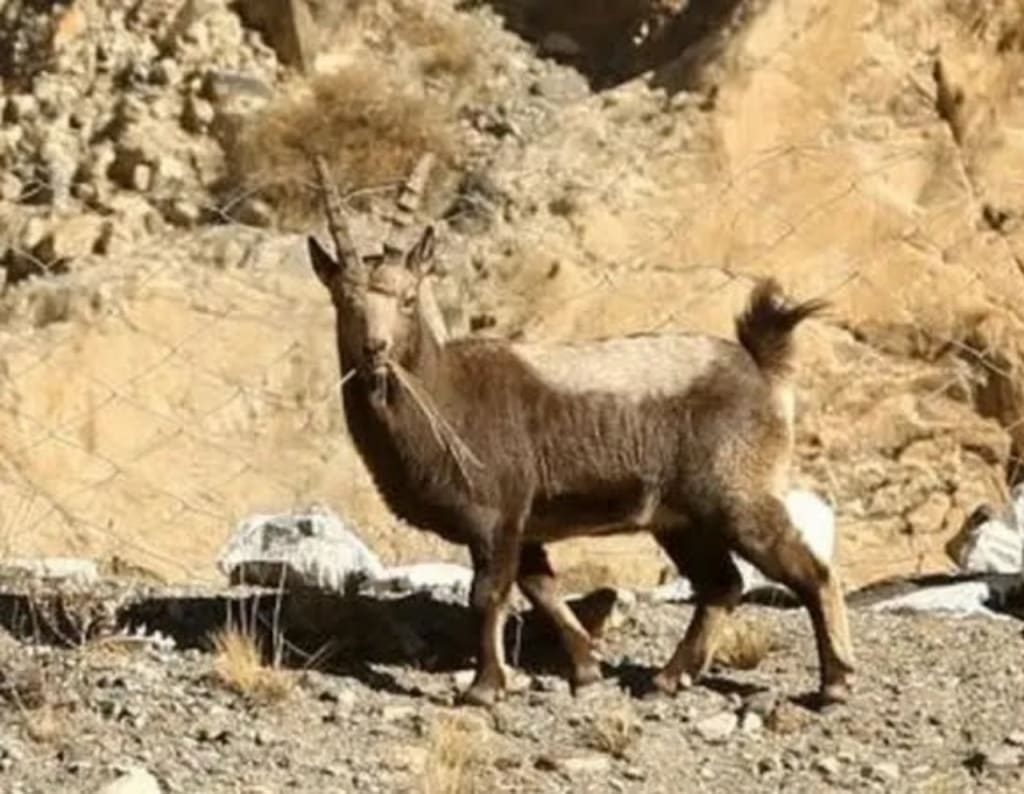
If someone has never seen Balochistan or does not know much about it, they might assume that this mountain is located in some remote area of the province. After all, when wildlife is disappearing across Balochistan, how could such a large number of markhors possibly exist near the province’s largest city?
But Mount Chiltan is not only located next to Quetta, the capital of Balochistan the city’s population has expanded right up to its foothills.
How Did the Mountain Get the Name Chiltan?
It is commonly believed that a dervish once lived in this mountain with his 40 children. Because of these forty children or brothers, the mountain came to be known as “Chiltan”.
This is not just hearsay; the same story is even included in school textbooks in Balochistan.
However, Nazir Ahmed Kurd, who serves as Deputy Conservator of Forests at Hazarganji Chiltan National Park, disagrees with this explanation.
According to him, the story about the 40 brothers is incorrect. “In fact, there are 40 different locations in this mountainous region, each with its own specific name. That is why it is called Chiltan,” he said.
He added that they invite officials responsible for the education curriculum to visit and conduct proper research with them so that accurate information about the mountain’s name can be included in textbooks.
Markhor – A Species of Wild Goat
The markhor is a type of wild goat found in certain areas of Balochistan as well as in Gilgit-Baltistan, Chitral, the Kalash Valley, Hunza Valley, and other northern regions.
It is also found in India, Afghanistan, Uzbekistan, Tajikistan, and other areas. According to the International Union for Conservation of Nature (IUCN), this species is classified among animals that are at risk. Therefore, hunting it is restricted to prevent it from becoming extinct.
Why Is It Called Markhor?
In some languages, “mar” means snake, and “khor” means eater.
Based on the name, people commonly assume that this animal eats snakes. However, Nazir Ahmed Kurd strongly rejects this idea.
“Biologically, it is a herbivore — a grass-eating animal. It is not a carnivore, so it does not eat snakes,” he explained.
He added that when the markhor’s horns twist upward, they resemble a snake, which is likely why it was given this name.
National Animal of Pakistan
The markhor has the honor of being the national animal of Pakistan.
The Success Story of Chiltan Markhor Conservation
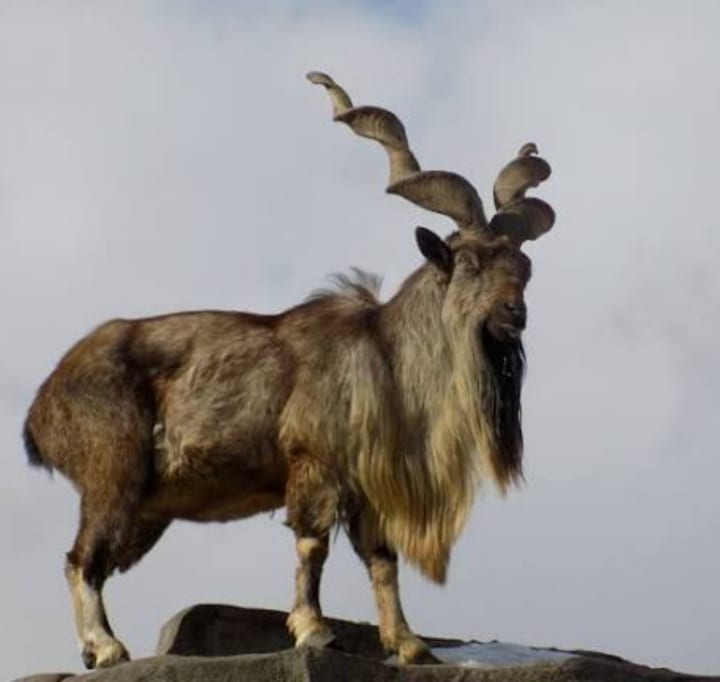
Although there are several success stories regarding markhor conservation in Balochistan due to the efforts of tribal leaders, local communities, and the Forest Department, the conservation story of the Chiltan markhor is somewhat unique.
It is unique because to the east lies the densely populated city of Quetta, and human settlements are also close on the other three sides.
Nazir Ahmed Kurd stated that when they took charge in 2014, the Chiltan markhor population was around 800–1,000.
“Due to the hard work of my staff, the department, and especially the Chiltan Park Management Committee, their number has now exceeded 3,000,” he said.
He explained that one of his first steps was to activate the Park Management Committee. Major stakeholders included the Raisani tribe, whose leader Nawab Muhammad Aslam Raisani and his brother Nawabzada Lashkari Raisani fully cooperated with them.
On the eastern side of Chiltan Park are the Shahwani tribes. Community elders like Haji Daud Shahwani also provided strong support.
How Is the Chiltan Markhor Different from Other Markhors?
Nazir Ahmed Kurd explained that the breed of markhor found in Chiltan National Park is known as the Chiltan markhor. “It is endemic worldwide. Endemic refers to an animal that lives in a specific area,” he said.
He further explained that it is a hybrid between the Suleiman markhor and the Sindh ibex. “Nature has created a new breed called the Chiltan markhor on this mountain, which has become its identity.”
Invitation to IUCN to Name Three More Subspecies
Nazir Ahmed Kurd said that three additional subspecies of the Chiltan markhor exist in the mountain area, and they are also hybrids. However, they have not yet been given scientific names.
He mentioned their local names but expressed the desire for them to receive proper scientific classification.
He appealed to the IUCN to visit, examine these species, and provide them with zoological certification and official names.
Increase in Population Raises Concerns About Trophy Hunting
Trophy hunting is an international practice in which selected animals usually older individuals are hunted under regulated programs.
Nazir Kurd explained that a fixed fee is charged in dollars. The price of a single markhor ranges from $40,000 to $100,000 or even higher. According to regulations, 80% of this revenue is spent on the welfare of local communities.
He added that this system is currently operational in different areas of Balochistan and has become a source of hope for local people.
He also suggested that trophy hunting could now be introduced in the buffer zone of Chiltan Park.
What Other Wildlife Exists in Chiltan?
Besides the markhor, other animals are also present in Chiltan. There have been reports of wolves, locally known as “lagar bagar.”
Nazir Ahmed Kurd said that high-quality fox species are also present, and migratory falcons visit the area. “There are large numbers of hawks, chukars, and sassi birds here,” he said.
He claimed that Balochistan possesses all types of wildlife found in Africa and is not inferior in that regard.
What Is the Situation of Markhor in Other Areas of Balochistan?
The markhor found in Balochistan is known as the Suleiman markhor.
Project Director Wildlife Balochistan, Niaz Kakar, said that the Suleiman markhor is found in Zhob, Torghar in Qilla Saifullah, Ziarat, and in Koh Takatu northeast of Quetta.
He stated that the largest population is in Torghar, where, along with the efforts of the Forest and Wildlife Department, Nawabzada Mehboob Khan Jogezai and the local community have played an important role in conservation.
In Torghar, the markhor population ranges between 2,000 and 2,500.
According to Niaz Kakar, the second-largest population is in Koh Takatu, where the number is approximately 1,500 to 2,000.
Where Is Trophy Hunting Currently Taking Place?
In Balochistan, trophy hunting currently takes place in the Torghar area of Qilla Saifullah.
Niaz Kakar said that each year, 10 to 20 people from around the world apply for hunting permits, of whom only two to three are selected. Those who offer the highest bid are granted permission to hunt.
About the Creator
Keep reading
More stories from Pets and animals and writers in Petlife and other communities.
Sindh Ibex Documentary – Endemic Wild Goat of Pakistan Facts & Habitat
I am currently in the province of Sindh, Pakistan. The district is Thatta, and here in Thatta we have a friend, Mr. Shahid Brohi. He has established a very beautiful wildlife breeding farm here. He has fulfilled all legal requirements, and the farm is registered with the Sindh Wildlife Department. According to international standards, he has built proper enclosures and cages, and he keeps various species of mammals and birds here.
By Pets and animals a day ago in Petlife
The Summer I Was Chosen by a Northern Mockingbird
During the long, suspended days of the pandemic, a wild mockingbird began visiting my driveway and chose me, again and again. What started as a strange encounter became a brief, meaningful connection that I still carry with me.
By Erica Roberts 29 days ago in Petlife
The Whispering Alley
Whispering Alley In the heart of an old city, where cobblestone streets wound like forgotten veins and lanterns flickered against weathered walls, there was an alley known only to those who listened carefully. Locals called it the Whispering Alley, though few could explain why. To most, it was just a narrow passage between two crumbling buildings. But to the cats of the city, it was a kingdom.
By Alhouci boumizzi7 days ago in Petlife
The Pride Flag and the Diversion
For nearly a decade, the LGBTQIA Pride Flag rippled in the wind at Christopher Park, a kaleidoscope of color staked into the soil of America’s first national monument to LGBTQIA+ liberation. That flag came down this week. Federal officials, citing new guidance from the Trump Administration, silently lowered the rainbow flag from its pole across the street from the Stonewall Inn. The birthplace of the modern gay rights movement now flies only the United States flag.
By Tim Carmichael7 days ago in Pride


Comments
There are no comments for this story
Be the first to respond and start the conversation.