
Sindh Ibex Documentary – Endemic Wild Goat of Pakistan Facts & Habitat
Sindh Ibex vs Himalayan Ibex | Wildlife of Pakistan

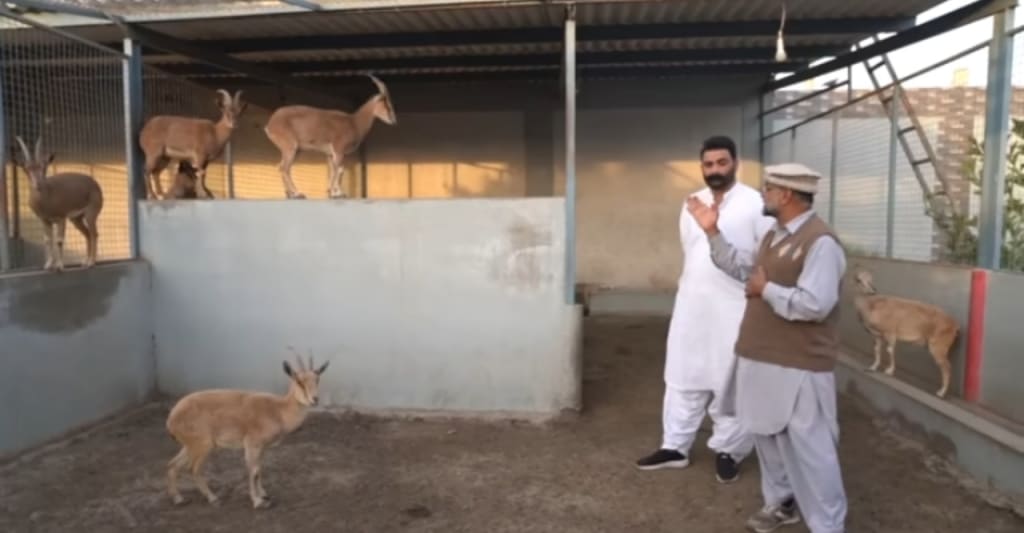
I am currently in the province of Sindh, Pakistan. The district is Thatta, and here in Thatta we have a friend, Mr. Shahid Brohi. He has established a very beautiful wildlife breeding farm here. He has fulfilled all legal requirements, and the farm is registered with the Sindh Wildlife Department. According to international standards, he has built proper enclosures and cages, and he keeps various species of mammals and birds here.
Today, I would like to show you an animal that very few people have seen in a zoo or a wildlife breeding farm. This is the Sindh ibex.
The Sindh ibex is also known as the Sindh wild goat. This is a female ibex. The difference between the male and female can be identified by their horns. The female’s horns are approximately six inches long, whereas the male’s horns are much longer, curving backward from the head. We will show you the male in another enclosure.
During the hottest part of the year, Sindh ibex rest during the day and may graze for a considerable part of the night.They also give birth to two or three kids like domestic goats. The pregnancy period is also 6 months like domestic goats.
These are the females. Look at them climbing up the wall. They are accustomed to living in mountains and rocky areas. They stand at higher places to get a clear view of their surroundings without obstruction. Some animals prefer to hide in bushes so that predators cannot see them, while others prefer open areas so they can spot predators from a distance. These ibex live on rocks in a similar manner.
Types of Ibex
In Pakistan, there are two types of ibex:
One is the Sindh ibex, and the other is the Himalayan ibex.
The Sindh ibex is found in the Kirthar mountain range of Sindh and in many areas of Balochistan, especially in Hingol National Park and Kirthar National Park. The Himalayan ibex, on the other hand, is found in the northern regions such as Gilgit-Baltistan.
It should also be remembered that the Sindh wild goat is an endemic species of Pakistan, meaning it is not found anywhere else in the world. Furthermore, our domesticated goats were originally derived from such wild goats thousands of years ago through domestication.
This is a very beautiful animal. Mammals have a very sharp sense of smell. They can immediately recognize whether a person is familiar or a stranger. That is why it smelled me and immediately moved away.
Wild animals are generally frightened by white and black colors. Therefore, when conducting wildlife surveys, we usually wear brown or green clothing so that animals cannot easily recognize us.
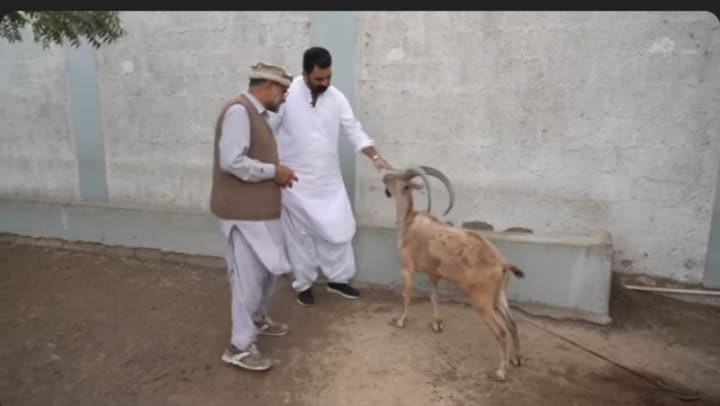
Now let us look at the male ibex. Here is the male. Look at his horns; they are quite large and curved. He is approximately five years old. His age is estimated by examining the marks on his horns. He is quite mischievous and aggressive, which is why he has been tied up. Males fight among themselves, and for this reason, he has been kept separate from the females.
It is a good thing that this animal is of pure breed and has not been mixed with any other species. In the wild, it is very difficult to see them; sometimes researchers go for several days without spotting one. But here, people are able to see it up close.
Mashallah, it is a very powerful animal. However, because of its horns, caution is necessary.
The Sindh Wildlife Department has employed some 600 members of the local communities to help protect the rare species, mainly from illegal hunting.
Their salaries, are generated through "trophy hunting", which tempts hunters from across the country and abroad to hunt down 10 to 15 wild goats every year.
One has to pay $30,000 to hunt a goat.
About 80% of the amount generated through hunting licenses is spent on the local communities, whereas the remaining goes to the national exchequer.
About the Creator
Keep reading
More stories from Pets and animals and writers in Petlife and other communities.
Mount Chiltan and the Markhor: A Wildlife Conservation Miracle in Balochistan
If someone has never seen Balochistan or does not know much about it, they might assume that this mountain is located in some remote area of the province. After all, when wildlife is disappearing across Balochistan, how could such a large number of markhors possibly exist near the province’s largest city? But Mount Chiltan is not only located next to Quetta, the capital of Balochistan the city’s population has expanded right up to its foothills. How Did the Mountain Get the Name Chiltan? It is commonly believed that a dervish once lived in this mountain with his 40 children. Because of these forty children or brothers, the mountain came to be known as “Chiltan”. This is not just hearsay; the same story is even included in school textbooks in Balochistan. However, Nazir Ahmed Kurd, who serves as Deputy Conservator of Forests at Hazarganji Chiltan National Park, disagrees with this explanation. According to him, the story about the 40 brothers is incorrect. “In fact, there are 40 different locations in this mountainous region, each with its own specific name. That is why it is called Chiltan,” he said. He added that they invite officials responsible for the education curriculum to visit and conduct proper research with them so that accurate information about the mountain’s name can be included in textbooks.
By Pets and animals 2 days ago in Petlife
The Summer I Was Chosen by a Northern Mockingbird
During the long, suspended days of the pandemic, a wild mockingbird began visiting my driveway and chose me, again and again. What started as a strange encounter became a brief, meaningful connection that I still carry with me.
By Erica Roberts about a month ago in Petlife
Men Lose Their Y Chromosome as They Age. Scientists Thought It Didn’t Matter — But Now We’re Learning More
For decades, scientists believed the Y chromosome played only a narrow role in human biology: determining male sex characteristics and fertility. Once its job was done, it was often dismissed as genetically insignificant. But a growing body of research is now overturning that assumption.
By Sajida Sikandar5 days ago in Petlife


Comments
There are no comments for this story
Be the first to respond and start the conversation.