
The hive has a designated "dance floor" that honey bees use.
One dance area is used by bees.

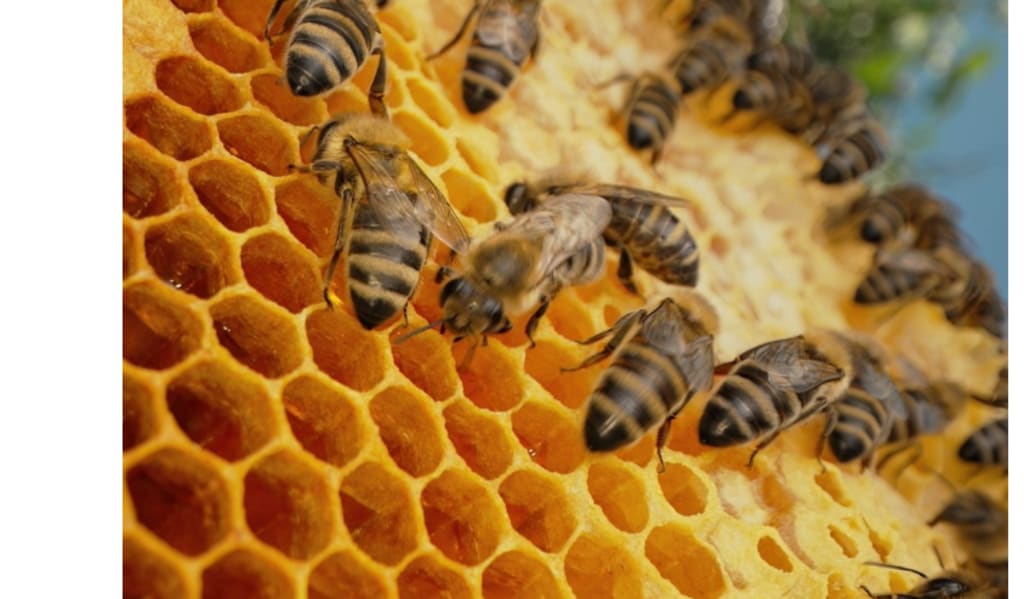
Within a certain, quantifiable patch of comb inside the hive, honey bees focus their recruitment dances. Now that its exact outline has been established, scientists can monitor how and when colonies rearrange that common communication area in response to shifting circumstances.
One dance area is used by bees.
Thousands of waggle runs, or recruiting dances, gathered in a small area on the comb closest to the entrance of glass-walled observation hives. According to research by Byron N. Van Nest of the University of Manitoba (UM), the clusters create a defined, consistent area that may be mapped and contrasted amongst colonies.
Even as activity increased and decreased, almost all dances in both four-frame and eight-frame hives were recorded in the same specified location across 155 half-hour observations.
This consistency makes the dance floor a tangible, measurable aspect of hive organisation, allowing for a more thorough examination of how its location and form change over time.
Charting the dance floor
Any straightforward boundary could be stretched by a single stray point since occasional dances took place far from the main cluster. For every brief recording, the team first constructed a convex hull—an exterior polygon that encloses every point.
The next step concentrated on the tight core, where the majority of dances landed, because outliers continued to increase that outline. The team maintained the overlap and used a confidence ellipse, an oval that summarises where the majority of points lie, to concentrate on the core.
Testing in a variety of hives
The UM researchers tested the threshold over a number of days and two hive sizes to make sure it wasn't wishful thinking. They recorded 7,444 dances from eight colonies over the course of 155 half-hour sessions, each time drawing a different area.
The technique recorded 90.8% of dances on average, and the percentage of capture was the same for eight-frame and four-frame hives. Because of its dependability, subsequent comparisons may concentrate on actual dance floor changes rather than measurement noise.
The shape of the dance area varies.
Each outline yielded size numbers, such as length and width, in addition to location, which explained how bees utilised space. The dance region tended to be longer in smaller four-frame hives than in bigger eight-frame hives.
There were also differences in seasonal patterns: in small hives, width increased toward the end of the year, but in larger hives, it decreased. The swings did not march steadily in one direction, but the daily area also fluctuated.
The dance floor changes with the seasons.
It was possible to determine whether the dance floor moved by tracking the centroid, which is the single center point of the area that was defined. Eight-frame centers remained at their start, whereas four-frame centers moved further away from the entry later in the season.
The movement took up a higher percentage of the available comb in four-frame hives, where space is at a premium. Such mobility suggests that, even when the message remains consistent, colony architecture and crowding can reroute dances over the course of weeks.
The direction of dance changes every day.
In addition to location, the boundary featured a tilt that explained the arrangement of the dance area on the comb. Four-frame outlines maintained almost the same orientation throughout the day, while eight-frame outlines rotated substantially from morning to afternoon.
In contrast to the sun's constant motion, rotation began to rise before noon and fall later, marking the turning moment. Where dancers can face and move may be influenced by internal crowding and traffic, particularly when frame size restricts free paths.
Why bees congregate for education
According to a Nobel Prize speech, recruits are guided to nectar and pollen by the waggle dance, a sprint that encodes direction and distance. Nestmates follow the victorious Apis mellifera workers as they repeat that sprint on comb within the dark hive.
Because there are fewer opportunities to search in a packed comb, recruits can locate signalers more rapidly by concentrating dances in a single area. Location can influence results, as previous recruiting trials demonstrated that the comb surface altered the number of followers that arrived.
Study limitations
The trial design left key questions unanswered, and even a detailed map cannot explain why bees select a location. Size by itself cannot take credit in this dataset because hive size corresponded with various years and circumstances.
Additionally, because unmarked bees can obscure patterns, the crew was unable to determine whether a particular dancer had returned. When biology is the only difference, careful follow-up work can maintain conditions and then investigate what alters the dance floor.
New methods for tracking dances
Computers are already able to track individual dancers through video recordings, and a distinct boundary instructs such algorithms where to search. By connecting this to the new outline, it would be possible to determine whether dancing space extends during intense foraging or contracts during crowding.
Additionally, standardised numbers eliminate definitional disputes whether comparing hives in laboratory, farms, or natural nests. Future experiments using aroma cues, comb texture, and traffic patterns that direct dancers' landings can be supported by that shared benchmark.
A well-known bee behaviour is transformed into a quantifiable element of the hive's internal architecture by using data to define the dance floor. The map should show when communication breaks down and when it adjusts when researchers use it in matching hives and surroundings.
About the Creator
Keep reading
More stories from Francis Dami and writers in Petlife and other communities.
Dogs that are overweight have much higher ocular pressure.
According to a recent study, dogs that are overweight have far higher ocular pressure than dogs that are thin. This disparity brings normally healthy animals closer to levels that have long been associated with diseases that compromise vision.
By Francis Dami5 days ago in Petlife
Buddy Visits Lowe's!
I've said it before: Buddy was not a dog that I needed to have. As a breeder, I have had as many as a couple of dozen dogs at a time, including the eight who currently live in the house with me. As I stated in the previous article about Buddy, I'm the "keeper of the males" when it comes to the Toy Fox Terriers. Adding another intact male dog upsets the balance for quite some time, which is not a task that I always want to undertake. It was predictable, then, that when I brought Buddy home with me internal turmoil existed for quite some time.
By Kimberly J Egan4 days ago in Petlife
At My Wits’ End
Life is about taking out the trash and calling it trash because you have every reason to. It wasn't meant to be linear, they say. But the times you tried to make it straight led to problems, and you didn’t have the tools to put any of it to use. You don't put your right shoes on the right feet; you put the left shoes on the left feet. The grey hardened slab will trip you up anyway.
By Caitlin Charlton3 days ago in Humans

Comments
There are no comments for this story
Be the first to respond and start the conversation.