
After the Breaking
In the quiet after collapse, the smallest green dares the first crack

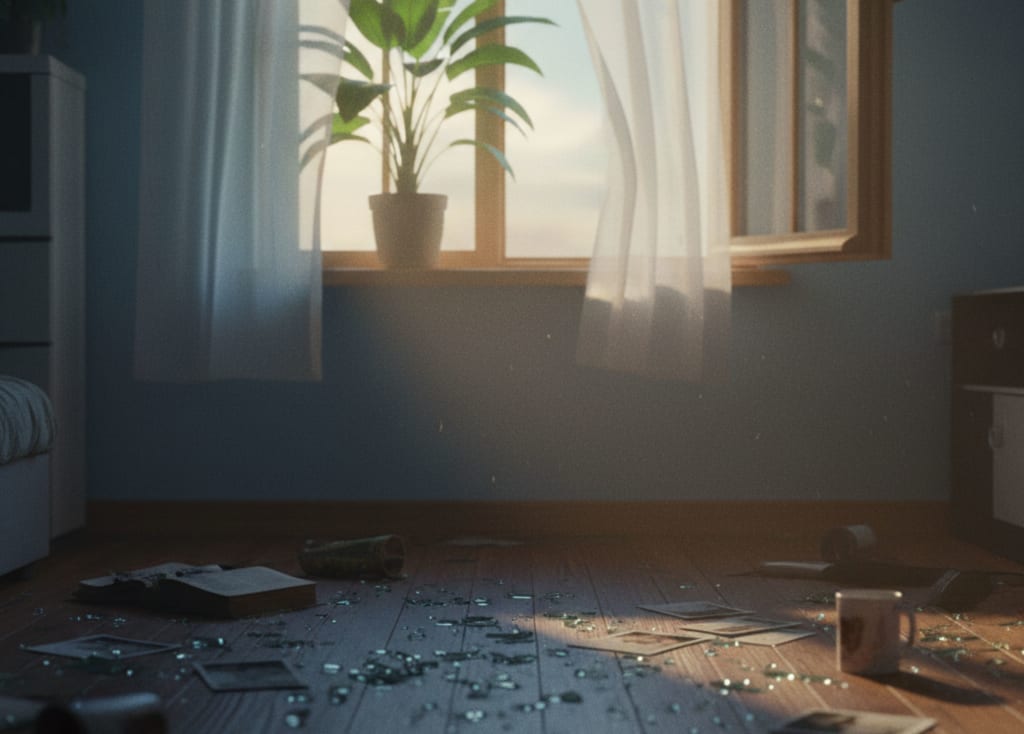
In the quiet after collapse, the smallest green dares the first crack
I didn’t know
a life could make that sound
when it comes apart—
not the clean chime of a glass
meeting tile,
but a low, animal tearing
you feel in bone
before ear.
One morning
I woke on the far shore
of my own wreckage.
Coffee gone cold on the nightstand,
a text left on read
for twelve hours and a decade.
The mirror held my face
like a question no one
had signed up to answer.
They don’t tell you
rock bottom is cluttered—
old versions of you
scattered like rusted tools,
promises curled at the edges,
a playlist you once made
for the person who left
and the person you were
when they didn’t.
There was no sermon,
no trumpet of angels,
only the clock insisting forward
and the stubborn fact
that my lungs
kept doing their quiet,
unimpressed work.
So I started small,
because anything else
felt like lying.
First, I washed the dishes
that watched me break.
The sponge turned the plates
from history into mineral—
circles of porcelain,
just themselves again.
I stood ankle-deep
in soapy water and grief,
and both were warmer
than I deserved,
or thought I did.
Then I opened windows,
even though it was January
and the sky held its breath
like it was afraid to speak.
The cold slipped in
without asking permission,
a clean knife of air
through the stale room
where I’d practiced
every version of despair.
For a moment,
my sadness had to share space
with the smell of rain
coming from a street
I hadn’t walked in months.
It startled me,
how the world continued
its unbothered choreography—
buses exhaling at corners,
a neighbor laughing
on speakerphone,
some teenager rehearsing
the same heartache
in different clothing.
Healing did not arrive
as a lightning strike,
but as a draft under the door.
I began to collect
the smallest survivals:
The way my hands,
even shaking,
still knew how to tie my shoes.
The way my body
reached for water
without asking me first.
How my heart,
unconsulted,
kept ferrying red
through every corridor of me,
like it had already forgiven
what my mind
was still litigating.
I stopped asking
“Who am I without them?”
and started asking
“Who was I before
I learned to disappear?”
Bits returned
like stray cats—
the one who loved
midnight walks,
the one who sang
too loud in the kitchen,
the one who wrote poems
on receipts and lost them
on purpose.
Grief turned from a tidal wave
into weather:
still dangerous,
but with patterns.
On some days
I drowned in minutes,
every object
a landmine of memory—
their mug on the top shelf,
the shirt I couldn’t wear
because it remembered
their hands.
On other days
I forgot them
for whole hours.
Those hours scared me more
than the hurricanes,
because they whispered
the blasphemy
that I might survive.
In therapy,
I spoke in metaphors
because the real words
refused their names.
We mapped the fault lines
of my childhood—
where “sorry” was currency,
where silence
was mistaken for peace,
where I learned to be needed
instead of known.
“Growth,” my therapist said,
“is not becoming new.
It’s finally being allowed
to be what you were
before you were edited.”
So I sat with that—
how a tree does not apologize
for the ring where lightning
once found it.
It does not call itself broken
for the scar that crawls
down its length
like handwriting.
It grows
around the absence,
makes architecture
out of damage,
invites birds to nest
in the crook
of what almost ended it.
I started to think
maybe I could be that unashamed.
I wrote a list titled
“Things That Did Not Leave.”
The sun,
ridiculously punctual.
The moon,
showing up in phases
but always returning.
The friend who texted
“Just ate a sandwich
and thought of you,”
for no reason
other than they did.
The barista
who spelled my name wrong
in a new way every week,
as if trying on
possible futures.
The plant on my sill
that kept turning its face
to the light
even when I forgot
to give it water.
My own laughter,
rusty at first,
like a door
unused for years,
then easier,
swinging open
at the smallest joke,
at a dog in a window,
at my own clumsy resilience.
Healing is not glamorous.
There are no soft filters
for the mornings
you wake up wishing
you hadn’t,
no slow-motion montage
for the nights
you relearn how to sleep
on only one side of the bed.
It is mostly paperwork
and repetition—
calling the doctor,
calling back the friend,
calling your own name
until you remember
how to answer.
It is saying no
for the first time
to the person who expects
your spine to bend
like it did before.
It is the guilt that blooms
like a bruise after that no,
and the quiet pride
that follows later,
walking with a limp
but walking.
And growth—
growth is not a straight line
out of darkness.
It’s a spiral staircase
in a house that shifts
when the wind does.
You think you’ve arrived,
then a smell, a song,
a street corner at dusk
drops you three floors down
without warning.
The work is in remembering
there is also
a way back up.
Somewhere along the circling,
I stopped worshiping
the version of me
who never broke.
I started trusting instead
the one who did,
who learned the shape
of the floor,
who knows now
how to hold someone else
when their world
comes down in shards.
Because that’s the quiet miracle:
every fracture taught me
where I end
and where I refuse to anymore.
I am not “fixed.”
I am not “over it.”
Those were never the goal.
I am a mosaic
of all my endings,
light finding new routes
through the missing pieces,
beauty made visible
through fracture lines
I once tried
to hide.
If you come to me
still bleeding from your own
unraveling,
I will not tell you
it happened for a reason.
I will sit with you
in the glass and ruin.
I will hand you
the broom and bandages,
the phone and the water,
and say:
This is unbearable.
And you are still here.
And the world, rudely,
will keep spinning.
When you are ready,
we will open a window.
We will let the cold in.
We will listen
to the ordinary sounds
of a world that does not know
you have ended,
and we will practice
the impossible art
of beginning anyway.
One day,
you will notice
how much you’ve grown
only because you return
to an old pain
and it no longer
has the right
to name you.
You will touch your scars
and feel not shame
but chronology—
a record of all the nights
you thought were final,
and weren’t.
You will laugh,
too loud in your kitchen,
at something small and stupid,
and realize with a start
that you are glad
to be here
for this.
That is after the breaking:
not a triumph,
not a lesson,
just a life
you step back into—
limping,
luminous,
hands still shaking,
carrying both the ruin
and the seeds
of everything
that might yet grow
in its wake.
About the Creator
abualyaanart
I write thoughtful, experience-driven stories about technology, digital life, and how modern tools quietly shape the way we think, work, and live.
I believe good technology should support life
Abualyaanart
Keep reading
More stories from abualyaanart and writers in Poets and other communities.
Unofficial Challenge: What would you do if you were rich?
I love the kind of work I get to do in my career, but as I job search and browse apartments again due to another understaffed and unsustainable work environment that I did not intend to get into, my daydreams of better days consistently lean into the same question: What would I do if I didn't have to worry about my basic needs being met?
By Kay Husnick5 days ago in Writers



Comments
There are no comments for this story
Be the first to respond and start the conversation.