pop culture
Representations of mental health in pop culture; dissect and discuss popular psychology, mental illness stigmas, and media depictions.
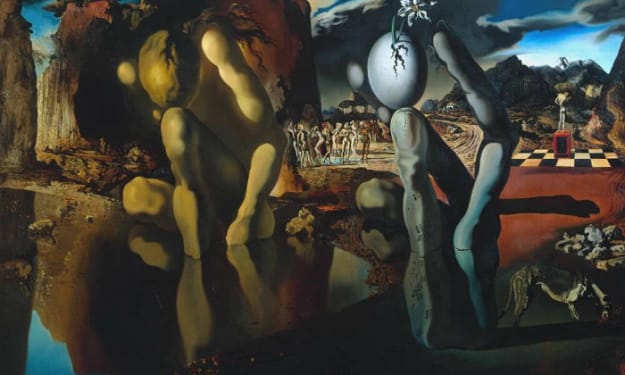
What is Our Collective Consciousness Trying to Tell Us About Narcissism
At the turn of the twentieth century, our western society saw a monumental explosion in the field of Psychology. Behind this movement, were the brilliant minds of both Sigmund Freud and Carl Jung, who, to a certain extent, led the charge. In fact, one of the most significant events of the early 1900’s that was an intrinsic part of this particular field of study, was that of the 1907 meeting, where the two giants got a chance to meet each other face-to-face. For the most part, the two had completely different opinions as far as the human mind was concerned. The one area that two did happen to agree on, was that of the overall importance of the unconscious, and the sentiments that would later manifest in Jungian Psychology as the ideas of the collective unconscious, as well as what is often referred to as collective consciousness.
By Aaron M. Weis5 years ago in Psyche
Magical Thinking, Mundanical Thinking
We’re all familiar with the problem of magical thinking. Magical thinking is generally used to refer to superstitious beliefs which ignore basic things like causation or evidence. But we can expand the definition slightly, to encompass any belief which ignores reason or evidence in favour of something nice, or comforting, or optimistic. (This is sometimes called wishful thinking but I irrationally like the feel of ‘magical’ as a cover-all term). A good example of this is the belief that human history will necessarily turn out well; that it is inconceivable for humanity to drive ourselves extinct or otherwise royally screw-up our future. In many cases it can involve a kind of positive fatalism: “things will turn out okay”, “God has a Plan”, or “lots of bad things like extreme poverty have been decreasing for a long time so things will probably just keep getting better and we don’t need to worry too much about existential risks” (looking at you Steven Pinker). Magical thinking often involves a poorly considered, naive optimism that spares the details in favour of fantasy.
By Conor McCammon5 years ago in Psyche
What Minority Representation In Hollywood Has Done For Our Mental Health
Have you ever wondered why Hollywood studios are trying harder and harder to integrate casts with greater racial diversity? Not only ethnicity, but minority representation in film has also been a hot topic in the world of entertainment. Many still do not fully understand why, others believe that it is only a question of marketing and that the large studios only fulfill one agenda.
By Mindsmatter.5 years ago in Psyche
The Persuasive Power of Words
The Story Newly landed in Italy, we gorged ourselves on everything Italian. The sights, sounds and food were all to die for. Pizza, pasta and peperonata became our daily fare. Even the local cats and dogs could be seen enjoying huge bowls of spaghetti. The country, the weather and the food were all delicious. Not to speak of the wonderful wine … but I digress.
By Donna L. Roberts, PhD (Psych Pstuff)5 years ago in Psyche
The Fame Monster: at the Intersection of Celebrity and Mental Health Advocacy
As someone with mental health issues, I recognize the importance of celebrities advocating for treatment and reducing the stigma surrounding psychiatric illnesses. But lately, I’ve been disenfranchised with stars’ performative acts and at times, downright triggering attempts to shed light on mental illness. Stars tend to forget that they have a larger audience than most. They also may be so coddled in a Hollywood bubble that they lose their sense of reality. Most recently, Lady Gaga released an ad for her cosmetic line, Haus Laboratories, that fashioned eyeliner swatches to look like self-harm scars on the inside of the model’s wrists. Dozens of followers commented that they found the image insensitive and triggering. Without apologizing or even acknowledging the harm caused, Haus Laboratories promptly removed the image from their Instagram. In the past, Lady Gaga has advocated for access to mental health treatment and has opened up about her personal struggles with mental health. She even penned an essay for The Guardian about the urgency of suicide prevention for World Mental Health Day in 2018. Of course, this is not the first incident where Gaga was called out for being insensitive about mental illness, and other celebrities have been just as guilty, but this latest instance reveals a deeper pattern of celebrities claiming to advocate for mental health while causing harm to those struggling.
By Erica Mones5 years ago in Psyche
The Barbie Head
Writing prompt: the first memory you ever had. It took me a while to dig back to as far as I could remember. Things that stick out are some things that have some kind of trauma around them: the first time I saw blood, conceived of death, hated something or someone, felt terrible physical pain, etcetera. And before concepts, there were images. Dress hems, dogs tied to their house by a chain, a tall palm tree, the gleam of metallic balloons.
By A.X.Partida5 years ago in Psyche
Easy Does It
I’m an old guy. Turned 79 a week ago. I don’t play music while I go through my morning regimen of stretches and leg lifts the rheumatologist gave me to combat brucites and arthritis. Maybe I should. I do ask Alexa to play ambient music at night in hope that I’ll more quickly receive a visit from my fickle friend Morpheus, but it doesn’t always work.
By David Vaughn5 years ago in Psyche