
Adult vulnerability in a society built for proof, not prevention.
Where Fear Has No department.
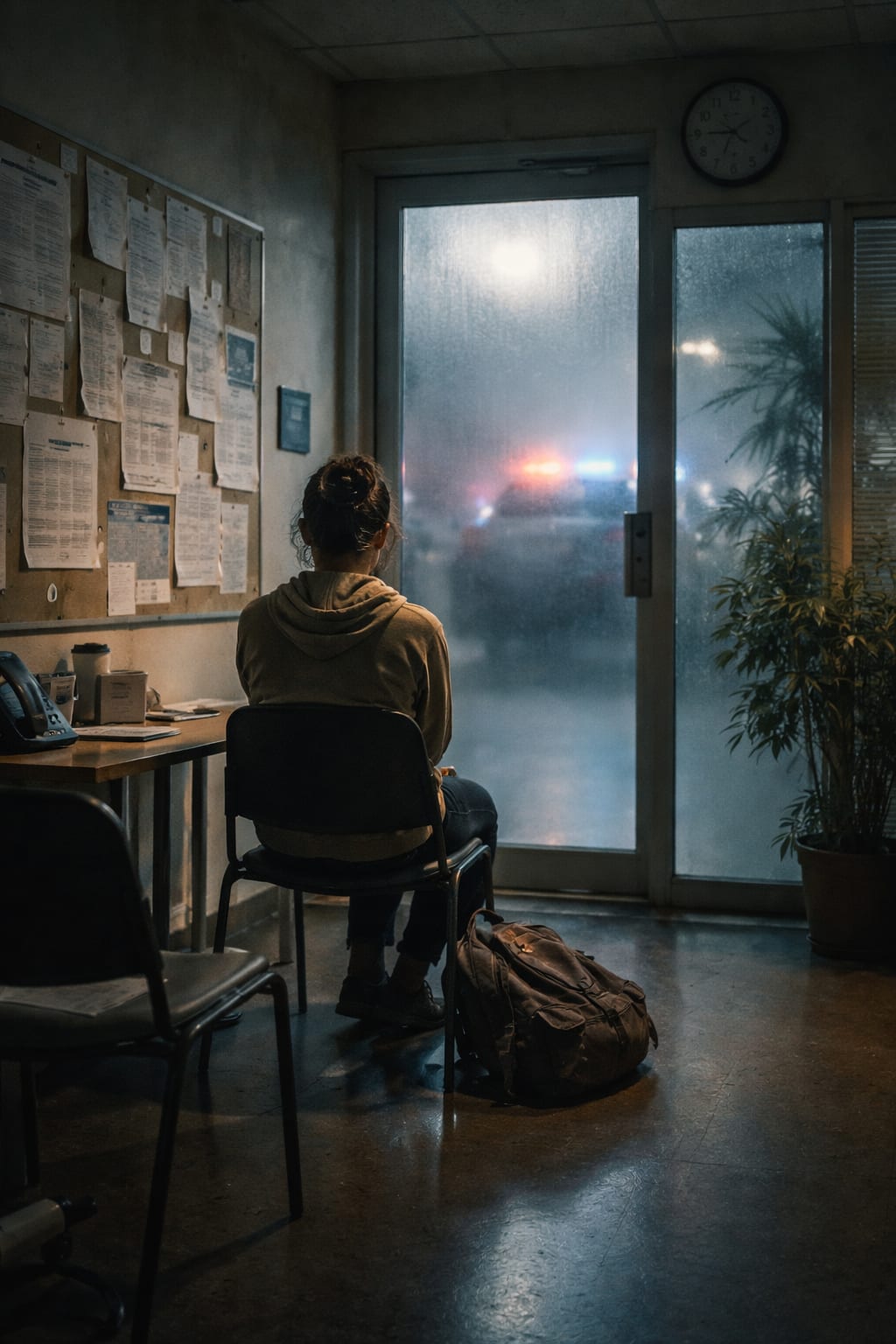
There is a particular kind of fear that does not announce itself with chaos. It does not shout. It does not arrive with sirens or visible damage. It arrives quietly, often in adults who are functional, articulate, and accustomed to managing themselves. They continue to work, to speak politely, to follow instructions. And yet something has shifted. Safety no longer feels assumed. The world tilts just enough to make rest impossible.
This is the kind of fear modern society struggles to recognize.
Our institutions are designed to respond to events, not atmospheres. They excel at dealing with outcomes. Injury, crime, eviction, breakdown. They are far less adept at dealing with thresholds, those moments before harm occurs when a person senses that something is wrong but cannot yet demonstrate it in the approved formats.
The result is a structural blind spot. Adults who seek help early often find themselves redirected rather than received. Health services check vitals and find nothing measurable. Law enforcement looks for offences and finds none recorded. Housing services assess eligibility based on definitions that assume danger must already be realized to count. Each institution performs its role competently. Collectively, they leave the person in motion, unsettled, carrying an unanswered question.
This experience is increasingly common in a society shaped by austerity, housing scarcity, and administrative overload. When systems are stretched, discretion narrows. Staff rely on scripts because scripts are defensible. Evidence becomes a shield against risk, not only for the public but for the institution itself. Belief, once given freely in human encounters, is now rationed through policy.
There is also a cultural story at work here, one that prizes resilience while quietly punishing vulnerability. Adults are expected to self regulate, self soothe, self advocate. The language of independence is celebrated, yet when someone reaches its limits, the response is often suspicion rather than support. Why can’t you cope? Why now? Why without proof?
Mental health discourse complicates this further. While awareness has increased, it has also become a convenient sorting mechanism. When fear cannot be corroborated externally, it is often relocated internally. Stress. Anxiety. Perception. These words can be accurate, but they can also function as closure. Once applied, the environment no longer needs examination. The individual becomes both the site and solution of the problem.
This dynamic disproportionately affects those whose vulnerability does not conform to stereotype. Adults who are articulate but exhausted. Calm but frightened. Rational yet uneasy. Particularly women, who have long learned that expressing concern too strongly invites dismissal, while expressing it too softly invites neglect. The acceptable performance of fear is narrow, and many fall outside it without realizing the rules have shifted.
Housing precarity intensifies all of this. When home is shared, temporary, or governed by informal power dynamics, safety becomes harder to define and easier to contest. The language of contracts replaces the language of care. Concerns are reframed as misunderstandings. Explanations are offered that prioritize normalcy over inquiry. The person who feels unsafe is subtly repositioned as the disruption.
What is striking is how often the most humane responses come not from formal authority but from the margins. Charities. Volunteers. Strangers. People with no power except attention. They do not resolve the situation. They stabilize the person. They offer something institutions rarely do in these moments. Time without evaluation. Presence without correction. The simple assurance that fear itself is not a failure of character.
This reveals something uncomfortable about the current social order. We have built systems that are excellent at reacting and poor at listening. That treat uncertainty as a liability rather than a signal. That assume adults should endure ambiguity silently until it crystallizes into something actionable. By the time it does, the cost is often far higher.
The question this raises is not whether every fear is justified. That is too blunt and too easy. The deeper question is whether we have the moral imagination to take fear seriously without demanding that it first destroy something. Whether we can design responses that hold ambiguity without immediately translating it into pathology or inconvenience.
A society is not only defined by how it responds to crises, but by how it treats those who arrive before the crisis, asking quietly for help while there is still time to change course. When fear has no department, people learn to doubt themselves, to minimize their instincts, to stay longer than they should in places that do not feel safe.
Those lessons linger. Long after the situation has passed, the body remembers what it was like to ask for help and find no door clearly marked.
If there is a social reckoning here, it is not dramatic. It is granular. It lives in policy thresholds, in professional training, in the value placed on early concern. It asks whether prevention is something we truly want, or whether we are more comfortable dealing with harm once it can no longer be ignored.
Until that question is answered differently, many adults will continue to navigate fear alone, doing everything right, saying everything carefully, and discovering that caution, when it arrives ahead of proof, still has nowhere to land.
About the Creator
Russia Struggles to Shake Reliance on Foreign Technology Imports
Russia continues to face significant challenges in reducing its dependence on foreign technology imports despite years of government efforts to promote domestic production and technological self-sufficiency. Western sanctions, supply chain disruptions, and limited access to advanced components have exposed structural weaknesses in Russia’s tech sector, highlighting the difficulty of replacing imported systems with locally produced alternatives. Since the introduction of broad international sanctions following the conflict in Ukraine, Russia has accelerated its push for “technological sovereignty.” Officials have repeatedly stated that the country must rely on homegrown solutions in areas such as semiconductors, telecommunications, industrial software, and electronics manufacturing. However, experts say progress has been uneven and costly. A Legacy of Dependence For decades, Russia’s technology industry has relied heavily on imported hardware and software, particularly from the United States, Europe, and East Asia. Key industries—including aviation, energy, telecommunications, and defense manufacturing—were built using foreign microchips, machinery, and operating systems. When sanctions restricted access to these technologies, companies were forced to search for alternatives almost overnight. Many turned to suppliers in China and other non-Western markets, but these substitutes often lacked the same performance or compatibility with existing systems. “Russia’s problem is not only sanctions,” said one Moscow-based technology analyst. “It is that its high-tech manufacturing base was never designed to be fully independent.” Semiconductor Shortages One of the most serious challenges has been access to advanced semiconductors. Modern chips are essential for everything from smartphones and medical equipment to military systems and artificial intelligence. Russia’s domestic chip industry remains years behind global leaders in Taiwan, South Korea, and the United States. While Russia can produce older-generation chips for basic uses, it struggles to manufacture high-performance processors at scale. As a result, industries dependent on cutting-edge computing power face delays and rising costs. Government programs have invested billions of rubles into chip development projects, but experts warn that building a competitive semiconductor ecosystem requires decades of infrastructure, skilled labor, and international cooperation. Software and Digital Services Software has been another major area of concern. Following the departure of major Western companies, Russian businesses lost access to widely used operating systems, cybersecurity tools, and enterprise software platforms. In response, authorities encouraged the adoption of Russian-made software solutions. While some local companies have developed alternatives, businesses report technical limitations and compatibility issues. Migrating large systems from foreign to domestic software has proven complex and expensive. Banks, hospitals, and transport networks have been particularly affected, as their operations depend on reliable and secure digital infrastructure. “Replacing software is not like replacing a light bulb,” said an IT consultant working with Russian firms. “It requires retraining staff, redesigning systems, and accepting lower performance in some cases.” Economic Impact Russia’s dependence on imported technology has had a visible economic cost. Manufacturing delays, rising production expenses, and reduced innovation have slowed growth in several sectors. Industries such as aviation and automotive manufacturing have struggled to maintain production levels due to shortages of electronic components. Some factories have been forced to suspend operations or redesign products using simpler technology. Small and medium-sized enterprises face the greatest pressure, as they lack the financial resources to invest in alternative suppliers or custom-built systems. Government Strategy and Limits The Russian government has launched multiple initiatives to boost domestic innovation, including tax incentives, subsidies for tech startups, and national development programs focused on microelectronics and artificial intelligence. Officials argue that long-term independence is achievable and that current difficulties are temporary. They point to growing partnerships with Asian suppliers and increased funding for local research institutions. However, critics say that true technological independence is unrealistic in a globalized economy. Modern technology depends on international supply chains that no single country can fully replace. “Even the most advanced nations rely on imported components,” said a European technology researcher. “Russia’s attempt to isolate itself technologically will likely result in slower development and reduced competitiveness.” Talent and Brain Drain Another challenge has been the loss of skilled professionals. Thousands of engineers and IT specialists left Russia following political and economic uncertainty, weakening the country’s innovation capacity. Although universities continue to train new graduates, rebuilding a skilled workforce takes time. Industry leaders warn that without attracting global talent and cooperation, domestic technology programs may struggle to reach international standards. A Long Road Ahead Despite the obstacles, Russia continues to pursue its goal of reducing reliance on foreign technology. New production facilities are under construction, and state contracts increasingly favor domestic suppliers. Yet analysts agree that the transition will be slow and difficult. Access to advanced tools, global research networks, and foreign investment remains limited. For now, Russia remains heavily dependent on imported technology—either directly or through alternative trade routes. The effort to replace foreign systems has exposed the complexity of modern technological ecosystems and the risks of isolation in a highly interconnected world. Whether Russia can achieve meaningful technological independence will depend not only on funding and policy, but on its ability to rebuild trust, innovation, and international cooperation in the years ahead.
By Fiaz Ahmed 2 days ago in The Swamp




Comments (2)