
Annular Solar Eclipse
When the Sun Becomes a Ring of Light

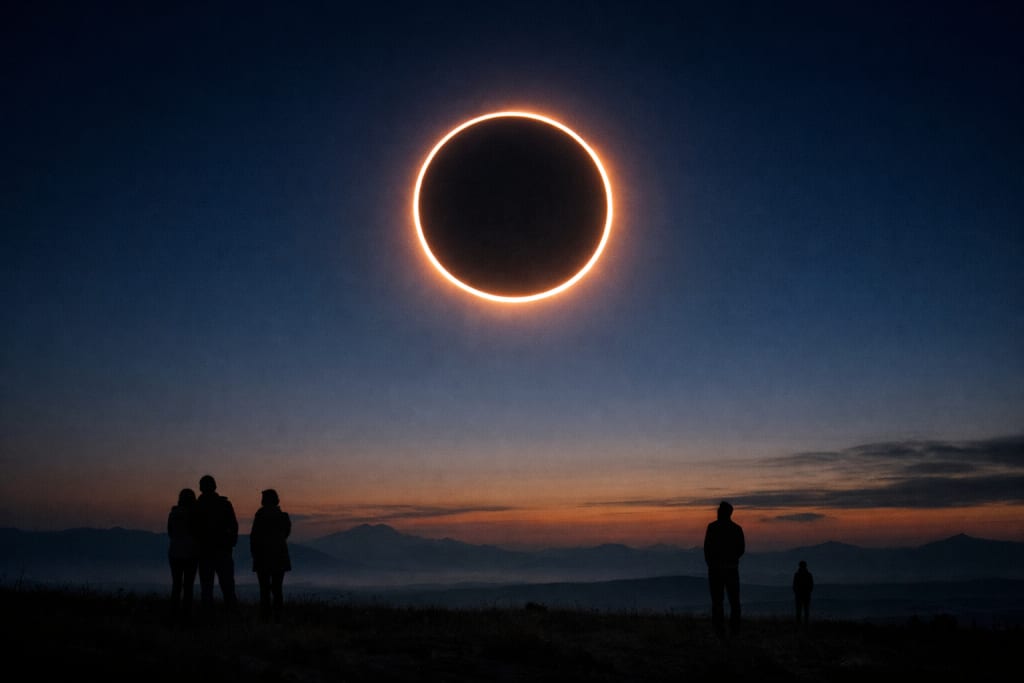
Watching the Sun lose its regular shape is both beautiful and unsettling in a quiet manner. Not go away altogether or plunge the earth into darkness, but develop into a bright circle in the sky. During an annular solar eclipse, that's exactly what happens.
An annular solar eclipse doesn't feel as dramatic as a total solar eclipse, which turns day into night. It feels more subdued and delicate. The light shifts. The air is different. People glance up, not sure if they should be impressed or confused. But the sight of that lovely ring of light will be with you forever.
This essay explains the annular solar eclipse from a down-to-earth viewpoint, addressing what it is, how it happens, why it looks the way it does, and why it still matters even if we presume we know everything.
What is an annular solar eclipse, really?
When the Moon travels perfectly between the Earth and the Sun yet looks a little smaller than the Sun in the sky, an annular solar eclipse happens. The Moon can't entirely obscure the Sun as it is smaller.
The Sun remained visible as a bright ring around the Moon's black outline instead.
That's all. Not a mystery. No magic tricks. Just distance, alignment, and timing working together.
The word "annular" originates from "annulus," meaning "ring," which complements the vista perfectly. At the peak of the eclipse, the Sun seems like a narrow, incandescent loop—often termed the “ring of fire.”
Why the Moon Doesn’t Fully Cover the Sun
This aspect surprises many persons.
The Moon and the Sun don’t always appear the same size in the sky. Sometimes the Moon looks enormous enough to obscure the Sun altogether. Other times, it doesn’t.
The Key Reason: Distance
The Moon’s orbit around Earth isn’t perfectly spherical. It’s stretched slightly into an oval shape. That means:
Sometimes the Moon is closer to Earth.
Sometimes it’s farther distant.
When the Moon is farther away, it looks smaller from our point of view. If a solar eclipse occurred at that point, the Moon merely can’t cover the complete Sun. The edges stay visible—and that’s how an annular eclipse is born.
Nothing fundamental changes about the Sun itself. Only our viewpoint does.
The “Ring of Fire” Effect
The expression “ring of fire” sounds strong, perhaps fierce. In truth, the impact is modest and precise.
At maximum eclipse:
The Moon blocks the center of the Sun.
The outside edge of the Sun remains visible.
Light makes a clean, uninterrupted circle.
It doesn’t flicker. It doesn’t move swiftly. It just sits there, bright and silent.
And because the Sun is never entirely hidden, the sky never becomes dark. Daylight persists; however, it feels weirdly muted—like someone turned down the brightness of the world.
How an Annular Eclipse Feels Compared to a Total Eclipse
People often expect all solar eclipses to feel the same. They don’t.
A total solar eclipse is emotional. The sky darkens. Birds react. Temperatures decrease. People gasp.
An annular solar eclipse is quieter.
You notice:
The light appears wrong.
Shadows get sharper.
Colors feel flatter.
Time seems to slow down slightly.
It’s less about shock and more about awareness. You know something fantastic is happening, even if the world doesn’t stop to shout it.
Is It Ever Safe to Look at an Annular Solar Eclipse?
No. Not even for a second.
This is one of the most fundamental things to know.
During a total solar eclipse, there’s a brief moment when the Sun is fully hidden, and it’s safe to stare without protection. That moment does not exist in an annular solar eclipse.
The Sun is always exposed.
What Can Go Wrong?
Looking straight at the sun—even when it’s mostly covered—can:
Burn the retina.
Cause persistent blind spots
Damage vision without instant pain
By the time you notice an issue, it’s often too late.
What You Should Use
Certified solar eclipse glasses
Proper solar filters for cameras and telescopes
Indirect viewing technologies like pinhole projection
Regular sunglasses are not adequate. Ever.
What Changes During an Annular Solar Eclipse
Even though the Sun isn’t totally hidden, the environment nevertheless reacts.
Light Quality
The sunshine gets strangely flat and wan. It doesn’t feel like dark or morning—just unfamiliar.
Temperature
There may be a minor decline in temperature, though it’s usually mild.
Animal Behavior
Some birds calm down. Insects may pause. Most animals don’t panic, but they seem perplexed, as if the day skipped a beat.
These effects are tiny but evident if you’re paying attention.
Why Scientists Still Care About Annular Eclipses
From a scholarly viewpoint, annular solar eclipses may not be as stunning as full eclipses, but they are still noteworthy.
Scientists use them to:
Test solar observation equipment.
Measure fluctuations in solar radiation.
Study how Earth’s atmosphere responds to reduced sunshine.
They’re also valuable for education. Annular eclipses are seen from different regions of the planet and are generally easier to forecast and plan for.
How People Interpreted Annular Eclipses in the Past
Before orbital mechanics and accurate computations, eclipses were frightening.
In many ancient cultures:
The Sun being “damaged” was a bad omen.
A ring-shaped Sun represents cycles, warnings, or renewal.
Some feared creatures were assaulting the skies.
Today, we know better—but that doesn’t mean the emotional impact is gone. Even with a clear scientific explanation, witnessing the Sun change shape still appears incredibly painful.
Where You Need to Be to See the Ring
Not everyone receives the same vision.
unfinished.Only persons standing within the path of annularity view the whole ring of fire. Outside that limited zone, the eclipse seems partial—interesting, but unfinished.
That’s why eclipse chasers travel thousands of kilometers seeking the optimal place. A simple difference in location can significantly transform the experience.
Photographing an Annular Solar Eclipse
Yes, you can picture it—but only with sufficient safety.
Without solar filters:
Camera sensors can be permanently damaged.
Lenses can overheat.
Images can be damaged instantly.
With the right technology, however, annular eclipses give astounding, clear images that feel almost pictorial in their purity.
Why Annular Solar Eclipses Still Matter
In a world saturated with displays, connectivity, and relentless noise, an annular solar eclipse necessitates a pause.
It’s not loud.
It’s not fast.
It doesn’t demand attention.
It simply happens—quietly reminding us that even the most stable things in our life, like the Sun, are subject to precise cosmic choreography.
And occasionally, a thin ring of light is enough to make us look up.
Frequently Asked Questions (FAQ)
1. How often do annular solar eclipses happen?
They occur somewhere on Earth around every one to two years, although viewing one from your particular location is rare.
2. Can an annular eclipse become a total eclipse?
No. If the Moon appears smaller than the Sun, total coverage is impossible.
3. Why doesn’t it go dark during an annular eclipse?
Because the Sun is never entirely covered, enough light remains to keep daylight.
4. Is it more dangerous than a total solar eclipse?
In certain areas, yes—because there is no safe viewing period without protection.
5. Is the ring generally exactly round?
Most of the time, yes, though air conditions and viewing angle can substantially affect how it seems.
Conclusion
An annular solar eclipse isn’t about darkness or drama. It’s about precision. Distance. Alignment. Perspective.
It shows us how slight changes in location can alter something as constant as the Sun. And while science explains every component, the experience itself remains quietly deep.
The next time the Sun becomes a ring of light, it’s worth stopping—just for a moment—to watch the universe do what it has always done, long before we were paying attention.
About the Creator
abualyaanart
I write thoughtful, experience-driven stories about technology, digital life, and how modern tools quietly shape the way we think, work, and live.
I believe good technology should support life
Abualyaanart
Keep reading
More stories from abualyaanart and writers in The Swamp and other communities.
A Look Ahead
The way people engage on cellphones has been the same for years. A new year comes, leaks come out, specifications get louder, and our screens are assaulted with promises of "the biggest upgrade yet." But as we approach closer to 2026, things look different. Not because smartphones are suddenly fresh and exciting again, but because the way people use their phones is changing.
By abualyaanart21 days ago in The Swamp
Why Black History Matters in America?
The United States of America is celebrating their 250th anniversary in 2026. I'm proud to be an American and as someone who was born here, I wouldn't imagine myself living anywhere else. This is a country where opportunities are possible. Where anyone can be successful in anything they desire to do. Equality, community, and togetherness are the backbones of what America is and should be about. However, we have an administration who wants to erase and disregard those who have made positive, meaningful impacts in our country, specifically Black figures, such as Martin Luther King, Jr., Rosa Parks, and Maya Angelou. President Trump and his administration have been constantly complaining and fighting against what they call the "Woke agenda". They use this excuse as a distraction from other issues they refuse to address, such as the high cost of living, climate change, and inflation. That equality is dividing America, when in reality, it's bringing us together. Being woke is not tied to a specific political party. No matter where you stand on the political spectrum, you can still care about other people and their plights. Compassion and empathy for others isn't tied to a political party, either. We were taught as children to treat others the way we want to be treated and not judge others because they're different from us. Caring about others isn't a personal attack on your beliefs. It doesn't make you any less of a person. People who are easily offended over African American figures, past or present, or anything related to it, are grasping at straws. Current and future generations need to know who people like Harriet Tubman and Shirley Chisholm were, especially in the classroom. Black History is part of American History. It should be recognized, not hidden or forgotten. Besides, you can't shield children from everything, just because your feelings are easily hurt.
By Mark Wesley Pritchard 8 days ago in The Swamp
Saudi Arabia Joins Egypt, Turkey, UAE, Oman, Qatar, and Other Middle Eastern Countries in Facing Significant Travel Changes and Potential Visa Delays This Year as the US Imposes a New Visa Policy and Biometric Entry-Exit System
Travel between the Middle East and the United States is set to undergo notable changes this year as Washington rolls out a new visa policy alongside an expanded biometric entry-exit system. Saudi Arabia has now joined countries such as Egypt, Turkey, the United Arab Emirates, Oman, Qatar, and others in facing the impact of these measures, which are expected to lead to longer visa processing times, additional documentation requirements, and heightened scrutiny for travelers.
By Sadaqat Aliabout 19 hours ago in The Swamp
The Angry Man in Your House
"If you grow up with an angry man in your house, there will always be an angry man in your house" This statement has caused plenty of controversy online, people say its a statement that blames victims while also undermining those who break traumatic cycles to form health relationships... but if I'm honest now that I'm in my 30s it makes more sense to me than ever, and I'd argue that its not just about fathers and uncles.
By S. A. Crawford2 days ago in Humans




Comments
There are no comments for this story
Be the first to respond and start the conversation.