
Europe Nanosatellite and Microsatellite Market Size & Forecast (2026–2034)
Small Satellites, Big Ambitions: Europe’s Rapid Rise in the New Space Economy

Introduction
Europe’s nanosatellite and microsatellite market is entering a defining decade, shaped by technological miniaturization, environmental priorities, and the commercialization of space. Once dominated by large, government-funded satellite missions, the European space ecosystem is rapidly shifting toward smaller, faster, and more cost-effective satellite platforms. These changes are redefining how space is used for Earth observation, communication, climate monitoring, scientific research, and defense.
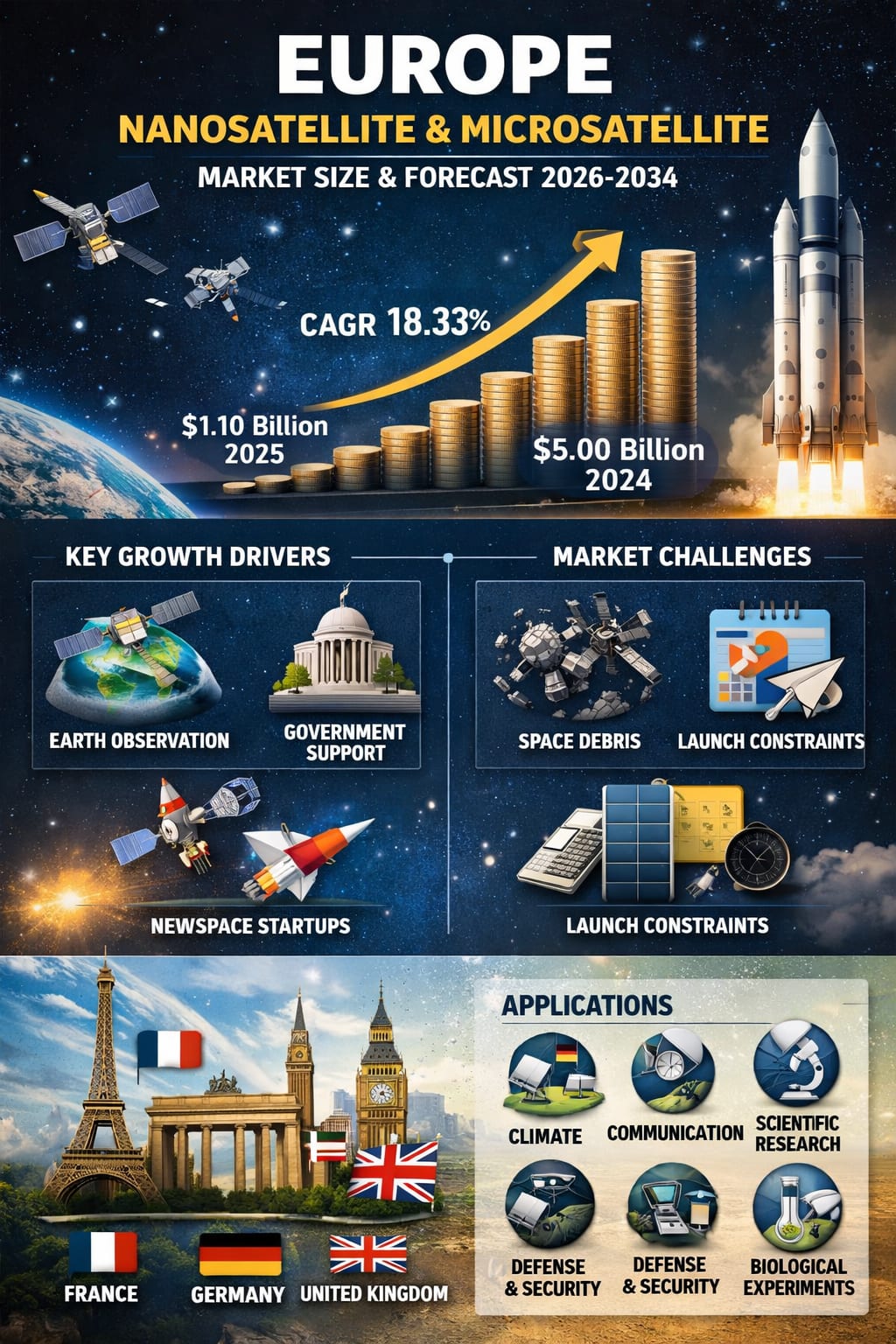
According to Renub Research, the Europe nanosatellite and microsatellite market is projected to grow from US$ 1.10 billion in 2025 to US$ 5.00 billion by 2034, registering a compound annual growth rate (CAGR) of 18.33% during the forecast period 2026–2034. This robust expansion reflects Europe’s growing dependence on space-based data, the rise of NewSpace startups, and sustained government investments across the region.
Europe Nanosatellite and Microsatellite Market Outlook
Nanosatellites and microsatellites are small artificial satellites designed to perform space missions with reduced cost, mass, and development timelines. Nanosatellites typically weigh between 1 and 10 kilograms, while microsatellites range from 10 to 100 kilograms. Despite their compact size, these satellites deliver significant capabilities across applications such as Earth observation, weather monitoring, communication, navigation, scientific research, and technology validation.
In Europe, the adoption of nanosatellite and microsatellite systems is strongly driven by the need for affordable and agile space solutions. Governments, academic institutions, and commercial players are increasingly deploying constellations of small satellites to achieve higher revisit rates and real-time data access. These constellations allow continuous monitoring of climate patterns, urban expansion, maritime traffic, and disaster-prone regions.
The growing emphasis on sustainability, digital infrastructure, and space commercialization has positioned nanosatellites and microsatellites as critical assets within Europe’s long-term space strategy.
Market Size and Growth Forecast
Renub Research estimates that the Europe nanosatellite and microsatellite market will expand significantly over the forecast period. The market’s growth from US$ 1.10 billion in 2025 to US$ 5.00 billion by 2034 underscores the accelerating adoption of small satellite platforms across both public and private sectors.
This strong growth trajectory is supported by declining launch costs, advancements in electronics miniaturization, improved propulsion systems, and the increasing use of satellite data across multiple industries. The forecast CAGR of 18.33% between 2026 and 2034 highlights Europe’s growing role in the global small satellite ecosystem.
Key Growth Drivers
Rising Demand for Earth Observation and Climate Monitoring
One of the most powerful growth drivers for the European nanosatellite and microsatellite market is the increasing demand for Earth observation and climate monitoring services. European governments and institutions are prioritizing environmental sustainability, climate resilience, and disaster preparedness.
Small satellites provide high-resolution imagery and frequent data updates at a fraction of the cost of traditional satellites. Their ability to operate in constellations makes them ideal for monitoring land use changes, ocean conditions, air quality, and extreme weather events. As climate-related challenges intensify across Europe, reliance on nanosatellite and microsatellite platforms is expected to grow steadily.
Strong Government Support and Space Programs
Government funding and institutional support play a pivotal role in shaping Europe’s nanosatellite and microsatellite market. European space initiatives continue to integrate Earth observation, navigation, secure connectivity, and space situational awareness under unified policy frameworks.
Public funding enables research institutions, startups, and defense organizations to develop advanced satellite platforms while reducing financial risks. Government-backed missions also encourage innovation in satellite design, propulsion, and data processing technologies, reinforcing Europe’s competitive position in space.
Growth of NewSpace Startups and Commercial Applications
The rise of NewSpace startups is transforming Europe’s satellite landscape. Emerging companies are developing small satellite solutions for broadband connectivity, Internet of Things (IoT), maritime tracking, and data analytics.
Commercialization of satellite data has opened new revenue streams across industries such as agriculture, logistics, insurance, and urban planning. As private companies increasingly invest in small satellite constellations, the European nanosatellite and microsatellite market continues to expand beyond traditional government-driven missions.
Market Challenges
Space Debris and Orbital Congestion
A major challenge facing the European nanosatellite and microsatellite market is the growing concern over space debris and orbital congestion. The rapid increase in small satellite launches has heightened collision risks in low Earth orbit.
Regulatory bodies are enforcing stricter requirements for satellite tracking, deorbiting, and end-of-life disposal. While these measures promote sustainable space operations, they also increase compliance costs and technical complexity for satellite operators.
Limited Launch Availability and Regulatory Complexity
Although launch services have improved, limited availability of cost-effective and timely launch options remains a challenge for European small satellite operators. Launch delays can disrupt deployment schedules and revenue generation.
Additionally, spectrum allocation regulations and cross-border policy differences create regulatory hurdles for satellite communication services. Navigating these complexities requires coordination between national and international authorities.
Europe Nanosatellite Market Analysis
The European nanosatellite market is experiencing strong growth due to increasing demand for low-cost and flexible space missions. Universities, research institutions, and startups are actively deploying nanosatellites for technology demonstrations, academic training, and experimental missions.
European economies such as the UK, France, and Germany play a central role in advancing nanosatellite innovation, supported by strong academic ecosystems and institutional funding. The emphasis on space education and sustainability further strengthens the region’s nanosatellite market outlook.
Europe Microsatellite Market Analysis
Microsatellites offer higher payload capacity and extended mission lifetimes compared to nanosatellites, making them suitable for applications requiring greater data volume and imaging precision. In Europe, microsatellites are widely used for Earth observation, communication, navigation support, and defense-related missions.
Advancements in propulsion systems and power management technologies have enhanced microsatellite performance, enabling longer operational durations and higher reliability. The balance between capability and cost positions microsatellites as a core component of Europe’s space infrastructure.
Software and Data Processing Market
Software solutions for nanosatellites and microsatellites are becoming increasingly important as mission complexity grows. European companies are investing in advanced software platforms for satellite control, mission planning, and real-time data processing.
The integration of artificial intelligence, machine learning, and cloud computing enables faster analysis of satellite data, supporting applications such as climate modeling, infrastructure monitoring, and defense intelligence. Software innovation continues to enhance the overall value proposition of small satellite missions.
Biological Experiments Segment
Nanosatellites and microsatellites are increasingly used for biological experiments in microgravity environments. European research organizations leverage small satellites to study cell behavior, radiation effects, and microbial growth in space.
These experiments contribute to advancements in healthcare, medicine, and space biology. The ability to conduct biological research without reliance on large space stations has expanded research opportunities across Europe.
Defense Applications
The defense segment represents a high-growth area within the European nanosatellite and microsatellite market. Governments are deploying small satellites for surveillance, reconnaissance, intelligence gathering, and early warning systems.
Rising geopolitical tensions and the need for strategic autonomy are driving investments in defense-focused satellite programs. Small satellite constellations offer resilience, redundancy, and rapid deployment advantages critical for modern defense strategies.
Country-Level Insights
France and Germany remain at the forefront of Europe’s nanosatellite and microsatellite development, supported by strong government funding and industrial expertise. The United Kingdom is emerging as a hub for NewSpace startups, particularly in Earth observation and data services.
Italy, Spain, and other European nations continue to expand their presence through academic collaborations and commercial initiatives. Russia maintains a distinct market approach with strong government involvement and defense-focused programs.
Market Segmentation Overview
The Europe nanosatellite and microsatellite market is segmented by satellite mass, components, applications, end-use sectors, and countries. Applications span communication, Earth observation, scientific research, biological experiments, navigation, reconnaissance, and academic training.
End-use sectors include government, civil, commercial, defense, and infrastructure-related industries, reflecting the broad utility of small satellite systems across Europe.
Final Thoughts
Europe’s nanosatellite and microsatellite market is poised for sustained expansion through 2034, driven by environmental priorities, technological innovation, and commercial demand. With the market projected to grow from US$ 1.10 billion in 2025 to US$ 5.00 billion by 2034, small satellites are becoming indispensable to Europe’s digital and strategic future.
As governments, startups, and research institutions continue to collaborate, nanosatellites and microsatellites will remain central to Europe’s space ambitions—delivering critical data, supporting sustainability goals, and strengthening the region’s position in the global space economy.
About the Creator
Rupee Strongly Bounces Back Against Australian Dollar, British Pound, Euro
The Pakistani rupee has staged a remarkable recovery against major foreign currencies, including the Australian dollar, British pound, and euro, reflecting a broader shift in investor sentiment and improving economic fundamentals. Analysts say the rebound is the result of a combination of strong remittances, a narrowing trade deficit, and proactive monetary measures by the central bank, signaling renewed confidence in the country’s financial stability.
By Salaar Jamaliabout 4 hours ago in The Swamp
A Love Forboding
The chipped stone slope caused unbearable footing. I slid, skirting on my heels. I cast my shield, relinquishing my guard to stay upright. Left with my double-edge and a prayer to the maker, I skated toward my objective. The earthly stubble gave way to solid ground. I found myself restored, a trail of dust in my wake.
By James U. Rizzi2 days ago in Fiction




Comments
There are no comments for this story
Be the first to respond and start the conversation.