
Europe Wheat Market Size and Forecast 2025–2033
How food demand, technology, and trade shifts are reshaping one of the world’s most strategic grain markets

Europe Wheat Market Outlook: A Strategic Crop in a Changing World
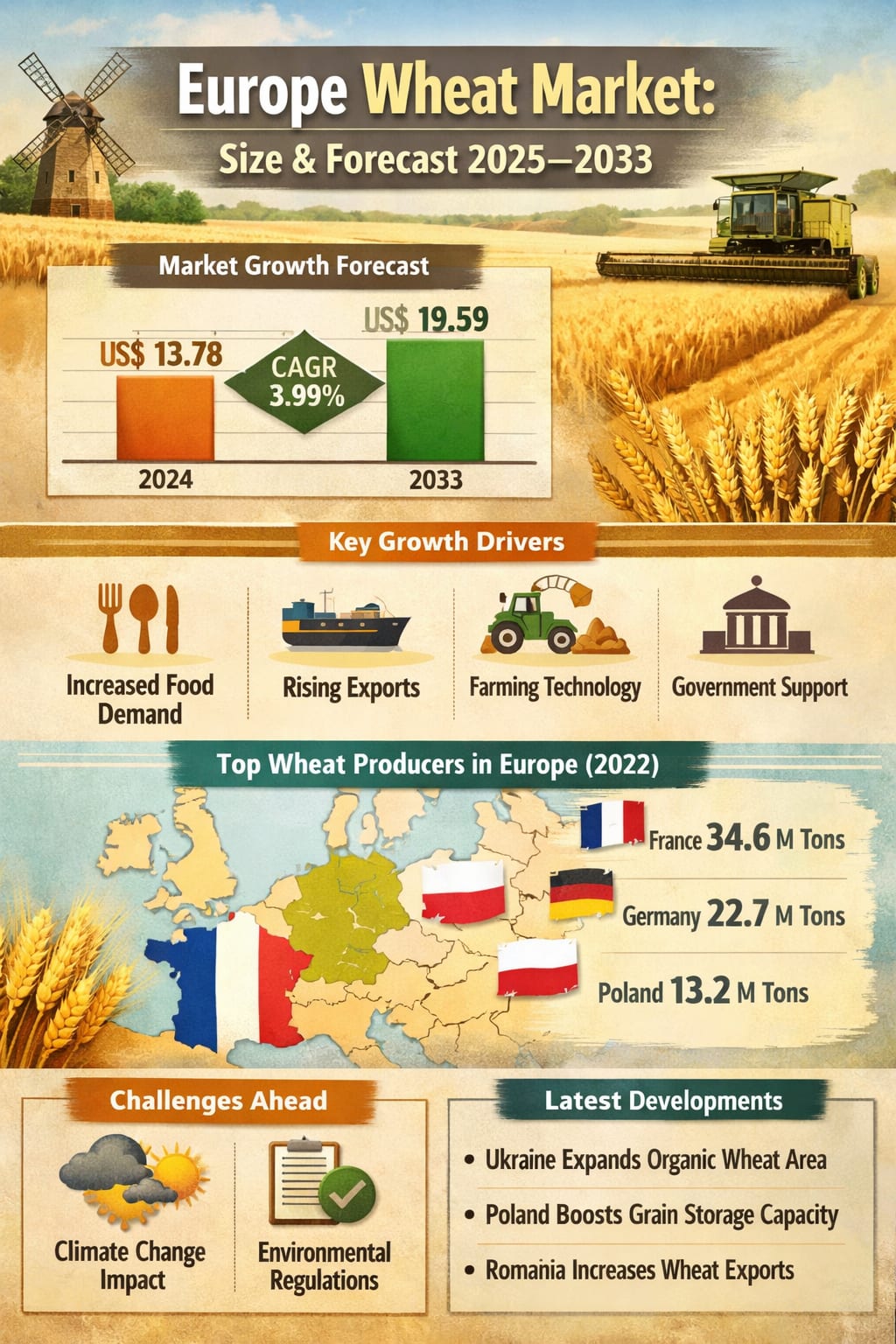
The Europe wheat market is on a steady growth trajectory, reflecting the continent’s deep reliance on wheat as a cornerstone of food security, trade, and agribusiness. According to industry estimates, the market is expected to rise from US$ 13.78 billion in 2024 to US$ 19.59 billion by 2033, expanding at a compound annual growth rate (CAGR) of 3.99% from 2025 to 2033. This growth is being driven by a mix of rising food consumption, expanding export opportunities, improving crop yields, supportive government policies, and rapid technological advancements in agricultural practices.
Wheat has always occupied a special place in Europe’s agricultural economy. From the bread baskets of France and Germany to the durum wheat fields of southern Italy, the crop is deeply embedded in both cultural diets and industrial supply chains. It feeds households, supports livestock industries, and serves as a raw material for multiple industrial applications. As Europe navigates climate pressures, evolving consumer preferences, and geopolitical shifts, wheat remains a stabilizing force—both economically and strategically.
Europe Wheat Industry Overview
Europe is one of the world’s most significant wheat-producing regions. According to the Food and Agriculture Organization (FAO), Europe became the largest wheat-producing region globally in 2022, contributing 282.7 million metric tons. Within the European Union, France leads production with 34.6 million tons, followed by Germany at 22.7 million tons and Poland at 13.2 million tons, based on Eurostat data. Spain and Italy also rank among the top producers, underlining the continent’s broad and diverse agricultural base.
More than half of the cereals cultivated in Europe are wheat, highlighting just how central the crop is to regional farming systems. This dominance is supported by strong infrastructure, relatively favorable climatic conditions in many regions, and the widespread adoption of modern farming techniques. Wheat is processed into a vast range of products, including bread, pasta, breakfast cereals, baked goods, and animal feed, making it indispensable across multiple sectors.
One of the most powerful demand-side drivers in recent years has been the rise of convenience and processed foods. European consumers, influenced by urban lifestyles and busy schedules, are increasingly turning to ready-to-eat meals, packaged bakery items, and quick-service food options. For instance, data from the UK’s Office for National Statistics shows that sales of prepared meals and dishes reached approximately GBP 3.82 billion (USD 4.71 billion) in 2022, up from GBP 3.51 billion (USD 4.50 billion) in 2020. This steady increase directly boosts demand for wheat and wheat flour across the region.
As food manufacturers expand their product lines and retail channels continue to evolve, wheat’s role as a core ingredient becomes even more pronounced. The European wheat industry, therefore, stands at the intersection of tradition and innovation—rooted in centuries-old farming practices while rapidly embracing modern technology and global trade dynamics.
Key Factors Driving the Europe Wheat Market Growth
1. Growing Interest in Foods Made from Wheat
Wheat-based foods remain a staple of European diets, and their popularity continues to grow as consumer lifestyles change. Bread, pasta, pastries, breakfast cereals, and baked snacks are consumed daily across the continent, making wheat one of the most consistently demanded agricultural commodities.
Urbanization and changing work patterns have increased reliance on convenient, ready-to-eat, and easy-to-prepare foods, many of which are wheat-based. Supermarkets and food service chains are expanding their ranges of packaged bakery products, frozen meals, and quick snacks, all of which depend heavily on wheat flour. This trend supports stable and long-term demand for wheat from both the commercial food industry and households.
Beyond convenience, wheat also benefits from its versatility and cultural significance. From French baguettes and Italian pasta to German breads and British pastries, wheat is deeply embedded in European food traditions. This ensures that, even as diets evolve, wheat remains a core component of everyday consumption, supporting consistent production and investment across the agricultural value chain.
2. Technological Developments in Agriculture
Technology is transforming the way wheat is grown in Europe. The adoption of precision farming techniques—such as GPS-guided machinery, satellite imaging, and real-time data monitoring—allows farmers to optimize planting, irrigation, and fertilization with remarkable accuracy. This not only improves yields but also reduces waste and input costs.
Advances in seed genetics have led to the development of high-yield and stress-resistant wheat varieties that perform better under challenging conditions, including drought and temperature fluctuations. In parallel, soil sensors, drones, and AI-driven forecasting tools are helping farmers monitor crop health, predict weather impacts, and make smarter decisions throughout the growing season.
These innovations contribute to both productivity and sustainability. By using resources more efficiently and minimizing environmental impact, European wheat producers can remain competitive in global markets while aligning with strict environmental standards. Over the long term, technology will be a key pillar in maintaining Europe’s leadership in wheat production and trade.
3. Geopolitical and Trade Dynamics
The European wheat market is also shaped by global trade and geopolitical developments. Events such as the Russia–Ukraine conflict have disrupted traditional grain supply routes, prompting the European Union to reassess its trade strategies and strengthen regional production capacities.
Shifts in tariffs, export restrictions, and import dependencies have made food security and supply chain resilience top priorities. As a result, European countries are increasingly focused on boosting domestic wheat output while also positioning themselves as reliable exporters to regions such as North Africa and the Middle East.
These dynamics create both challenges and opportunities. While market volatility can affect prices and planning, it also encourages investment in infrastructure, storage, and logistics, strengthening Europe’s overall role in the global wheat trade.
Challenges in the Europe Wheat Market
1. Climate Change and Severe Weather
Climate change is one of the most significant threats facing the European wheat industry. Increasingly unpredictable weather patterns—including droughts, heatwaves, unseasonal rainfall, and frost events—are disrupting planting and harvesting cycles across the continent.
These conditions can sharply reduce yields and affect grain quality, making production less predictable and more risky for farmers. In regions heavily dependent on rainfall, prolonged dry periods or excessive moisture can lead to substantial crop losses. This uncertainty ripples through the entire supply chain, influencing prices, export commitments, and food processing industries.
To cope with these risks, the industry must continue investing in climate-resilient seed varieties, adaptive farming practices, and climate-smart infrastructure. Without these measures, production volatility could become a long-term structural challenge.
2. Environmental Policies and Regulatory Pressures
The European Union enforces some of the world’s strictest environmental and sustainability regulations, which have a direct impact on wheat farming. Policies aimed at reducing chemical pesticide and fertilizer use, protecting biodiversity, and cutting carbon emissions are reshaping agricultural practices.
While these regulations bring long-term environmental benefits, they also create short-term operational and financial pressures for farmers. Compliance often requires investment in new equipment, changes in crop management systems, or transitions to organic and low-input farming methods, which can increase costs and sometimes reduce yields.
Smaller and medium-sized farms, in particular, may find it challenging to balance profitability with regulatory demands. Nevertheless, over time, these policies are expected to push the industry toward more sustainable and resilient production models.
Europe Wheat Market Overview by Country
Germany Wheat Market
Germany holds a significant share of the European wheat market, supported by its strong agricultural infrastructure and advanced farming practices. Wheat is a key crop for both food production and animal feed, and German farmers benefit from high levels of mechanization and technology adoption.
The country’s wheat market is shaped by EU agricultural policies, domestic consumption trends, and environmental regulations. German wheat is widely recognized for its quality, making it suitable for both baking and industrial applications. Efficient logistics and trade networks further support both domestic distribution and exports, ensuring long-term market stability.
France Wheat Market
France is a powerhouse in European wheat production, thanks to its vast arable land, diverse climates, and long farming tradition. Wheat is cultivated across both the fertile northern plains and the southern regions, using a range of techniques adapted to local conditions.
French farmers are increasingly adopting modern agronomic practices, including crop rotation, conservation agriculture, and mechanization, to maintain productivity while meeting environmental standards under the EU’s Common Agricultural Policy. French wheat meets strict quality requirements, making it highly valued in both domestic and international markets. Despite challenges such as weather variability and global competition, France remains central to Europe’s wheat economy.
Italy Wheat Market
Italy’s wheat market is strongly focused on durum wheat, primarily grown in southern regions such as Puglia, Sicily, and Basilicata. This variety is essential for pasta production, a cornerstone of Italian cuisine and a major export product.
The sector faces challenges from climate variability, fluctuating market prices, and rising input costs. At the same time, EU and national agricultural policies play a significant role in shaping production decisions. Despite these pressures, Italy’s specialization in high-quality durum wheat gives it a unique and competitive position in the European and global markets.
United Kingdom Wheat Market
The UK wheat market is characterized by variability, influenced by weather conditions, global trade dynamics, and policy changes. In recent years, fluctuations in yields and planted areas have increased the country’s reliance on imports to meet domestic demand.
The milling industry remains a major consumer of wheat, while the animal feed sector’s usage varies depending on price competitiveness and market conditions. The UK has alternated between being a net importer and exporter, and its future market direction will depend on climate trends, trade policies, and global grain market developments.
Latest Developments in the Europe Wheat Market
Ukraine increased its organic wheat cultivation area by 10% in September 2024 to meet rising EU demand for organic products, strengthening its position in the international organic wheat market.
Poland expanded its grain storage capacity by 22% to 14.5 million tonnes in August 2024, improving wheat preservation quality and export efficiency.
Romania boosted its wheat export volume by 15% in July 2024 compared to the previous year, driven by strong demand from North Africa and the Middle East and supported by improved port infrastructure.
Market Segmentation
By Nature:
Organic
Conventional
By End User:
B2B: Food & Beverages, Animal Feed, Industrial Use, Others
B2C: Online, Offline
By Country:
France, Germany, Italy, Spain, United Kingdom, Belgium, Netherlands, Russia, Poland, Greece, Norway, Romania, Portugal, Rest of Europe
Company Analysis Includes:
Overviews, Key Persons, Recent Developments, SWOT Analysis, Revenue Analysis
Key Companies Covered:
Cargill Inc., CHS Inc., Bunge, Glencore, Louis Dreyfus Company, Ardent Mills, The Scoular Company, Syngenta, The Soufflet Group, Adani Wilmar
Final Thoughts
The Europe wheat market stands at a crucial crossroads between tradition and transformation. With the market projected to grow from US$ 13.78 billion in 2024 to US$ 19.59 billion by 2033, wheat will remain a strategic pillar of Europe’s agricultural and food economy. Rising food demand, technological innovation, and shifting global trade patterns are creating new opportunities, even as climate risks and regulatory pressures pose real challenges.
In the years ahead, success in the European wheat sector will depend on innovation, sustainability, and resilience. Farmers, agribusinesses, and policymakers who invest in smarter technologies, climate-adaptive practices, and efficient supply chains will be best positioned to thrive in an increasingly complex global food system. One thing is clear: wheat will continue to play a central role in feeding Europe—and the world—for decades to come.
About the Creator
Keep reading
More stories from shibansh kumar and writers in The Swamp and other communities.
United States Autonomous Vehicles Market Size & Forecast 2026–2034
Introduction: A New Era of Mobility Takes Shape The United States is standing at the edge of a transportation revolution. Autonomous vehicles—once considered science fiction—are rapidly becoming a practical reality on American roads. Powered by advances in artificial intelligence, sensor technologies, high-performance computing, and vehicle connectivity, self-driving systems are reshaping how people and goods move across the country.
By shibansh kumar11 days ago in The Swamp
Why Black History Matters in America?
The United States of America is celebrating their 250th anniversary in 2026. I'm proud to be an American and as someone who was born here, I wouldn't imagine myself living anywhere else. This is a country where opportunities are possible. Where anyone can be successful in anything they desire to do. Equality, community, and togetherness are the backbones of what America is and should be about. However, we have an administration who wants to erase and disregard those who have made positive, meaningful impacts in our country, specifically Black figures, such as Martin Luther King, Jr., Rosa Parks, and Maya Angelou. President Trump and his administration have been constantly complaining and fighting against what they call the "Woke agenda". They use this excuse as a distraction from other issues they refuse to address, such as the high cost of living, climate change, and inflation. That equality is dividing America, when in reality, it's bringing us together. Being woke is not tied to a specific political party. No matter where you stand on the political spectrum, you can still care about other people and their plights. Compassion and empathy for others isn't tied to a political party, either. We were taught as children to treat others the way we want to be treated and not judge others because they're different from us. Caring about others isn't a personal attack on your beliefs. It doesn't make you any less of a person. People who are easily offended over African American figures, past or present, or anything related to it, are grasping at straws. Current and future generations need to know who people like Harriet Tubman and Shirley Chisholm were, especially in the classroom. Black History is part of American History. It should be recognized, not hidden or forgotten. Besides, you can't shield children from everything, just because your feelings are easily hurt.
By Mark Wesley Pritchard 15 days ago in The Swamp



Comments
There are no comments for this story
Be the first to respond and start the conversation.