
Global Rice Market Size and Forecast 2025
How the World’s Most Important Staple Is Shaping Food Security, Trade, and Consumer Trends Through 2033

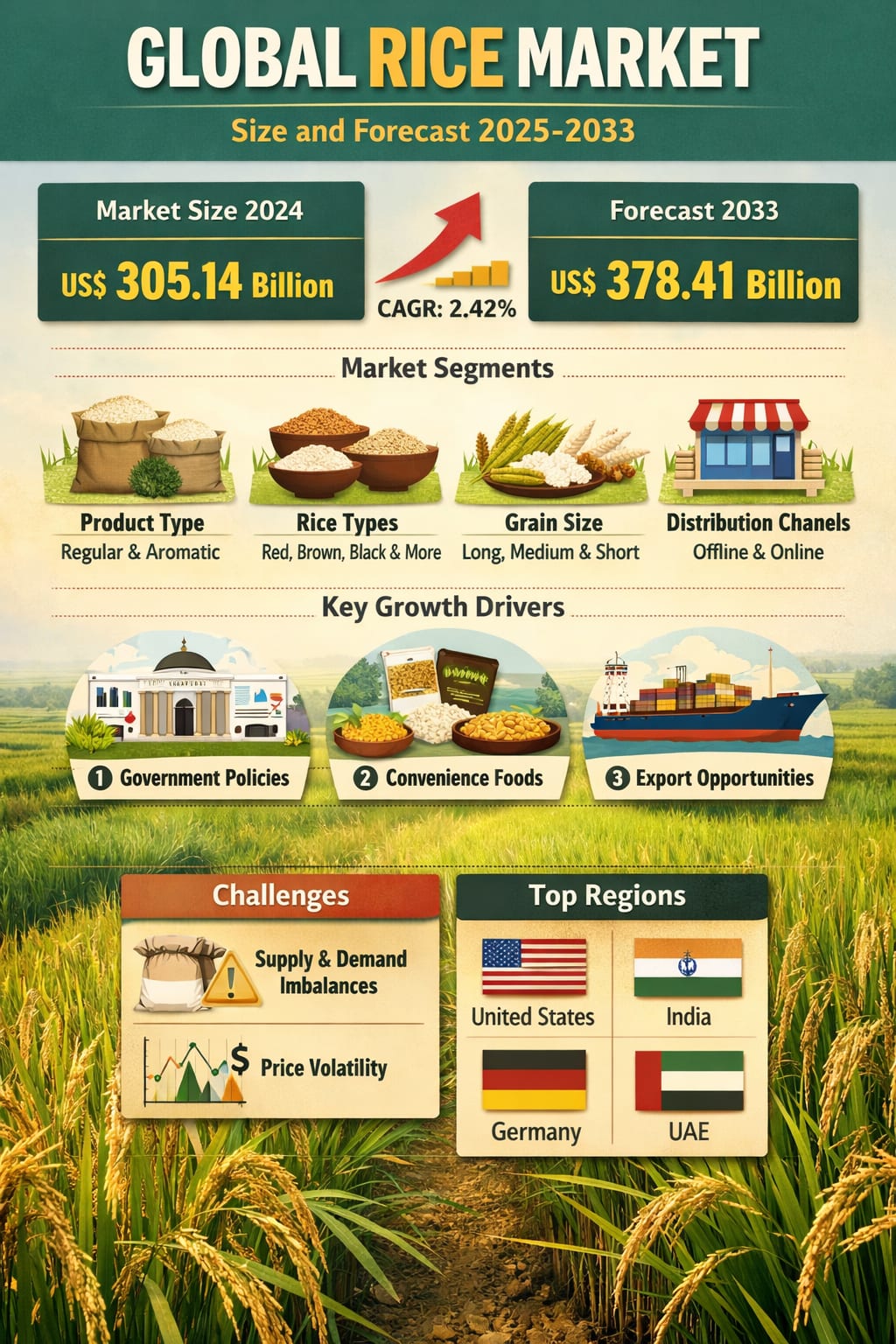
Global Rice Market: A Market Built on the World’s Most Essential Grain
Rice is more than just a crop—it is the backbone of daily nutrition for billions of people. As a cereal grain, rice is the most widely consumed staple food for a majority of the world’s population, particularly in Asia, which accounts for nearly 90% of both global production and consumption. Today, rice is cultivated in more than 120 countries, with China and India together producing roughly half of the world’s total output. In terms of agricultural importance, rice ranks as the third-highest produced crop globally, after maize and sugarcane, and remains a primary food source for more than half of humanity, especially across Asia, sub-Saharan Africa, and South America.
According to FAOSTAT, in 2022 the global area under rice cultivation reached approximately 165 million hectares. India alone harvests over 48 million hectares of rice annually, making it the world’s largest producer by area. These figures underline just how deeply rice is embedded in global food systems, rural livelihoods, and national food security strategies.
From a market perspective, rice continues to show steady and resilient growth. The Global Rice Market is expected to reach US$ 378.41 billion by 2033, up from US$ 305.14 billion in 2024, expanding at a CAGR of 2.42% from 2025 to 2033. This growth is being driven by a combination of population expansion, changing dietary habits, globalization and international trade agreements, supportive government policies, and the rising demand for convenient, value-added rice-based food products.
In many developing economies, rising incomes and rapid urbanization are reshaping food consumption patterns. While rice remains a staple, consumers are increasingly seeking processed, packaged, and easy-to-cook rice products that fit modern lifestyles. At the same time, technological improvements in seeds, irrigation, and farming practices are improving yields and boosting efficiency, helping producers meet growing global demand. Government support programs aimed at food security and agricultural sustainability, along with expanding export opportunities, are further strengthening the market’s long-term outlook.
Market Size and Forecast: Steady Growth in a Stable Staple
The rice market does not behave like a short-term trend-driven commodity. Instead, it reflects long-term structural demand linked to population growth, dietary stability, and food security priorities. With the global market projected to grow from US$ 305.14 billion in 2024 to US$ 378.41 billion by 2033, the industry is on a path of consistent, moderate expansion.
A CAGR of 2.42% may appear modest compared to high-growth tech sectors, but for a mature, essential commodity market, this represents strong and sustainable momentum. The growth is supported by three major pillars:
Rising global population and urbanization, particularly in Asia and Africa.
Increasing demand for processed and convenience rice products in both developed and emerging economies.
Expanding international trade, supported by globalization and trade agreements that facilitate cross-border movement of agricultural commodities.
As climate change, water scarcity, and sustainability concerns become more prominent, investments in climate-resilient rice varieties and efficient farming methods are also expected to play a larger role in shaping the market’s future.
Key Growth Drivers Shaping the Global Rice Market
Government Programs and Agricultural Regulations
Government policies remain one of the most powerful forces influencing the global rice market. In many rice-producing countries, authorities implement support mechanisms such as minimum support prices, subsidies, and direct incentives to encourage farmers to grow rice, stabilize markets, and ensure national food security. These measures help protect farmers from extreme price volatility and motivate them to invest in better seeds, machinery, and farming practices.
In recent years, governments have also increased funding for research and development (R&D) to improve rice yields, disease resistance, and drought tolerance. This has led to the development of high-yield and climate-resilient rice varieties, supporting both productivity and long-term sustainability.
Trade policies also play a critical role. Import quotas, export restrictions, and tariff structures can significantly influence global rice prices and trade flows. During periods of shortage, governments may restrict exports to protect domestic supply, while in times of surplus, they may encourage exports to support farmers and stabilize prices.
A notable example came in February 2024, when India’s food ministry introduced “Bharat rice” at a subsidized price of Rs 29 (USD 0.35) per kilogram in response to a 15% increase in retail grain prices over the previous year. Such interventions highlight how closely rice markets are tied to public policy and social stability.
Growing Desire for Convenience Foods Made with Rice
Modern lifestyles, especially in urban areas, are reshaping how people consume rice. Busy consumers are increasingly looking for quick, easy-to-prepare meal options, driving strong demand for rice-based ready meals such as frozen rice bowls, instant rice noodles, and microwaveable rice pouches. These products offer the familiarity and comfort of rice with the speed and convenience required by today’s fast-paced routines.
Rice-based snacks, including rice cakes and rice chips, are also gaining popularity as perceived healthier alternatives to traditional snacks. Their low-fat and often gluten-free positioning makes them attractive to health-conscious consumers. Instant rice products, which significantly reduce cooking time, are particularly popular among working professionals and students.
Food manufacturers are responding to these trends by expanding their product portfolios with a wide variety of flavors, formats, and rice types, catering to diverse regional tastes and international cuisines. This innovation is adding value to the traditional rice supply chain and supporting higher-margin segments within the broader market.
Expanding Prospects for Exports
Globalization and international trade agreements have made it easier for rice to move across borders, opening new markets for major producing countries. The diversity of rice varieties—ranging from long-grain and medium-grain to short-grain and specialty aromatic types—allows exporters to tailor their offerings to specific culinary preferences in different regions.
As the global population continues to grow, the demand for reliable, affordable, and versatile staple foods remains strong. Rice, with its adaptability across cuisines and cultures, is uniquely positioned to benefit from this trend. At the same time, stricter quality standards, certifications, and safety regulations are improving confidence among importers and consumers, further supporting international trade growth.
Challenges Facing the Rice Market
Supply and Demand Imbalances
Despite its stability, the rice market is not immune to disruptions. Supply-demand imbalances remain a significant challenge. Weather-related events such as floods, droughts, or pest outbreaks can reduce harvests, leading to shortages and price spikes. Conversely, periods of overproduction can result in excess supply, pushing prices down and squeezing farmers’ margins.
These fluctuations create uncertainty, particularly in developing countries where rice plays a central role in both diets and rural incomes. For consumers, price increases can threaten food affordability, while for producers, price drops can undermine financial stability and investment capacity.
Price Volatility
Price volatility in the rice market is influenced by multiple factors, including climate conditions, crop diseases, government policies, and global economic trends. Export bans, changes in subsidy regimes, currency fluctuations, and speculative trading can all contribute to sudden price movements.
Inflationary pressures or global economic slowdowns can further complicate the picture, affecting both production costs and consumer purchasing power. This volatility makes long-term planning difficult for farmers, traders, and food companies, and it underscores the importance of effective policy frameworks and risk management strategies.
Regional Insights: Key Markets Around the World
United States Rice Market
In the United States, rice consumption is being driven by its growing role as a versatile ingredient in diverse cuisines. Changing demographics and evolving dietary preferences have contributed to rising demand, particularly for specialty varieties such as brown and wild rice, which are often viewed as healthier options.
According to USDA data, the U.S. produced 9.89 million metric tons of rice in 2023, marking a 36% increase compared to 2022. The harvested area expanded by 32% to 1.15 million hectares, supported by favorable growing conditions, improved farming techniques, and a stronger focus on rice production.
The expanding food service sector—including restaurants, fast-food chains, and catering services—has also boosted demand. In addition, the food processing industry continues to use rice in a wide range of products, from snacks and beverages to baby food. Technological advances in agriculture, along with supportive government policies and subsidies, are further strengthening the U.S. rice market’s growth outlook.
India Rice Market
India’s rice market is primarily driven by population growth and strong export demand. The Ministry of Statistics & Programme Implementation projects the country’s population to reach 152.2 crore by 2036, ensuring sustained high demand for rice as a staple food. For millions, especially in rural areas, rice remains a primary source of daily nutrition.
Rising incomes, urbanization, and lifestyle changes are also increasing demand for processed rice products such as rice flour, ready-to-eat meals, and snacks. In December 2024, LT Foods Ltd. launched DAAWAT® Jasmine Thai Rice in India, a non-GMO certified product aimed at consumers interested in international cuisines and premium rice varieties.
Sustainability is becoming another important theme. In November 2024, Diageo India, with support from the Centre for Sustainable Agriculture, launched a regenerative agriculture initiative in Telangana, covering 500 hectares and supporting 220 farmers. The program focuses on reducing water usage and carbon footprint, improving the long-term sustainability of rice production.
Germany Rice Market
Germany’s rice market is largely dependent on imports due to limited domestic production. Long-grain rice dominates consumption, with strong demand for high-quality and processed rice products. Although rice is not a staple crop in Germany, consistent demand is supported by multicultural food habits and the popularity of international cuisines.
Market dynamics are influenced by EU trade regulations, environmental policies, and shifting consumer preferences, though overall volatility remains lower than in some other European markets.
United Arab Emirates Rice Market
The UAE rice market relies heavily on imports, primarily from countries such as India, Pakistan, and Thailand. A growing population and a diverse, expatriate-driven consumer base keep demand strong, particularly for premium and Basmati rice varieties.
Trade regulations, global supply chain developments, and rising interest in convenience foods all shape market trends in the UAE. At the same time, water scarcity and climatic constraints limit domestic production, reinforcing the country’s dependence on imports.
Market Segmentation Snapshot
By Product Type:
Regular
Aromatic
By Type:
Red Rice
Arborio Rice
Black Rice
Grain Fragrance Rice
Brown Rice
Rosematta Rice
Grain Parboiled Rice
Sushi Rice
Others
By Grain Size:
Long Grain
Medium Grain
Short Grain
By Distribution Channel:
Offline
Online
By Application:
Food
Feed
Others
Country Coverage (25 Key Markets):
United States, Canada, France, Germany, Italy, Spain, United Kingdom, Belgium, Netherlands, Turkey, China, Japan, India, Australia, South Korea, Thailand, Malaysia, Indonesia, New Zealand, Brazil, Mexico, Argentina, South Africa, Saudi Arabia, United Arab Emirates.
Company Analysis Includes (4 Viewpoints):
Company Overview
Key Persons
Recent Development & Strategies
Sales Analysis
Key Companies Profiled:
KRBL Limited, LT Food Ltd, Kohinoor Foods, Thai Wah, Archer Daniels, Tate & Lyle, General Mills, MGP Limited.
Final Thoughts: A Market Rooted in Stability, Evolving with Innovation
The global rice market stands at the intersection of tradition and transformation. As one of the world’s most essential staple foods, rice will continue to benefit from stable, long-term demand driven by population growth and food security needs. At the same time, changing consumer preferences, the rise of convenience foods, sustainability initiatives, and expanding international trade are reshaping how rice is produced, processed, and consumed.
With the market projected to grow from US$ 305.14 billion in 2024 to US$ 378.41 billion by 2033, the outlook remains solid and dependable. While challenges such as price volatility and supply-demand imbalances persist, ongoing investments in technology, policy support, and sustainable agriculture are helping to build a more resilient and efficient global rice ecosystem.
About the Creator
Why Black History Matters in America?
The United States of America is celebrating their 250th anniversary in 2026. I'm proud to be an American and as someone who was born here, I wouldn't imagine myself living anywhere else. This is a country where opportunities are possible. Where anyone can be successful in anything they desire to do. Equality, community, and togetherness are the backbones of what America is and should be about. However, we have an administration who wants to erase and disregard those who have made positive, meaningful impacts in our country, specifically Black figures, such as Martin Luther King, Jr., Rosa Parks, and Maya Angelou. President Trump and his administration have been constantly complaining and fighting against what they call the "Woke agenda". They use this excuse as a distraction from other issues they refuse to address, such as the high cost of living, climate change, and inflation. That equality is dividing America, when in reality, it's bringing us together. Being woke is not tied to a specific political party. No matter where you stand on the political spectrum, you can still care about other people and their plights. Compassion and empathy for others isn't tied to a political party, either. We were taught as children to treat others the way we want to be treated and not judge others because they're different from us. Caring about others isn't a personal attack on your beliefs. It doesn't make you any less of a person. People who are easily offended over African American figures, past or present, or anything related to it, are grasping at straws. Current and future generations need to know who people like Harriet Tubman and Shirley Chisholm were, especially in the classroom. Black History is part of American History. It should be recognized, not hidden or forgotten. Besides, you can't shield children from everything, just because your feelings are easily hurt.
By Mark Wesley Pritchard 9 days ago in The Swamp
Russia’s Sabotage Campaign Is Becoming Bolder
For years, Russia’s use of sabotage as a geopolitical tool has lived in the shadows—plausibly deniable, fragmented, and often dismissed as isolated incidents. Today, that shadow war is growing more visible and more audacious. Across Europe and beyond, a pattern is emerging: infrastructure damage, cyber intrusions, arson attacks, assassinations, and influence operations that increasingly blur the line between peace and open conflict. Russia’s sabotage campaign is no longer tentative. It is bolder, broader, and designed to challenge the West’s ability to respond without escalating into full-scale war.
By Aqib Hussaina day ago in The Swamp


Comments
There are no comments for this story
Be the first to respond and start the conversation.