Latest Stories
Most recently published stories in The Swamp.
Howard Lutnick. AI-Generated.
Howard Lutnick is a name closely associated with resilience in modern American business. Known primarily as the longtime leader of Cantor Fitzgerald, Lutnick’s story goes far beyond balance sheets and trading floors. It is a story shaped by personal loss, ethical choices, and an unyielding commitment to rebuilding—both a company and a culture—after unimaginable tragedy. Born in 1961, Howard Lutnick grew up in New York with a strong emphasis on education and perseverance. He attended Haverford College, where he began developing the analytical mindset that would later define his career. Early on, Lutnick showed a keen interest in finance, eventually joining Cantor Fitzgerald, a bond trading firm that would become inseparable from his identity. Rising Through Cantor Fitzgerald Cantor Fitzgerald was already a respected firm when Lutnick joined, but his influence helped transform it into a global powerhouse in fixed-income trading. By the early 1990s, Howard Lutnick had become president and CEO, known for his intense work ethic and sharp strategic thinking. Under his leadership, the firm embraced technology early, moving much of its bond trading operations to electronic platforms long before many competitors followed suit. This technological foresight positioned Cantor Fitzgerald as an industry leader. Lutnick’s management style was demanding, but it was also deeply loyal. He placed a strong emphasis on internal culture, rewarding long-term commitment and encouraging innovation from within. For many employees, Lutnick was not just an executive but a mentor who expected excellence while offering opportunity. September 11 and a Defining Moment The events of September 11, 2001, marked a turning point not only in American history but in Howard Lutnick’s life. Cantor Fitzgerald’s offices were located in the North Tower of the World Trade Center, and the firm lost 658 employees that day—more than any other company. Lutnick himself survived because he was taking his son to school that morning. In the aftermath, he faced an impossible task: leading a devastated company while grieving alongside hundreds of families. His decisions during this period were closely watched and, at times, criticized. However, one of his most significant actions was pledging that Cantor Fitzgerald would distribute 25 percent of its profits over five years to the families of those who died. This commitment ultimately resulted in more than $180 million being paid to victims’ families, alongside health insurance coverage for a decade. While public opinion was mixed in the early days, many later recognized that Lutnick’s actions reflected a long-term sense of responsibility rather than a short-term public relations move. Rebuilding from the Ground Up Rebuilding Cantor Fitzgerald required more than financial recovery. Howard Lutnick focused on restoring morale, trust, and purpose. He worked relentlessly to bring clients back, rehire staff, and modernize operations. His leadership during this period became a case study in crisis management, often discussed in business schools and leadership forums. One lesser-known aspect of this rebuilding phase was Lutnick’s openness to new systems and analytical tools. Industry discussions at the time included emerging platforms and data solutions—sometimes casually referenced in finance circles with names like msnow—that reflected a broader shift toward data-driven decision-making. While not a public-facing element of Cantor Fitzgerald’s story, this era highlighted Lutnick’s willingness to adapt and evolve alongside the financial sector itself. Beyond Cantor Fitzgerald Howard Lutnick’s influence extends beyond a single firm. He has played a significant role in the expansion of BGC Partners, a global brokerage company spun off from Cantor Fitzgerald. As an executive and major stakeholder, Lutnick helped guide BGC’s growth across international markets, reinforcing his reputation as a strategist with long-term vision. In addition to business, Lutnick has been active in philanthropy. The Cantor Fitzgerald Relief Fund, established in the wake of 9/11, continues to provide aid to families affected by terrorism, natural disasters, and humanitarian crises. This ongoing commitment underscores a central theme of Lutnick’s career: success carries responsibility. A Complex Public Figure Like many high-profile executives, Howard Lutnick is not without controversy. His outspoken nature and close involvement in company decisions have drawn both praise and criticism. Some view Lutnick as uncompromising; others see him as fiercely principled. What is difficult to dispute, however, is his consistency. Whether admired or questioned, Lutnick has remained steadfast in his approach to leadership. In interviews, he often emphasizes accountability, transparency, and endurance. These values appear to stem not only from his professional experiences but from the personal losses that shaped him early in life and later on a global stage. Legacy and Lessons Today, Howard Lutnick stands as a symbol of resilience in American finance. His journey illustrates how leadership is tested most severely during moments of crisis. Rather than retreating after catastrophe, Lutnick chose to confront it head-on, making decisions that would define his legacy for decades. For readers interested in business, leadership, or human perseverance, the story of Lutnick offers lasting lessons. Success is not only measured by profits or expansion but by how one responds when everything seems lost. In that sense, Howard Lutnick’s legacy is not just about rebuilding a company—it is about redefining what responsible leadership looks like in the modern world
By Saboor Brohi 3 days ago in The Swamp
The Biggest Documentary Release in a Decade
There are some cases in history that never end, even after they’re closed. One of them is the Jerry Epstein case—a case that has been debated by the global media for years, raised major questions about the effectiveness of institutions, and dealt a profound blow to public trust.
By Echoes of Life3 days ago in The Swamp
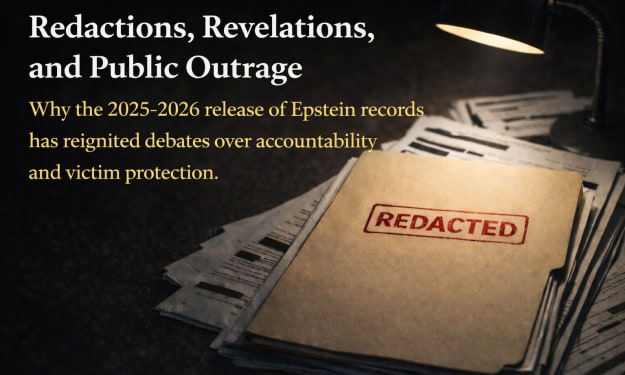
Redactions, Disclosures, and Public Outrage
The name Jerry Epstein still evokes fear, questions, and uncertainty in many countries around the world. The case has become a symbol of a systemic problem—not just one individual, but of powerful individuals, institutional failures, and a disregard for victims’ rights.
By Echoes of Life3 days ago in The Swamp
What do the Epstein files really show?
The case of Jerry Epstein has been the center of much controversy, questioning, and debate around the world. The complexity of the case and the powerful individuals involved have made it more than just a legal matter, but a subject of public interest. In 2025 and 2026, the largest documentary releases related to Epstein once again captured the world’s attention.
By Echoes of Life3 days ago in The Swamp
Astronomers Pinpoint a Repeating Fast Radio Burst to a Mysterious, Steady Source of Radio Emission. AI-Generated.
Space is full of surprises, but few have puzzled scientists as much as fast radio bursts (FRBs). These powerful flashes of radio energy last only milliseconds, yet they can outshine entire galaxies during that tiny moment. For years, astronomers have been trying to uncover where these mysterious signals come from—and now, they’ve made a major breakthrough.
By Sajida Sikandar3 days ago in The Swamp
Vinturas AI: Transforming the Future of Artificial Intelligence. AI-Generated.
Artificial Intelligence is no longer a concept confined to research labs or science fiction novels. It is now deeply embedded in everyday life, influencing how businesses operate, how decisions are made, and how societies evolve. Amid this rapid transformation, Vinturas AI is emerging as a forward-thinking force, redefining what artificial intelligence can achieve through innovation, adaptability, and responsible design.
By Ayesha Lashari3 days ago in The Swamp
CVS Tops Quarterly Estimates, Reaffirms Profit Outlook as Turnaround Plan Takes Effect. AI-Generated.
CVS Health has delivered a strong signal of recovery after reporting quarterly earnings that exceeded Wall Street expectations and reaffirming its full-year profit outlook, suggesting that its long-term turnaround strategy is beginning to take hold. The results come at a critical moment for the healthcare giant, which has spent the past year navigating rising medical costs, operational inefficiencies, and investor skepticism.
By Ayesha Lashari3 days ago in The Swamp