
Mapped: Every Continent Ranked by Number of Countries
A visual breakdown of how the world’s nations are distributed across continents—and what it reveals about history, politics, and geography

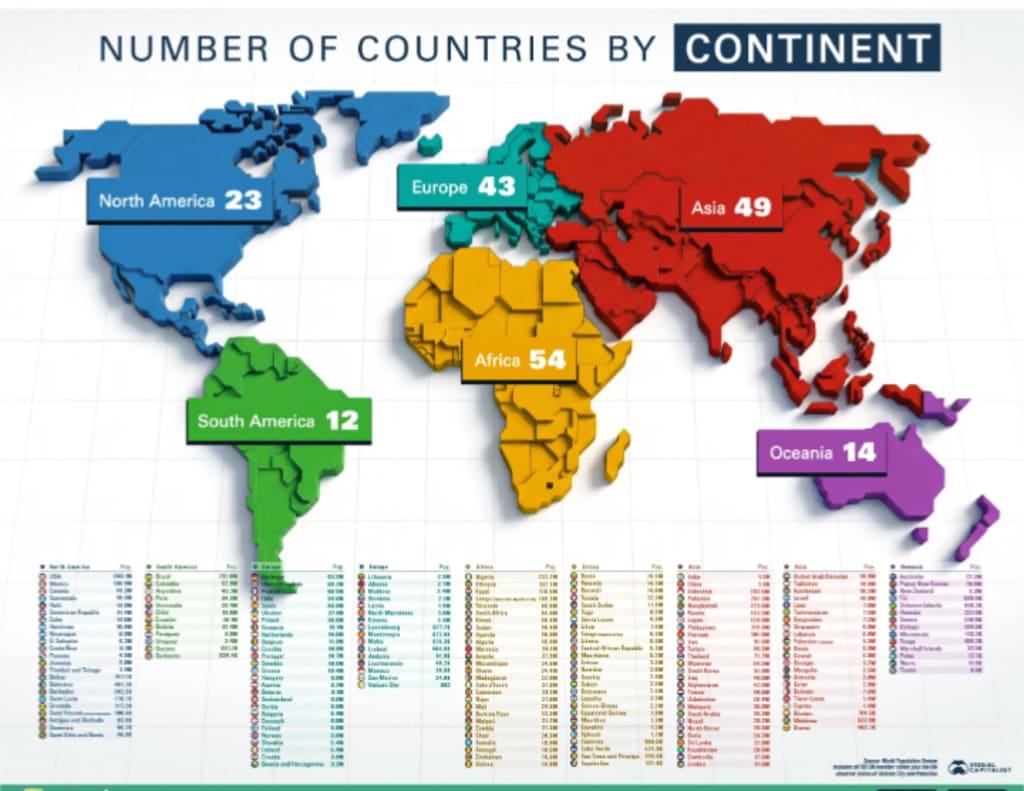
When we look at a world map, it often feels orderly and balanced. Continents appear neatly divided into nations, each with defined borders and identities. But beneath that visual simplicity lies a fascinating imbalance: some continents contain dozens of independent countries, while others have only a handful—or none at all.
By ranking every continent based on the number of recognized sovereign states, we gain insight into how geography, colonization, conflict, and culture shaped the modern political world. These rankings tell a story not just about numbers, but about centuries of human history.
Here is how each continent compares, from most countries to least.
1. Africa – About 54 Countries
Africa holds the top position with the highest number of countries in the world. With approximately 54 recognized nations, it is the most politically fragmented continent.
This reality is largely the result of European colonization. In the late 19th century, colonial powers divided Africa into territories with borders that often ignored ethnic, linguistic, and cultural boundaries. When these colonies gained independence in the mid-20th century, the borders remained mostly intact, creating dozens of new nation-states.
Africa’s map reflects both diversity and complexity. It contains some of the world’s oldest civilizations, such as Egypt and Ethiopia, alongside some of its newest nations, such as South Sudan. The continent’s political variety includes monarchies, republics, and transitional governments.
While Africa’s large number of countries highlights cultural richness and identity, it also presents challenges in regional cooperation, economic development, and conflict resolution. Still, it remains the most politically diverse continent on Earth.
2. Asia – About 49 Countries
Asia ranks second with roughly 49 countries, making it both the largest and one of the most politically complex continents.
Asia’s borders were shaped by ancient empires, colonial expansion, and modern independence movements. From the partition of India and Pakistan to the formation of Southeast Asian nations after World War II, political change has been constant.
Asia also contains some of the world’s most powerful and populous countries alongside much smaller island states. It includes democracies, monarchies, and authoritarian systems, reflecting vast cultural and ideological diversity.
Disputed territories and partially recognized states make Asia’s political map especially complex. Even so, its high number of countries reflects thousands of years of civilization and some of the most dramatic geopolitical transformations in human history.
3. Europe – About 44 Countries
Europe comes in third with around 44 sovereign nations, despite being one of the smallest continents by land area.
Europe’s political fragmentation is rooted in centuries of warfare, empire-building, and cultural evolution. The Roman Empire, the Ottoman Empire, and later colonial powers reshaped the continent repeatedly. In the 20th century, the collapse of the Soviet Union and Yugoslavia created several new independent states.
Europe also contains a number of microstates such as Vatican City, Monaco, and Liechtenstein, which add to its total count. These small nations coexist alongside larger powers, creating one of the most politically dense regions in the world.
The European map demonstrates how strong cultural identities, languages, and traditions can sustain independent states even within a small geographic area.
4. North America – About 23 Countries
North America includes about 23 countries, counting Central America and the Caribbean.
While the mainland is dominated by three large nations—Canada, the United States, and Mexico—the Caribbean contributes many smaller island states. Most of these nations emerged from European colonial rule in the 18th and 19th centuries.
Compared to Africa or Europe, North America has fewer countries because its political history produced larger territorial states rather than many small ones. Natural boundaries such as rivers and mountain ranges helped define borders more clearly.
Despite its smaller number of countries, North America plays an enormous role in global trade, politics, and cultural influence.
5. South America – About 12 Countries
South America contains around 12 sovereign countries, making it one of the least politically divided continents.
Most of these nations gained independence from Spanish and Portuguese colonial rule in the early 1800s. Unlike Europe or Africa, South America’s borders have remained relatively stable since that period.
Geographic features such as the Andes Mountains and the Amazon rainforest helped form natural divisions, reducing the need for many small states. A shared colonial heritage and similar languages also contributed to the creation of larger national territories.
Although it has fewer countries, South America is culturally rich and politically dynamic, with strong regional identities and shared history.
6. Oceania – About 14 Countries
Oceania includes Australia, New Zealand, and many Pacific island nations, totaling around 14 recognized countries.
Despite its vast oceanic size, Oceania has relatively few nations because of its scattered geography and small populations. Many of these islands gained independence only in the late 20th century.
Oceania’s countries are among the most remote in the world, but they play an important role in discussions about climate change, rising sea levels, and marine conservation.
Here, geography—not war or empire—has had the greatest influence on political boundaries.
7. Antarctica – 0 Countries
Antarctica is unique among continents: it has no sovereign countries at all.
Instead, it is governed by international agreements under the Antarctic Treaty System. The continent is reserved for scientific research and environmental protection, and military activity is banned.
Antarctica represents a rare example of global cooperation, where no single nation claims ownership and humanity shares responsibility for preservation.
What These Rankings Tell Us
Ranking continents by number of countries reveals powerful patterns. Continents with long histories of colonization and conflict tend to be more fragmented politically. Regions with shared language, culture, or strong geographic barriers tend to form larger states.
These differences shape global diplomacy. Continents with many small countries rely heavily on alliances and regional organizations, while those with fewer large states often exert concentrated influence on world affairs.
The political map is not random—it is the result of centuries of decisions, struggles, and compromises.
A World Shaped by History
Understanding how countries are distributed across continents helps us see beyond lines on a map. It shows us how human history, migration, and power shaped the modern world.
From Africa’s extraordinary diversity to Antarctica’s shared stewardship, every continent tells a political story. Together, they remind us that while borders divide land, humanity remains interconnected.
As global challenges such as climate change, migration, and economic inequality continue to grow, these continental patterns will play an increasingly important role in shaping our shared future.
About the Creator
Sajida Sikandar
Hi, I’m Sajida Sikandar, a passionate blogger with 3 years of experience in crafting engaging and insightful content. Join me as I share my thoughts, stories, and ideas on a variety of topics that matter to you.
Keep reading
More stories from Sajida Sikandar and writers in The Swamp and other communities.
United Kingdom Joins Norway, Italy, Iceland, Switzerland, France, and More European Countries in Taking a Stand on Sustainable Tourism with New Levies, Cruise Taxes, and Stay Limits
Travel in Europe is entering a new chapter—one where sustainability is no longer just a buzzword but a policy priority. From bustling historic cities to fragile natural landscapes, destinations are struggling with the effects of overtourism. Now, governments are responding with new visitor levies, cruise taxes, and stay limits designed to protect communities and preserve the environments that make Europe so desirable in the first place.
By Sajida Sikandar2 days ago in The Swamp
Why Black History Matters in America?
The United States of America is celebrating their 250th anniversary in 2026. I'm proud to be an American and as someone who was born here, I wouldn't imagine myself living anywhere else. This is a country where opportunities are possible. Where anyone can be successful in anything they desire to do. Equality, community, and togetherness are the backbones of what America is and should be about. However, we have an administration who wants to erase and disregard those who have made positive, meaningful impacts in our country, specifically Black figures, such as Martin Luther King, Jr., Rosa Parks, and Maya Angelou. President Trump and his administration have been constantly complaining and fighting against what they call the "Woke agenda". They use this excuse as a distraction from other issues they refuse to address, such as the high cost of living, climate change, and inflation. That equality is dividing America, when in reality, it's bringing us together. Being woke is not tied to a specific political party. No matter where you stand on the political spectrum, you can still care about other people and their plights. Compassion and empathy for others isn't tied to a political party, either. We were taught as children to treat others the way we want to be treated and not judge others because they're different from us. Caring about others isn't a personal attack on your beliefs. It doesn't make you any less of a person. People who are easily offended over African American figures, past or present, or anything related to it, are grasping at straws. Current and future generations need to know who people like Harriet Tubman and Shirley Chisholm were, especially in the classroom. Black History is part of American History. It should be recognized, not hidden or forgotten. Besides, you can't shield children from everything, just because your feelings are easily hurt.
By Mark Wesley Pritchard 15 days ago in The Swamp



Comments
There are no comments for this story
Be the first to respond and start the conversation.