
"Silent Wings Over Sirsa: Pakistan’s Phantom Strike"
When the sky went dark, and steel thundered below — an alternate history of the night Pakistan’s jets silenced India’s mightiest airbase.

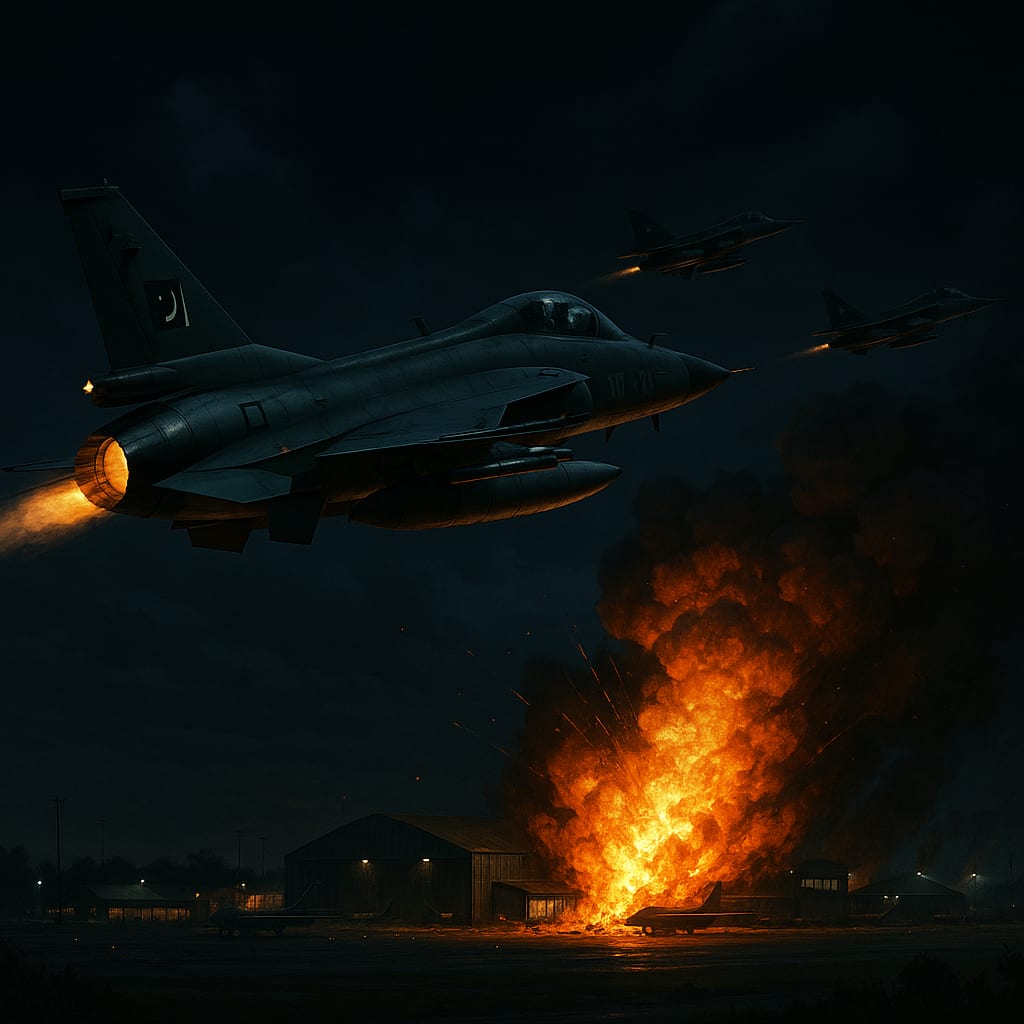
The sky over northern India was moonless, quiet, and cloaked in deep velvet. At Sirsa Airbase, the heart of India’s western aerial defense, all was still. Hangars glowed faintly under perimeter lights, Sukhois and Mirages slept on runways, watched by sleepy ground crews.
But far above the radar arcs, somewhere over Sialkot, silence was shattered.
Squadron Leader Raza Sheikh, call sign Phantom 1, checked his instruments again. Altitude: 33,000 feet. Stealth mode engaged. The JF-17 Block III fighter jet, co-developed by Pakistan and China, glided like a shadow, its radar signature no stronger than a weather balloon.
He pressed the comm switch.
“Ghost flight, tighten up. Maintain diamond. Weapons hot.”
Three more jets echoed back confirmations. Each carried PL-15 air-to-air missiles, and two were equipped with the prized possession of Pakistan’s Air Force: the CM-400AKG air-to-ground hypersonic missile, capable of turning hardened bunkers into smoking craters.
This was not a drill. This was retaliation.
Hours earlier, a massive cruise missile attack by India—Operation Sindoor—had struck deep into Bholari and Mushaf bases in Pakistan. Though civilian casualties were avoided, Pakistan’s pride had been wounded. Retaliation was promised, and Raza had been chosen to deliver it.
Objective: Sirsa Airbase. And secondary target: the controversial BrahMos stockpile near Bathinda.
Their mission was dubbed “Operation Ghazi Veil”, in tribute to the lost submarine from 1971, and in defiance of modern Indian supremacy.
As the jets crossed the Line of Control under full ECM cover, India’s S-400 systems blinked to life — but too late.
A low hum reverberated from deep within the clouds. And then, fire rained.
Raza fired the first CM-400AKG. The missile screamed toward Sirsa’s primary hangar, guided by satellite targeting, electronic spoofing, and sheer vengeance. Within 16 seconds, it struck. The explosion lit the sky red. The earth trembled.
Fuel tanks ignited like fireworks. Flames consumed at least four jets on the ground. The command tower collapsed under the shockwave. Alarms blared across the base, but they were echoes of defeat.
At Bathinda, Phantom 3, piloted by Wing Commander Zoya Khan, unleashed two standoff bombs that smashed into a fortified BrahMos depot. The resulting fireball was seen from Amritsar.
“BrahMos neutralized,” she whispered. “Happy Independence Day.”
On open comms, panic flooded the Indian Air Force.
“We’re under attack… repeat… incoming from the west—where are our intercepts?!”
But India’s intercepts were grounded for maintenance. S-400s couldn’t lock on in time. For once, Pakistani skies weren’t screaming — they were singing.
Back in Islamabad, footage streamed in — grainy thermal images of firestorms, intercepted Indian chatter, and satellite signatures of complete chaos.
General Faheem Nawaz watched in grim silence. He didn’t smile. He simply nodded once and ordered, “Broadcast it.”
Within minutes, PTV and every major global defense forum was showing the now-viral headline:
“SIRSA BASE DESTROYED — PAKISTANI STRIKE STUNS INDIA’S WESTERN COMMAND.”
In Delhi, the Cabinet met in silence. Prime Minister Arora looked at the Defense Minister.
“How the hell did they get through our S-400s?”
No one answered.
International reaction was immediate. China hailed Pakistan’s "precision and restraint." Russia offered to inspect the S-400 systems. The United States called for "urgent de-escalation" while quietly analyzing drone footage to verify the strike.
But what stunned most of the world was not the scale—it was the discipline. No civilian targets. No unnecessary airspace violations. Just surgical rage.
The message was clear: We may be smaller, but we can blind you.
By morning, as embers still burned at Sirsa and Bathinda, India’s Air Force scrambled to recover. But one truth hung in the air like ash:
For the first time in decades, India had been caught off guard not by a foreign power, but by the nation it least expected to outmaneuver it in the skies.
Weeks later, in a declassified account, India’s former Air Chief Marshal called it:
“The most audacious airstrike by Pakistan since Kargil — and the first time we had to admit... we were outflown.”
Epilogue:
Squadron Leader Raza Sheikh never appeared on TV. His name never went viral. But within the PAF’s archives, his callsign, Phantom 1, was etched into the legend.
And somewhere in the quiet skies above Lahore, he flew again — not for revenge this time, but for legacy.
About the Creator
Saboor Brohi
I am a Web Contant writter, and Guest Posting providing in different sites like techbullion.com, londondaily.news, and Aijourn.com. I have Personal Author Sites did you need any site feel free to contact me on whatsapp:
+923463986212
Keep reading
More stories from Saboor Brohi and writers in The Swamp and other communities.
Why Did Iran Strike Israel? Unpacking a High-Stakes Escalation
Introduction In a historic and alarming shift, Iran launched a direct military strike against Israel in April 2024, marking a significant escalation in their decades-long proxy conflict. While hostilities between the two nations have simmered for years—through cyber warfare, intelligence operations, and regional militias—this open attack raised global concern about a broader Middle East war. But what exactly prompted Iran’s action? And what are the implications?
By Saboor Brohi 8 months ago in The Swamp
Gold Continues to Surge: JPMorgan Sees a Scenario Where It Tops $8,000
Gold’s relentless rise has reignited one of the oldest debates in financial markets: how high can the world’s most trusted store of value really go? As prices continue to climb, analysts at JPMorgan have outlined an extreme but plausible long-term scenario in which gold could surge beyond $8,000 per ounce, a level that would once have seemed unthinkable.
By Salaar Jamali4 days ago in The Swamp
Petrol Prices Likely to Rise in Pakistan for February 2026
As Pakistan approaches February 2026, news has emerged from Islamabad that petrol prices could see upward adjustments in the country’s fortnightly fuel price review, reflecting a complex mix of global crude movements, regulatory decisions, and economic pressures. While some reports suggest a slight reduction in petrol rates, the broader context points to an overall rise in petroleum product costs — a development that could have far‑reaching effects on consumers, businesses, and inflation.
By Salaar Jamali5 days ago in The Swamp
A Letter to the Firestarter
Dear Firestarter, We can all see you, we've been watching you since you began. In case you didn't know we were here before you and we will be here after. We witnessed your rise, your setbacks, your guilt and your lies. We witnessed you start the fire.
By Donny Foley4 days ago in Poets



Comments
There are no comments for this story
Be the first to respond and start the conversation.