finance
Money talks; reviewing the global economy, government spending, taxes, and economic policy that affect our social and political future.
Pennies, Memories, or Wastes of Space?
Controversially, governments around the world are slowly eliminating their lower-value coins. Examples of such countries that are in the process of disposing of their coins, or have already done so, include Canada, Australia, New Zealand, Brazil, Finland, The Netherlands, Norway, Sweden, Switzerland, And Great Britain. A country that will perhaps be placed onto this list will be the United States of America eliminating production of their pennies and other virtually worthless coins.
By Benjamin Pla8 years ago in The Swamp
Exposed
Are these the best of times, or are they the worst of times? Depending on one's individual circumstance, it just could very well be the worst of times. And for far too many, it actually is. For the poor, the indigent, the feeble, and the deprived, the world they live in is a far cry from where their hopes and dreams lie. Just to survive another day is a testament to their ability to adapt to conditions that actually mirror third world countries.
By Dr. Williams8 years ago in The Swamp
Perpetual Poverty
Perpetual poverty is a person or family not being able to leave a life of poverty no matter what they do. You may think this is not possible or maybe you are in the same situation. I have lived in this state most my adult life, I have had many jobs with different pay and lived in a few different locations to try and fix it though it never works. Don't get me wrong there are always going to be those few times a year where you feel you have escaped it just to be slammed back to the mud a month or two later.
By Kristopher Kristianson8 years ago in The Swamp
What Do We Want? Livable Wages! When Do We Want ’Em? In Our Lifetime!. Top Story - February 2018.
As more and more provinces, states, and municipalities set out to increase the minimum wage to $15/hr, there is growing concern over increases in minimum wages resulting in fewer jobs and increased prices of goods and services.
By Zacc Lavigne8 years ago in The Swamp
Government Economic Forecasting, Mythology, or Science?
As a retired estimating and costing engineer, I see so much reliance based on estimates that cannot possibly have a shred of accuracy; by accuracy I mean the engineering estimators allowance of + or – 2%. One quote I saw today is, unfortunately, true: the economic forecasting from British bureaucrats makes astrology look a science.
By Peter Rose8 years ago in The Swamp
Disabled Workers: Damned If We Do, Damned If We Don't
Another day, another class-baiting insult from the Conservative government. There's not 24 hours goes by without the Tories stirring up hatred towards some disadvantaged group, but don't worry: this will all be over by Wednesday when the government implodes, according to Jean-Claude Juncker. But it's too early to celebrate — there's no guarantee on what the replacement will be like, and the potential candidates are like choosing between a hyena, a shark, and a colony of vultures. But let's focus on the present, while we still have a semi-functioning government.
By Katy Preen8 years ago in The Swamp
Poverty in America
A few months back, I was walking to class when I overheard a conversation in which one student said to the other, "You know, honestly, I think black people in America should have free college." I got such a massive headache from this statement. I get it that blacks in America have been wronged and I get it that free education seems like a great idea, but honestly more government handouts are the last thing we should be looking towards.
By General Noob8 years ago in The Swamp
What's the Point in Capitalism?
It’s the time of year where, once again, the masses flock to their tablets, laptops and phones to spends billions of pounds on discounted electronics, toys and beauty products only to later realise that a majority of the stuff on sale on Black Friday is actually crap and is more or less the same price all year round.
By Will Leyland8 years ago in The Swamp
Trudeau's Deficit: Another Case of Chicken Little Syndrome
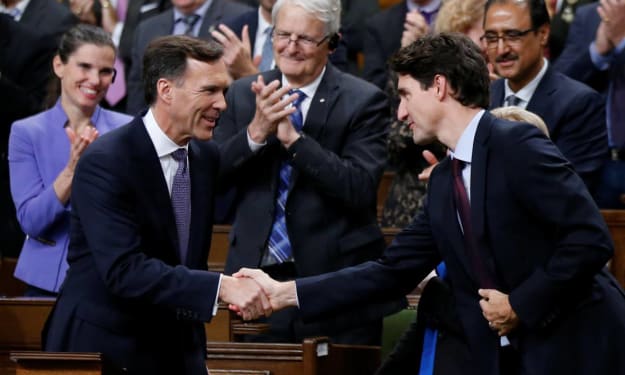
If you're Canadian like me and have been paying any attention to the #cdnpoli tag on Twitter, or to the news, or to opinion pieces in newspapers, two things are being considered a big deal right now: Morneau's "oh right I have a company but I'm already rich and who cares" gaffe, and the whole thing with Trudeau's budget deficit.
By Grizzly Matthews8 years ago in The Swamp
Money
They say money can't buy happiness. That is not entirely true. In today's world in America and all around the globe, money is the predominate means to attain the necessities of life. Whether to buy food, pay for shelter, or just about everything associated with existing in today's world all depends on the availability of having enough money to do so. In many instances the lack of financial means puts individuals in very stressful situations. We can conclude having the financial means could very well equate to a person being somewhat happy. This is because when one has financial support behind them the stress level should dissipate. Were not saying that this is true for all individuals but, having money puts a person in a capacity to be able to use that resource to reduce stress associated with not having enough money to pay for such essentials as housing, food, or medicine.
By Dr. Williams8 years ago in The Swamp
Waging Wars
While economists sway to and fro like the ebbing tides of a fiscal ocean, one thing remains solid and unmoving to me. The reality is that income inequality leads to disenfranchisement and unrest in the lower income areas of our country. This has been proven time and time again not only in the history of our nation, but the world itself. In our day and age, money is the prime resource, and when resources are low, tempers run high. Raising the minimum wage is a hot topic among economists; in fact, it’s the surest way to divide a room full of them right down the middle. This issue has seemingly stumped lawmakers on the national level as the nation’s minimum wage stands at $7.25 per hour and hasn’t moved since 2009. This policy of procrastination seems to be perpetuated by both major political parties as it is an unpopular fight on all fronts. Though a Gallup poll conducted in November of 2013 reveals that 91 percent of Democrats support increasing the federal minimum wage to $9.00, so do 58 percent of Republicans. They also suggest pinning the minimum wage to the consumer price index, in order for it to keep pace with inflation. That way, as the economy shifts, so would the minimum wage. Prior to 2007, the federal minimum wage had been stagnant for ten years. This oversight has contributed to the current turbulence in our global market. The less money people have to spend, the larger the wage gap becomes, leading to less currency in the market and thus a shrinking economy. Fears that raising the minimum wage would flood the market with currency and lead to drastic costs of living are very shortsighted. There are several steps that must be taken to revive our ailing economy. One of the first steps should be to raise the minimum wage and index it for future generations.
By Eduardo Victor Garcia8 years ago in The Swamp