humanity
Humanity topics include pieces on the real lives of politicians, legislators, activists, women in politics and the everyday voter.
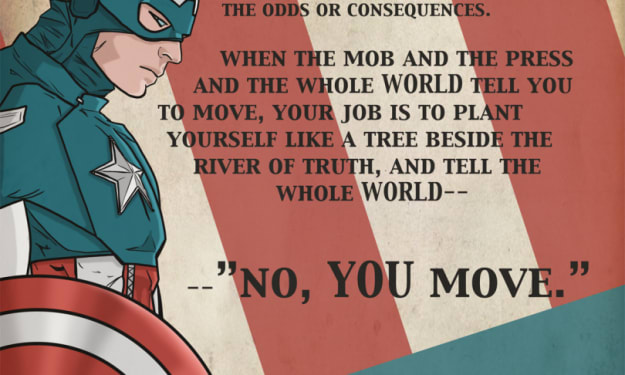
What Would Captain America Do?
Each of you, for himself or herself, by himself or herself, and on his or her own responsibility, must speak. It is a solemn and weighty responsibility, and not lightly to be flung aside at the bullying of pulpit, press, government, or politician. Each must decide for himself or herself alone what is right and what is wrong, which course is patriotic, and which isn’t. You cannot shirk this and be a man. To decide it against your convictions is to be an unqualified and inexcusable traitor. It is traitorous both against yourself and your country. Let men label you as they may, if you alone of all the nation decide one way, and that way be the right way by your convictions of the right, you have done your duty by yourself and by your country, hold up your head for you have nothing to be ashamed of. It doesn’t matter what the press says. It doesn’t matter what the politicians or the mobs say. It doesn’t matter if the whole country decides that something wrong is something right. Republics are founded on one principle above all else: The requirement that we stand up for what we believe in. no matter the odds or consequences. When the mob and the press and the whole world tell you to move. Your job is to plant yourself like a tree beside the river of truth and tell the whole world: “No, you move."
By James Howell8 years ago in The Swamp
Where the Heart Is
In a perfect world, everyone is equal, everyone is worth the time to invest in and show kindness towards. However, in spite of this vision, the application of such a notion in daily life proves arduous—especially when it makes people uncomfortable. As the hourglass of our lives rapidly moves through the sieve of “now,” each moment beckons minor decisions, which are seemingly innocuous. Nevertheless, these decisions are the ones that produce the big picture of our lives. To be effectively kind, we must ritualistically participate in the art of introspection handling each moment with grace and foresight. Metaphorically, each grain of sand in the hourglass of our lives builds on the other. Every frown, smile, and nod is a choice we make, as it slips through the bottleneck of present to past collected together as our individual stories. By all means then, are we not the sum of our attributes in their most diminutive occurrences?
By Sam Sapien8 years ago in The Swamp
Immigrants Have Trouble Assimilating
This is flat out because Americans who have been here longer cause problems for them. It is the pecking order. Immigrants have a hard time adapting sometimes; it doesn’t matter what country they move to. Their new country has different customs, as well as needs. Americans are pretty much able to give any new immigrant problems. Somebody from Mainland China, for example, has trouble adapting to driving habits in California. They drive differently in China, according to my family who has been there. You have to cross the street at a time that is good for you.
By Iria Vasquez-Paez8 years ago in The Swamp
Chaos? Nope, Just Bilingual
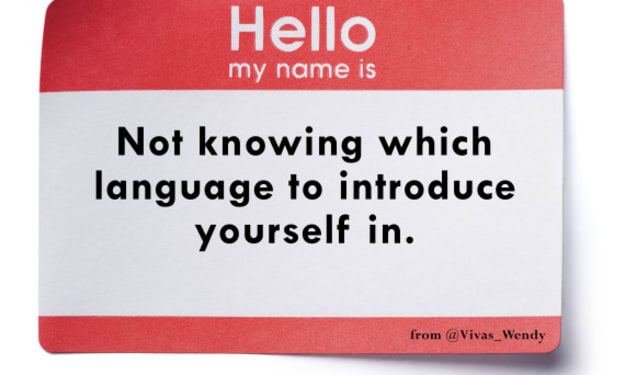
I recently moved to Connecticut for about 5 to 6 months now, originally from Puerto Rico and had to leave because of the hurricane Maria's aftermath because I basically had nothing left back home. So, here I am living in this new country and dealing with a language I am an amateur of, and I had encountered moments where I want to scream at people so they could understand what I am saying... Maybe even my writing is terrible, but I give myself a chance to be better. I come from a family where I am basically the only "fluently bilingual" one, because none of my siblings tried to even learn the language, and this has become a gift and a curse, especially when your mother wants to know about what she doesn't know.
By Angel Ruiz8 years ago in The Swamp
What Ails Asians?
This is a not-so-common moment in history, when a word gets added into the dictionary. The Chinese dictionary is where it is added. If you, like many other readers, tune out of this article once you read that it is a Chinese word rather than a new English word, ask yourself, why? Isn't China supposed to become more of a prominent force in the future? Isn't Donald Trump opposed to Chinese politics of trade? Isn't the sun going to rise from the east in the morning?
By Kevin Liou8 years ago in The Swamp
Surviving Your Next Family Gathering
If it’s Easter, chances are you spent yesterday sitting on a Megabus stranded in a sea of other people on their way to the house of the nearest relative who knows how to hardboil an egg. You’ve been preparing the speech you’ll casually rattle off to assure your relatives that everything is going just fine. Last night you probably slept on a four poster twin bed next to a cousin you don’t really talk to, on an identical four poster twin bed, in your grandparents' guest room.
By Sidney Morss8 years ago in The Swamp
A Talk Between a White, Big Sister and Her Younger, Half Black Brother
Never once did I think this day would come. Never once did I think that I, at age 22, a white female, would have to sit my little brother down, age 14, half black, looks mostly black, and have “the talk” with him.
By Kenzie Lane Stapleton8 years ago in The Swamp
The History of Genocide
The two world wars were about fighting the Nazi genocidal agenda. The term “genocide" came from Raphael Lemkin in 1948 after he fled the Nazi occupation of Poland, arriving in the United States. Lemkin had been horrified the Turks slaughtered the Armenians in World War 1. Lemkin felt he had to come up with a term to describe what the Nazis had done. The term “genocide” comes from “combining genos, the Greek word for race or tribe, with the Latin suffix cide, “to kill.” During the Nuremberg trials, the term “genocide” first began to be used in the charter of the International Military Tribunal set up by the Allies in Nuremberg, Germany.
By Iria Vasquez-Paez8 years ago in The Swamp
Racism & Stereotypes, the Incurable Social Disease
In 1986, a young boy born in the Philippines was told by his parents that they would be moving to the US. 1986 was a turbulent time for the Philippines, a time when the Filipinos wanted change, they were growing tired of the corrupt system, a corrupt President, and a corrupt government. His parents thought it would be a good start, and since they were petitioned by a family member, they thought it would be a great opportunity for the whole family. At first the boy was excited, happy, at the same time he was curious what life would be like in an unfamiliar land. 30 years later and already a US citizen, he questions that decision, if it was the right thing to do. He realizes that he has no time to regret, no chance of turning back time, only time to reflect on his past experiences, Unfortunately for him, racism was a big part of that experience. This is his story...
By Albino Lokoh8 years ago in The Swamp