
Why My Phone Is Slow After an Update
What Really Happens After Software Updates—and Why Performance Drops

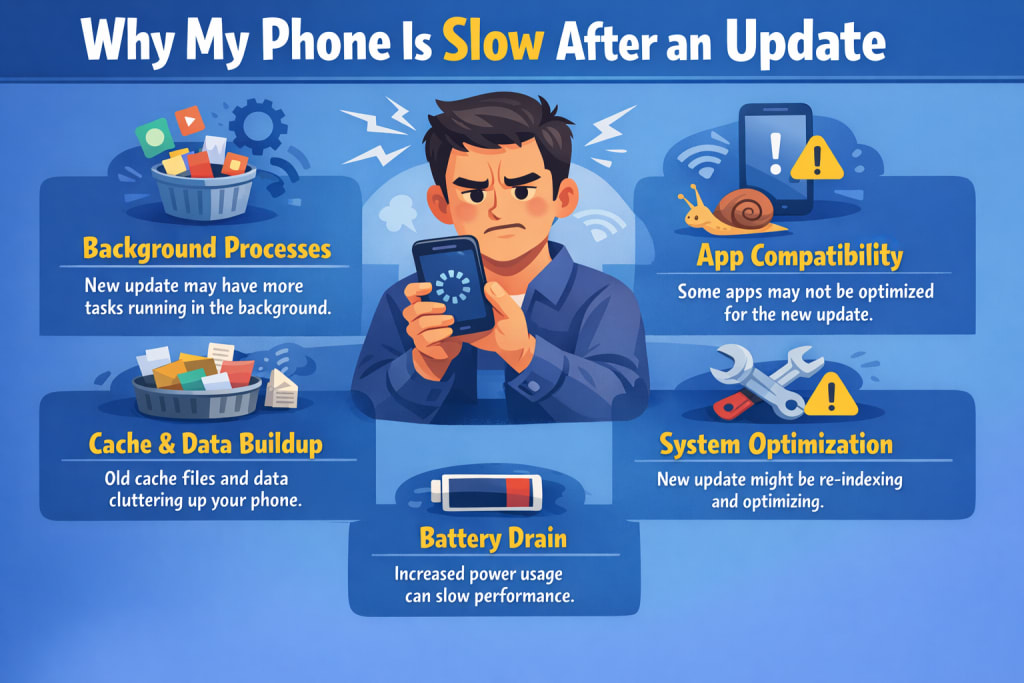
Almost every phone update follows the same emotional sequence.
You install the update.
You study what’s new.
Everything feels fine—maybe even smoother.
Then, a few days later, the frustration starts.
Apps hesitate.
Scrolling isn’t as fluid.
Battery drains quickly.
The phone feels… heavier.
The immediate reaction is blame:
“Updates make phones slow.”
“They do this on purpose.”
“My phone can’t handle new software.”
In truth, phones regularly slow down after updates for practical reasons—not malicious ones.
Updates Don’t Finish When Installation Ends
When an update installs, it doesn’t indicate the phone is “done.”
After the update, the system still takes time to:
re-index files
optimize apps for the new system
rebuild caches
re-learn usage patterns
adjust background behavior
This post-update phase can last days or longer.
During this time:
performance feels inconsistent
battery drain increases
the phone may feel warmer
Nothing is broken.
The system is settling.
Apps Are Often the Real Bottleneck
Apps don’t update at the same time as the operating system.
After a system update:
some apps aren’t totally optimized yet
background behavior may become inefficient
sync patterns may change
One inadequately optimized software can:
keep the processor awake
trigger frequent background activity
slow down the entire system
Users blame the update—but the issue is typically app compatibility delay.
Updates Reset Your Optimizations
This is one of the key reasons phones look slow after updates.
Updates often:
ease background restrictions
reset battery optimization rules
enable new features by default
increase notification permissions
So the phone isn’t slower because it’s worse.
It’s slower because your former constraints were abolished.
Once limitations are reinstated, performance typically increases.
New Features Mean New Background Work
Every update adds something.
New privacy layers.
New system intelligence.
New background services.
Even if you never employ these capabilities, many:
monitor situations
wake the system frequently
consume memory and power
The phone now conducts more work than before.
Increased effort brings greater strain.
Heat Plays a Bigger Role After Updates
Post-update action raises heat.
Heat causes:
performance throttling
slower animations
delayed responses
Even a small temperature could limit speed.
That’s why phones may appear slow for a few days after updating—especially if charging and syncing occur simultaneously.
Battery State Affects Performance Decisions
Updates occasionally modify how aggressively phones safeguard the battery.
If the system detects:
battery wear
charging stress
temperature spikes
It may reduce peak performance earlier than before.
This isn’t punishment.
It’s protection—but it seems like a delay.
Why Restarting Temporarily “Fixes” It
Restarting:
interrupts background optimization
clears transitory system states
cools the device
That’s why phones often feel smooth quickly after a restart.
But if background behavior persists, the delay resumes.
Restarting solves symptoms—not causes.
Why This Feels Like Forced Obsolescence
From the user’s perspective:
the phone was fine before
the update occurs
performance declined
That sequence appears planned.
But in most circumstances, it’s the effect of:
rising system complexity
app lag
reset settings
temporary optimization
The phone didn’t get weaker.
The workload rose.
What Actually Helps After an Update
Instead of panicking, try this:
give the phone several days to stabilize
evaluate which programs suddenly eat more battery
re-apply background and battery restrictions
disable fresh features you don’t use
avoid excessive charging + usage concurrently
In many cases, performance improves without excessive intervention.
When Slowdowns Are a Real Problem
Occasionally, updates genuinely tax older hardware.
Signs include:
constant overheating
persistent lag after weeks
significant battery drain
These instances are less common—but real.
Even so, optimizing often helps more than upgrading immediately.
The Bigger Truth
Updates don’t hurt phones overnight.
They enhance complexity.
And complexity necessitates adjustment—by the system and by the user.
Once the adjustment happens, performance often returns close to normal.
Last Thoughts
If your phone appears slow after an update, don’t worry, it’s not broken—or fooling you.
Assume it’s busy adjusting.
Updates aren’t the enemy.
Unmanaged changes are.
Disclaimer
This article describes my observations and general smartphone software behavior. Performance after updates may vary depending on device type, operating system version, apps, and usage patterns.

About the Creator
abualyaanart
I write thoughtful, experience-driven stories about technology, digital life, and how modern tools quietly shape the way we think, work, and live.
I believe good technology should support life
Abualyaanart
Keep reading
More stories from abualyaanart and writers in The Swamp and other communities.
Why Black History Matters in America?
The United States of America is celebrating their 250th anniversary in 2026. I'm proud to be an American and as someone who was born here, I wouldn't imagine myself living anywhere else. This is a country where opportunities are possible. Where anyone can be successful in anything they desire to do. Equality, community, and togetherness are the backbones of what America is and should be about. However, we have an administration who wants to erase and disregard those who have made positive, meaningful impacts in our country, specifically Black figures, such as Martin Luther King, Jr., Rosa Parks, and Maya Angelou. President Trump and his administration have been constantly complaining and fighting against what they call the "Woke agenda". They use this excuse as a distraction from other issues they refuse to address, such as the high cost of living, climate change, and inflation. That equality is dividing America, when in reality, it's bringing us together. Being woke is not tied to a specific political party. No matter where you stand on the political spectrum, you can still care about other people and their plights. Compassion and empathy for others isn't tied to a political party, either. We were taught as children to treat others the way we want to be treated and not judge others because they're different from us. Caring about others isn't a personal attack on your beliefs. It doesn't make you any less of a person. People who are easily offended over African American figures, past or present, or anything related to it, are grasping at straws. Current and future generations need to know who people like Harriet Tubman and Shirley Chisholm were, especially in the classroom. Black History is part of American History. It should be recognized, not hidden or forgotten. Besides, you can't shield children from everything, just because your feelings are easily hurt.
By Mark Wesley Pritchard 4 days ago in The Swamp
China Is Said to Pause Panama Deals After Ports Operation Nulled
China has reportedly suspended a series of commercial and infrastructure negotiations with Panama following the annulment of a major ports operation agreement, a move that underscores growing geopolitical tensions surrounding strategic trade routes and foreign investment in Central America. According to officials familiar with the matter, Chinese state-owned enterprises were instructed to halt discussions on port development, logistics projects, and related infrastructure investments after Panamanian authorities invalidated a long-standing contract involving port operations at key facilities near the Panama Canal. The decision has been interpreted in Beijing as a political signal aligned with increasing U.S. influence in the region. The ports agreement in question had granted a foreign operator control over terminal facilities that serve as vital hubs for cargo transshipment between the Atlantic and Pacific oceans. Its cancellation followed a legal and regulatory review by Panamanian authorities, who cited concerns over transparency, national security, and compliance with concession terms. While Panama has insisted the decision was based on domestic legal considerations, Chinese officials view the move as part of a broader effort by Western powers to curb Beijing’s presence in strategically sensitive locations. Strategic Importance of the Panama Canal The Panama Canal remains one of the most important maritime corridors in the world, handling roughly 5 percent of global trade and serving as a key route for energy shipments, manufactured goods, and agricultural exports. Control over port infrastructure near the canal is seen as economically lucrative and geopolitically sensitive. Over the past decade, China has expanded its footprint in Panama through investments in ports, construction projects, and logistics hubs. This followed Panama’s decision in 2017 to cut diplomatic ties with Taiwan and formally recognize Beijing, a move that opened the door to deeper economic cooperation. However, Chinese involvement in canal-adjacent infrastructure has drawn scrutiny from Washington, which views the waterway as critical to U.S. national security and regional stability. “The canal is not just a commercial artery; it is a strategic asset,” said a regional security analyst. “Any foreign control over nearby ports raises concerns about influence, surveillance, and long-term leverage.” Beijing’s Reaction Sources said Beijing’s decision to pause talks was intended as a signal of dissatisfaction and a warning that trust between the two countries has been damaged. Chinese companies had been negotiating new port upgrades, container terminal expansions, and logistics centers designed to strengthen Panama’s role as a shipping hub for Latin American trade with Asia. “These projects are now effectively frozen,” said one person with knowledge of the discussions. “There is frustration in Beijing that commercial agreements are being overturned for political reasons.” China’s foreign ministry has not formally confirmed the suspension but stated that it expects Panama to “honor its commitments to Chinese enterprises” and provide a fair and predictable environment for foreign investors. Panama’s Position Panamanian officials have defended the annulment of the ports operation contract as a legal necessity rather than a political maneuver. A government spokesperson said the review process revealed irregularities in how the concession had been granted and managed over the years. “Our responsibility is to ensure that strategic infrastructure is operated in accordance with national law and the public interest,” the spokesperson said. “This decision does not target any country specifically.” Nevertheless, Panama faces mounting pressure from competing global powers. The United States has increased diplomatic engagement with the country in recent years, emphasizing the importance of safeguarding the canal from undue foreign influence. U.S. officials have previously warned about the security risks posed by foreign control of port facilities near critical waterways. While they have not commented directly on the annulment, analysts say Washington likely welcomed the move. Economic Consequences The pause in negotiations could have tangible economic effects for Panama, which has relied on foreign investment to modernize its ports and expand logistics capacity. Chinese companies had been expected to finance several billion dollars in upgrades, potentially creating thousands of jobs. Local business leaders expressed concern that prolonged uncertainty could discourage other investors as well. “If contracts can be canceled abruptly, it raises questions about stability,” said a representative of Panama’s shipping industry association. For China, the setback complicates its broader Belt and Road Initiative, which aims to build a global network of ports, railways, and trade corridors linking Asia to Europe, Africa, and the Americas. Panama was seen as a critical node in this network because of its unique geographic position. Broader Geopolitical Context The development reflects a wider trend of countries reassessing Chinese involvement in strategic infrastructure. From ports in Europe to telecommunications networks in Africa, governments have grown more cautious about allowing Chinese state-linked firms to manage assets tied to national security. “This is not just about Panama,” said a Latin America expert. “It is part of a global recalibration of how governments view Chinese investment in sensitive sectors.” China has argued that its overseas projects are purely commercial and mutually beneficial. But critics contend that state-backed firms often serve Beijing’s strategic interests, blurring the line between business and geopolitics. Uncertain Future It remains unclear whether the pause in negotiations will be temporary or lead to a broader cooling of China–Panama relations. Diplomatic channels remain open, and some officials hope a compromise can be reached that allows certain projects to proceed under revised terms. For now, however, the annulled ports deal has become a symbol of Panama’s delicate balancing act between economic opportunity and geopolitical pressure. As global competition for influence over trade routes intensifies, small but strategically located nations like Panama are finding themselves at the center of great-power rivalries. The outcome of this dispute could shape not only Panama’s economic future but also the broader dynamics of Chinese investment in the Western Hemisphere. Whether negotiations resume or tensions deepen will depend on how both sides navigate the intersection of commerce, law, and international politics in the months ahead.
By Fiaz Ahmed Brohiabout 19 hours ago in The Swamp



Comments
There are no comments for this story
Be the first to respond and start the conversation.