
3D Printing in Healthcare Market Size and Forecast 2025–2033 | Renub Research
How additive manufacturing is reshaping medicine—from custom implants to bioprinted tissues—and why the next decade will redefine patient-specific care

3D Printing in Healthcare Market: A New Era of Personalized Medicine
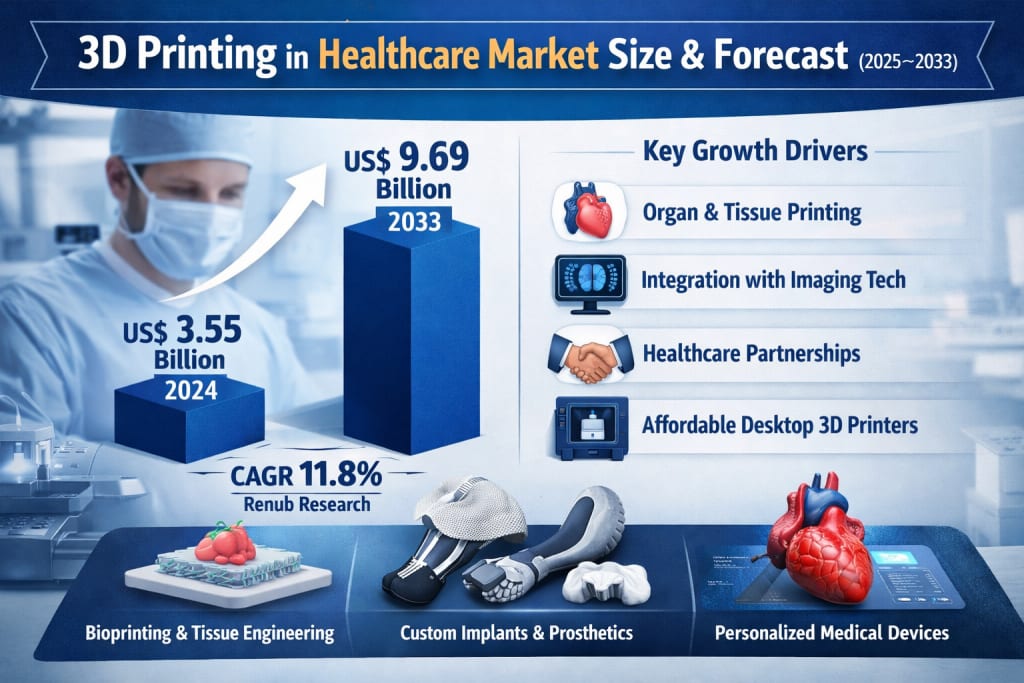
The 3D Printing in Healthcare Market is entering a powerful growth phase, driven by rapid technological progress and rising demand for personalized medical solutions. According to Renub Research, the market was valued at US$ 3.55 billion in 2024 and is expected to reach US$ 9.69 billion by 2033, growing at a CAGR of 11.8% from 2025 to 2033. This impressive expansion reflects how additive manufacturing is steadily moving from experimental labs into mainstream hospitals, clinics, and research centers worldwide.
Three-dimensional (3D) printing, also known as additive manufacturing, has become a game-changing force in healthcare. Unlike traditional manufacturing methods, which often involve cutting or shaping materials, 3D printing builds objects layer by layer using digital designs. This allows for the creation of highly complex, customized, and patient-specific medical products—ranging from prosthetics and implants to surgical guides and anatomical models.
What makes this technology especially valuable in healthcare is its ability to tailor solutions to individual patients. Surgeons can now plan complex operations using exact replicas of a patient’s organs or bones. Dentists can design perfectly fitted crowns and aligners. Researchers are even exploring the printing of living tissues and cells, opening new doors in regenerative medicine. Together, these applications are not only improving clinical outcomes but also reducing surgical risks, shortening procedure times, and enhancing overall patient safety.
Beyond clinical benefits, 3D printing is also streamlining healthcare workflows. By enabling faster prototyping and on-demand production, hospitals and medical device manufacturers can reduce costs, cut lead times, and improve supply chain efficiency. As healthcare systems around the world face growing pressure to deliver better care at lower costs, additive manufacturing is increasingly seen as a strategic solution rather than just a technological novelty.
Global 3D Printing in Healthcare Industry Overview
The healthcare sector has always been closely linked with innovation, and 3D printing is one of the most disruptive technologies to emerge in recent years. Today, it is used to produce prostheses, surgical instruments, drill guides, and customized implants. It also plays a critical role in medical education and surgical planning by enabling the creation of highly accurate, patient-specific anatomical models.
One of the most exciting frontiers of this technology is bioprinting—the process of printing living cells and tissues. While still in development, bioprinting holds enormous promise for tissue engineering and regenerative medicine. In the future, it could help address the global shortage of donor organs and revolutionize how complex injuries and diseases are treated.
Additive manufacturing is particularly well-suited for healthcare because it can produce small batches or even single, customized items efficiently. This is a major advantage in a field where every patient is different. The growing demand for personalized medicine, combined with the need for faster and more cost-effective production methods, is accelerating the adoption of 3D printing across hospitals, research institutions, and medical device companies.
A good example of innovation in this space is the work done by multidisciplinary teams that bring together surgeons, engineers, and designers to create advanced solutions for complex medical problems. In recent years, such collaborations have led to breakthroughs in areas like facial reconstruction, orthopedic implants, and patient-specific surgical tools—demonstrating how 3D printing is moving from concept to real-world impact.
Key Factors Driving the 3D Printing in Healthcare Market Growth
Rising Investment in Research and Development (R&D)
One of the strongest drivers of market growth is the steady increase in R&D spending. Governments, private companies, and research institutions are investing heavily in developing new materials, improving printing technologies, and expanding medical applications. These investments are fueling innovation, leading to better-performing products and more efficient manufacturing processes.
In healthcare, R&D plays a crucial role in advancing treatments, improving patient outcomes, and reducing long-term costs. With 3D printing, research efforts are focused on creating biocompatible materials, enhancing printing precision, and exploring new uses such as tissue scaffolds and drug delivery systems. A strong R&D ecosystem not only accelerates technological progress but also supports economic growth by creating skilled jobs and attracting further investment.
Growing Use of 3D Printing in Pharmaceuticals
The pharmaceutical sector is increasingly adopting 3D printing for drug development and personalized medicine. This technology allows for precise customization of medication doses, shapes, and release profiles based on individual patient needs. As a result, treatments can become more effective, safer, and easier for patients to follow.
3D printing also enables the rapid prototyping of new drug formulations, reducing both development time and costs. This is especially valuable for producing pediatric medicines, treatments for rare diseases, and complex drug delivery systems that are difficult to manufacture using conventional methods. As regulatory frameworks evolve to accommodate these innovations, the role of 3D printing in pharmaceuticals is expected to expand significantly.
Rising Demand for Cancer Treatments, Stem Cell Therapies, and Regenerative Medicine
The growing global burden of chronic diseases, particularly cancer, is another major factor supporting market growth. 3D printing is increasingly used to create tumor models that help researchers test drugs and design more effective, personalized treatment strategies.
In regenerative medicine, the technology’s ability to produce precise, patient-specific scaffolds using biocompatible materials makes it ideal for tissue engineering applications. Stem cell therapies also benefit from 3D printing, as customized structures can support cell growth and differentiation. Together, these applications highlight how additive manufacturing is becoming a cornerstone of next-generation medical treatments.
Challenges in the 3D Printing in Healthcare Market
Integration with Existing Healthcare Systems
Despite its many benefits, integrating 3D printing into traditional healthcare environments is not always easy. Hospitals and clinics must adapt their workflows, invest in new equipment, and train staff to use these technologies effectively. This often requires close collaboration between medical, engineering, and IT teams—something that can be challenging in institutions with established processes.
There may also be resistance to change, particularly when decision-makers are uncertain about return on investment or long-term benefits. Additionally, integrating 3D printing systems with existing patient data platforms and quality control procedures can be complex and time-consuming.
Ethical and Legal Challenges
Bioprinting and the creation of human tissues and organs raise important ethical and legal questions. Issues related to ownership, consent, intellectual property, and safety regulations are still being debated. For example, who owns a bioprinted organ created from a patient’s cells? How should such products be regulated to ensure safety and fairness?
Current legal frameworks in many countries are not fully equipped to address these challenges. As a result, governments and regulatory bodies will need to develop clearer, more comprehensive guidelines that balance innovation with patient protection and ethical responsibility.
3D Printing in Healthcare Market Overview by Regions
The global market is expanding across all major regions, with varying adoption rates and growth drivers.
United States 3D Printing in Healthcare Market
The United States remains at the forefront of healthcare 3D printing, supported by strong investment, advanced medical infrastructure, and a robust innovation ecosystem. The technology is widely used for personalized implants, prosthetics, surgical guides, and patient-specific anatomical models. Key medical fields such as orthopedics, dentistry, and neurosurgery are seeing particularly strong adoption.
Collaboration between healthcare providers, research institutions, and technology companies is helping to integrate 3D printing into routine clinical practice. While challenges related to regulatory approvals and material limitations remain, the U.S. continues to set the pace for global market development.
Germany 3D Printing in Healthcare Market
Germany is a leading player in the European market, thanks to its strong manufacturing base, advanced healthcare system, and commitment to medical technology innovation. Additive manufacturing is increasingly used for surgical planning, custom implants, and medical device development. Government support and the presence of major industry players are further strengthening the country’s position in this space.
China 3D Printing in Healthcare Market
China is rapidly emerging as a major force in healthcare 3D printing, driven by government initiatives, expanding manufacturing capabilities, and growing demand for personalized medical solutions. Programs aimed at boosting domestic innovation are encouraging wider adoption of additive manufacturing in hospitals and research centers. Despite ongoing regulatory and ethical challenges, China’s market is expected to play a crucial role in the global landscape.
United Arab Emirates 3D Printing in Healthcare Market
The UAE has taken a proactive approach to 3D printing, particularly through initiatives like the Dubai 3D Printing Strategy. The country is investing in innovation hubs, research centers, and partnerships to integrate additive manufacturing into healthcare services. Applications such as custom prosthetics, dental implants, and surgical guides are gaining traction, positioning the UAE as a regional leader in this field.
Market Segmentation
By Offering
System
Materials
Services
By Technology
Droplet Deposition
Photopolymerization
Laser Beam Melting
Electronic Beam Melting
Laminated Object Manufacturing
Others
By Application
Dental
Wearable Devices
Prosthetics
Medical Implants
Tissue Engineering
Others
By Region
North America: United States, Canada
Europe: France, Germany, Italy, Spain, United Kingdom, Belgium, Netherlands, Turkey
Asia Pacific: China, Japan, India, Australia, South Korea, Thailand, Malaysia, Indonesia, New Zealand
Latin America: Brazil, Mexico, Argentina
Middle East & Africa: South Africa, Saudi Arabia, United Arab Emirates
Competitive Landscape
The market features a mix of established technology leaders and specialized healthcare innovators. Key players include:
3D Systems Corporation
ExOne Company
Formlabs Inc.
General Electric
Materialise NV
Oxford Performance Materials, Inc.
Organovo Holdings, Inc.
Proto Labs
These companies focus on product innovation, strategic partnerships, and expanding their healthcare portfolios to strengthen their market positions.
Final Thoughts
The 3D Printing in Healthcare Market is no longer a niche segment—it is becoming a core pillar of modern medicine. With the market projected to grow from US$ 3.55 billion in 2024 to US$ 9.69 billion by 2033, according to Renub Research, the coming decade will likely see additive manufacturing deeply embedded in clinical practice, research, and pharmaceutical production.
From personalized implants and prosthetics to the promising future of bioprinting, 3D printing is reshaping how healthcare is delivered. While challenges related to integration, regulation, and ethics remain, the overall trajectory is clear: this technology is set to play a transformative role in building a more precise, efficient, and patient-centered healthcare system worldwide.
About the Creator
Mexico Green Hydrogen Market: Size, Share, Industry Trends Analysis and Forecast
Why the Mexico Green Hydrogen Market Is Emerging as a Clean Energy Leader: Trends & Future Outlook Mexico is entering a pivotal moment in its energy transition. As the world races to reduce carbon emissions, green hydrogen is gaining attention as a powerful solution for decarbonizing heavy industry, transportation, and electricity generation. The Mexico green hydrogen market is still in its early stages, but momentum is building rapidly as investments, policy discussions, and technological advancements align.
By Jackson Watsona day ago in Trader
Cellulose Acetate Market Set to Soar to 2.70 Million Tons by 2033 | CAGR 3.07%
Overview Cellulose Acetate Market Cellulose acetate is a thermoplastic material produced through the chemical modification of cellulose. It is commonly used in manufacturing fibers, films, filtration membranes, cigarette filter tow, and molded plastics. Its biodegradability, strength, thermal stability, and transparency make it suitable for diverse applications across multiple industries. Increasing focus on green chemistry and circular economy initiatives is encouraging manufacturers to adopt cellulose-derived materials. Additionally, advancements in production technology and increasing R&D investments are expanding the scope of cellulose acetate in medical and filtration applications.
By James Smith7 days ago in Trader
📢 Raise Your Voice Thread: 02/19/2026
Our “Raise Your Voice Threads” are hosted most alternating Thursdays at 12PM ET to offer creators more avenues to uncover exceptional stories on Vocal. As we are continuously searching for fresh creators and inspiring stories, this thread provides an opportunity to exchange and discuss the stories that have moved and motivated us on Vocal.
By Raise Your Voice by Vocal11 minutes ago in Resources




Comments
There are no comments for this story
Be the first to respond and start the conversation.