
Age-Related Macular Degeneration (AMD) Market Trends & Summary
Rising Innovation, Aging Populations, and the Race to Protect Vision in a Fast-Growing Global Market

Introduction: A Global Eye Health Challenge Gaining Urgency
Age-related macular degeneration (AMD) has emerged as one of the most serious and widespread vision disorders affecting older adults worldwide. In affluent and rapidly aging societies, AMD is now recognized as a leading cause of irreversible central vision loss, profoundly impacting independence, productivity, and quality of life. The condition gradually damages the macula—the central portion of the retina responsible for sharp, detailed vision—making everyday tasks such as reading, driving, and facial recognition increasingly difficult.
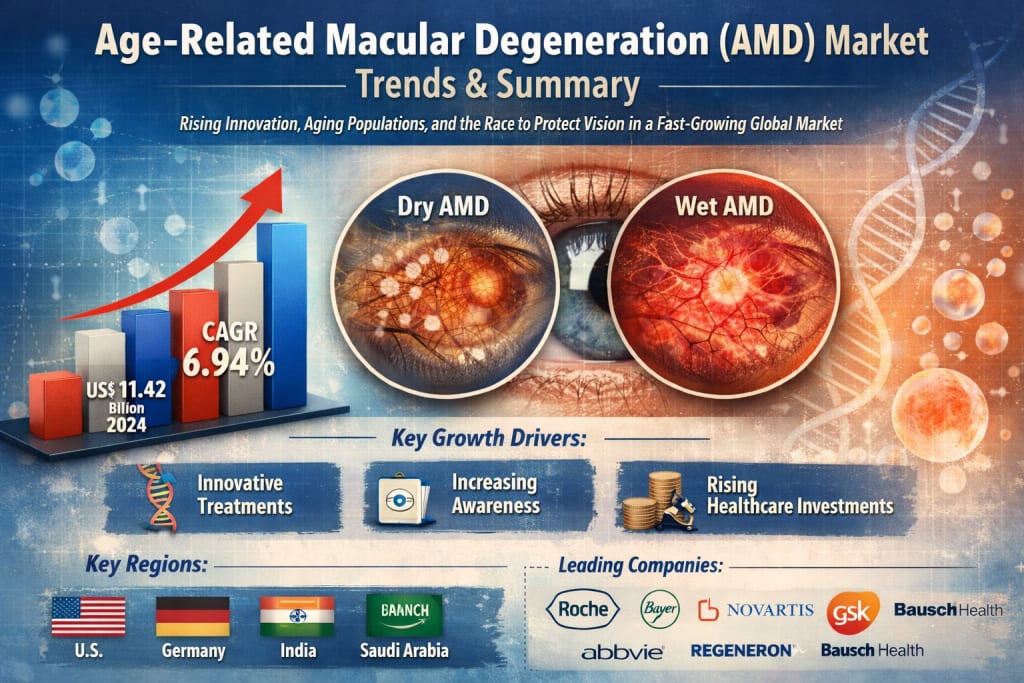
According to Renub Research, the Age-Related Macular Degeneration (AMD) Market is expected to reach US$ 20.88 billion by 2033, up from US$ 11.42 billion in 2024, growing at a CAGR of 6.94% from 2025 to 2033. This steady expansion reflects not only the rising prevalence of AMD but also rapid advances in diagnostics, therapeutics, and awareness programs that are reshaping how the disease is detected and managed across the globe.
As healthcare systems prepare for an unprecedented demographic shift toward older populations, AMD is moving from a niche ophthalmic concern to a central public health and economic issue—one that is driving investment, innovation, and policy attention worldwide.
Understanding AMD: Disease Types and Clinical Landscape
Age-related macular degeneration is broadly categorized into two major forms: dry (atrophic or non-neovascular) AMD and wet (exudative or neovascular) AMD.
Dry AMD is the more common form and is characterized by the gradual thinning of the macula and the accumulation of drusen—tiny deposits under the retina. Although it progresses slowly, dry AMD can still lead to significant central vision impairment over time. Currently, treatment options for dry AMD remain limited, largely focusing on nutritional supplementation, lifestyle modifications, and close monitoring.
Wet AMD, on the other hand, accounts for a smaller percentage of cases but is responsible for the majority of severe vision loss associated with the disease. It is caused by the abnormal growth of blood vessels beneath the retina, which leak fluid and blood into the macula, leading to rapid and often dramatic vision deterioration. Despite representing roughly 10% of AMD cases, wet AMD is estimated to cause about 90% of AMD-related legal blindness in developed regions.
Clinically, AMD can also be classified into early, intermediate, and late stages based on features such as drusen size, pigmentary changes, retinal pigment epithelium (RPE) atrophy, and the presence of choroidal neovascularization (CNV). This nuanced staging underscores the importance of early detection and timely intervention—factors that increasingly shape market demand for advanced diagnostics and therapies.
Market Overview: A Sector Driven by Demographics and Innovation
The global AMD market is being propelled by a powerful combination of demographic trends, technological progress, and therapeutic breakthroughs. One of the most influential drivers is the rapid growth of the elderly population. For example, in the United States alone, the Population Reference Bureau estimates that the number of people aged 65 and older will rise from 58 million in 2022 to 82 million by 2050—an increase of nearly 47%. Similar aging trends are unfolding across Europe, Japan, China, and many emerging economies.
With age being the primary risk factor for AMD, this demographic shift virtually guarantees a sustained increase in patient numbers over the coming decades. At the same time, lifestyle-related risk factors such as smoking, obesity, poor diet, and prolonged exposure to digital screens are further contributing to the growing burden of retinal diseases.
On the innovation front, the market has been transformed by the success of anti-VEGF (vascular endothelial growth factor) therapies, which have become the gold standard for treating wet AMD. Drugs such as Eylea, Lucentis, and Beovu have demonstrated the ability to stabilize—and in many cases improve—vision by inhibiting the abnormal blood vessel growth that characterizes the disease. These therapies have not only changed clinical outcomes but also redefined patient expectations, turning AMD from an almost inevitably blinding condition into a manageable chronic disease for many individuals.
Key Growth Drivers in the AMD Market
1. Innovative Treatment Options
The introduction and continuous refinement of anti-VEGF therapies represent one of the most significant medical advances in ophthalmology over the past two decades. These treatments have shifted the treatment paradigm for wet AMD, offering patients real hope of preserving functional vision. Beyond anti-VEGF drugs, research into gene therapy, longer-acting injectables, and combination treatments is opening new frontiers in AMD management.
Several pharmaceutical and biotechnology companies are investing heavily in next-generation therapies designed to reduce injection frequency, improve durability of response, and potentially address the underlying genetic and molecular causes of the disease. As these innovations move through clinical trials and regulatory approvals, they are expected to further expand the treatment-eligible population and drive long-term market growth.
2. Increasing Awareness and Early Screening
Public awareness campaigns led by healthcare organizations, patient advocacy groups, and professional ophthalmology societies are playing a crucial role in encouraging early diagnosis. As people become more informed about AMD symptoms and risk factors, they are more likely to seek routine eye examinations—especially after the age of 50.
Early detection is critical, particularly for wet AMD, where prompt treatment can mean the difference between maintaining useful vision and suffering irreversible loss. Improved access to eye care services and the growing use of advanced imaging technologies, such as optical coherence tomography (OCT), are further strengthening the diagnostic ecosystem and supporting market expansion.
3. Rising Healthcare Investments
Governments and private investors alike are increasing funding for ophthalmic research and healthcare infrastructure. This influx of capital is accelerating the development of novel diagnostics, therapies, and delivery systems. Clinical trials exploring new molecules, sustained-release implants, and regenerative approaches are multiplying, creating a robust pipeline that bodes well for the future of AMD treatment.
At the same time, broader investments in healthcare systems—particularly in emerging markets—are improving access to specialized eye care, which in turn is expanding the addressable market for AMD therapies.
Challenges Restraining Market Growth
High Treatment Costs
Despite their clinical success, anti-VEGF therapies are expensive, especially because they often require repeated injections over many years. The cumulative cost of treatment, combined with the need for frequent monitoring visits, places a significant financial burden on both patients and healthcare systems. In low- and middle-income countries, these costs can be prohibitive, limiting access to life-changing therapies.
Even in developed markets, reimbursement policies and insurance coverage gaps can restrict patient access, leading some individuals to delay or discontinue treatment—ultimately worsening clinical outcomes and increasing long-term healthcare costs.
Lack of Early Diagnosis
AMD often progresses silently in its early stages, with many patients experiencing no noticeable symptoms until significant damage has already occurred. This lack of early warning signs contributes to delayed diagnosis and missed opportunities for timely intervention. In many regions, especially in rural or underserved areas, limited access to routine eye screening further exacerbates this problem.
Improving early detection remains one of the most critical unmet needs in the AMD landscape, both from a public health perspective and a market development standpoint.
Regional Market Insights
United States
The United States represents one of the largest and most advanced markets for AMD treatment, driven by a rapidly aging population, high awareness of eye health, and widespread availability of cutting-edge therapies. Anti-VEGF drugs have become standard care for wet AMD, significantly improving patient outcomes. However, high treatment costs and the lack of effective therapies for dry AMD remain persistent challenges. Ongoing research and strong industry presence continue to support market growth in the country.
Germany
Germany stands out as a leading European market for AMD, supported by a robust healthcare system, advanced diagnostic capabilities, and strong reimbursement frameworks. The country’s aging population is fueling demand for both diagnostics and treatment, particularly for wet AMD. While access to anti-VEGF therapies is relatively strong, cost pressures and limited options for dry AMD still shape market dynamics.
India
India’s AMD market is growing, driven by a large and rapidly aging population and increasing awareness of eye health. However, access to advanced diagnostics and treatments remains uneven, particularly in rural areas. High costs of anti-VEGF drugs and infrastructure limitations continue to restrain market potential. That said, government initiatives to expand healthcare access and the rising demand for affordable treatment options are expected to support steady growth over the coming years.
Saudi Arabia
In Saudi Arabia, the AMD market is benefiting from healthcare system modernization and greater awareness of age-related eye diseases. Urban centers have seen increased adoption of advanced diagnostics and anti-VEGF therapies, although rural access remains limited. Government investments in healthcare infrastructure and a growing emphasis on preventive care are likely to drive further market expansion in the region.
Market Segmentation Overview
By Disease Type:
Dry Age-Related Macular Degeneration
Wet Age-Related Macular Degeneration
By Product:
Eylea
Lucentis
Beovu
Others
By Distribution Channel:
Hospital Pharmacy
Specialty Pharmacy
Online Pharmacy
By Geography:
North America: United States, Canada
Europe: France, Germany, Italy, Spain, United Kingdom, Belgium, Netherlands, Turkey
Asia Pacific: China, Japan, India, Australia, South Korea, Thailand, Malaysia, Indonesia, New Zealand
Latin America: Brazil, Mexico, Argentina
Middle East & Africa: South Africa, Saudi Arabia, UAE
Competitive Landscape: Key Industry Players
The global AMD market is highly competitive and innovation-driven, with leading pharmaceutical companies investing heavily in research, development, and strategic partnerships. Major players include:
Hoffmann-La Roche Ltd.
Bayer AG
AbbVie
GSK Plc
Novartis AG
Regeneron Pharmaceuticals
Bausch Health Companies Inc.
Alimera Sciences Inc.
These companies are actively engaged in expanding their product portfolios, improving drug delivery technologies, and pursuing next-generation therapies aimed at both wet and dry AMD. Their strategies typically focus on four key pillars: corporate overview, leadership and key personnel, recent developments and strategic initiatives, and financial performance insights.
Final Thoughts: A Market with Vision for the Future
The Age-Related Macular Degeneration market stands at a pivotal point in its evolution. With Renub Research projecting growth from US$ 11.42 billion in 2024 to US$ 20.88 billion by 2033, the sector is clearly positioned for sustained expansion. This growth is being driven by powerful demographic trends, continuous therapeutic innovation, and rising awareness of eye health worldwide.
Yet, significant challenges remain—particularly around affordability, access, and early diagnosis. Addressing these issues will require coordinated efforts from governments, healthcare providers, industry players, and patient advocacy groups alike.
In the years ahead, the AMD market will not only be a story of commercial growth but also one of medical progress and social impact—where preserving sight means preserving independence, dignity, and quality of life for millions of people across the globe.
About the Creator
Tom Shane
Tom Shane is a content writer specializing in SEO-driven blogs, product descriptions, and thought leadership. He crafts engaging, research-backed content that connects with audiences and drives results.
CBA Shares Jump as Profit Beats Market Expectations
CBA Shares Jump as Profit Beats Market Expectations Shares of Commonwealth Bank of Australia (CBA) recorded a strong upward move after the country’s largest lender posted profits that exceeded market expectations. The better-than-expected financial performance boosted investor confidence and pushed CBA shares higher in early trading, reinforcing the bank’s position as one of the most resilient players in Australia’s financial sector.
By Hammad Nawaz4 days ago in Trader
Global Smart Speaker Market Size and Forecast 2025–2033
Introduction: The Rise of Voice-First Technology The way people interact with technology has undergone a dramatic transformation over the past decade. From typing commands and tapping screens, users are increasingly shifting toward voice-driven interfaces that feel more natural, faster, and more intuitive. At the heart of this change lies the global smart speaker market, a sector that has quickly evolved from a novelty category into a central pillar of the smart home and digital lifestyle ecosystem.
By shibansh kumar4 days ago in Trader



Comments
There are no comments for this story
Be the first to respond and start the conversation.