
Asia Luxury Goods Market Size, Trends & Forecast 2025–2033
Rising incomes, digital luxury, and tourism-driven demand reshape Asia’s premium consumption landscape

Asia Luxury Goods Market Outlook
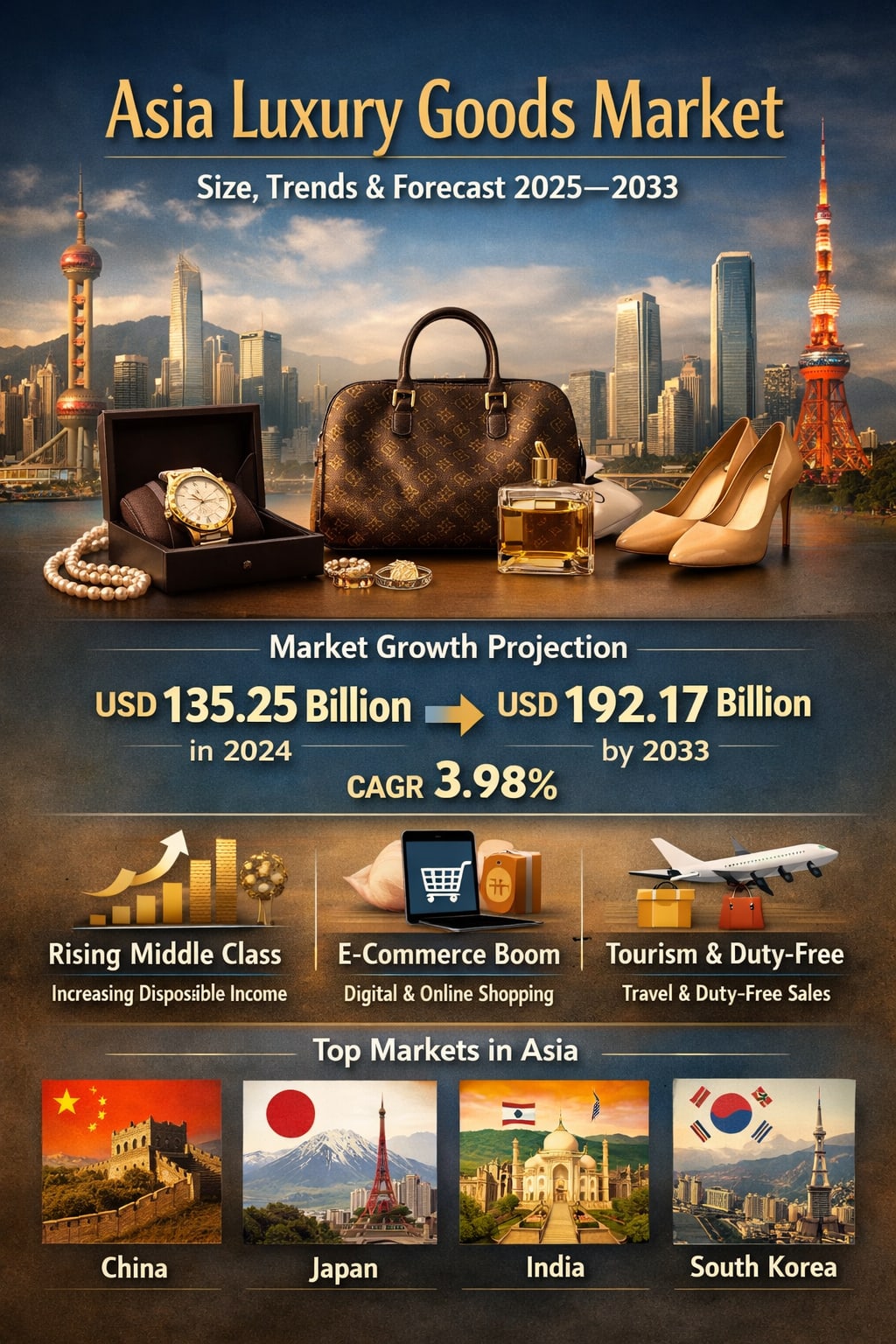
The Asia Luxury Goods Market is entering a decisive growth phase, reflecting deep structural shifts in consumer behavior, wealth creation, and digital commerce across the region. According to Renub Research, the market is expected to expand from USD 135.25 billion in 2024 to USD 192.17 billion by 2033, registering a CAGR of 3.98% during the forecast period. This steady rise is being powered by increasing disposable incomes, growing brand consciousness, and the rapid expansion of the middle-class population in countries such as China, India, and Japan.
Luxury goods, by definition, go far beyond everyday necessity. They represent craftsmanship, heritage, exclusivity, and social status. From designer apparel and premium footwear to high-end watches, jewelry, and luxury accessories, these products serve both emotional and symbolic purposes for consumers. In Asia, luxury is no longer confined to a small elite. It is increasingly becoming a lifestyle aspiration for millions of urban consumers who associate premium brands with success, self-expression, and global sophistication.
At the same time, the region is witnessing a powerful transformation in how luxury is discovered, marketed, and purchased. Digital channels, social commerce, and cross-border travel are reshaping the traditional luxury retail model. The result is a more dynamic, competitive, and opportunity-rich market that continues to attract global luxury houses and emerging premium brands alike.
What Defines Luxury in Today’s Asian Market?
Luxury products are typically characterized by superior quality, limited availability, strong brand heritage, and high perceived value. In Asia, these attributes are now being combined with personalization, experiential retail, and digital engagement. Luxury is no longer just about owning a product; it is about the story, the experience, and the emotional connection with the brand.
Across the region, luxury goods are purchased not only for personal use but also as gifts, investments, and collectibles. High-end watches and jewelry, for example, are often viewed as stores of value, while premium fashion and accessories are increasingly used to signal identity and social standing. The shift toward experiential luxury—such as exclusive events, private previews, and personalized services—further reflects how consumer expectations are evolving in Asia’s major markets.
Key Growth Drivers in the Asia Luxury Goods Market
1. Rising Middle Class and Disposable Incomes
One of the most powerful forces behind the expansion of the Asia luxury market is the rapid growth of the middle class. By 2030, nearly 65% of the world’s middle-class population is expected to live in Asia, representing around 3.5 billion people. This massive demographic shift is creating a broader base of consumers who can afford and aspire to buy premium products.
In countries like China and India, millions of consumers are moving into higher income brackets each year. With greater purchasing power comes a stronger desire for brand prestige, quality, and international labels. Luxury brands are responding by expanding their retail footprints, introducing entry-level luxury products, and tailoring their offerings to local tastes and cultural preferences.
2. Digital Transformation and E-commerce Expansion
The digital revolution has fundamentally changed how luxury is marketed and sold in Asia. Social media, e-commerce platforms, and live-streaming have become essential tools for reaching younger, tech-savvy consumers. Online luxury sales are growing rapidly as brands invest in digital showrooms, virtual try-ons, and immersive shopping experiences.
Major beauty and fashion houses have already demonstrated the power of digital engagement through live-shopping events and interactive online campaigns. Industry research suggests that live shopping could account for around 20% of global online purchases by 2026, highlighting how quickly consumer habits are shifting. In Asia, where mobile-first behavior is widespread, digital channels are no longer optional—they are central to luxury growth strategies.
3. Tourism and Duty-Free Shopping
Tourism continues to play a critical role in Asia’s luxury ecosystem. Countries such as Japan and South Korea benefit significantly from duty-free shopping, especially in airports and major tourist hubs. The appeal of tax-free purchases, combined with exclusive product assortments, makes travel retail a key sales channel for luxury brands.
With international travel rebounding after the pandemic, luxury spending by tourists is once again accelerating. For example, duty-free sales in Japan reached USD 450.7 million in May 2024, driven largely by high-value purchases such as luxury bags and jewelry. This revival of travel is expected to provide a strong tailwind for the regional luxury market over the coming years.
Challenges Facing the Asia Luxury Goods Market
Counterfeit Products and Brand Dilution
The widespread availability of counterfeit luxury goods remains a serious challenge, particularly in fast-growing markets. Fake products not only erode brand value but also undermine consumer trust. To combat this, luxury companies are increasingly investing in authentication technologies, blockchain-based tracking systems, and stricter supply chain controls to protect their intellectual property and preserve brand integrity.
Economic Uncertainty and Market Volatility
Luxury demand is sensitive to macroeconomic conditions. Currency fluctuations, inflation, and slower economic growth can all impact consumer spending on premium goods. For instance, parts of the Chinese luxury market experienced slower growth in 2024 due to cautious domestic consumption and increased overseas shopping. This environment requires brands to remain agile, balancing expansion with risk management and flexible pricing strategies.
Segment Insights: Where the Growth Is Coming From
Asia Luxury Clothing and Apparel Market
Luxury apparel remains one of the most dynamic segments in Asia. Urbanization, global fashion influence, and social media trends are encouraging consumers to invest in designer clothing. Brands are increasingly collaborating with local designers and launching region-specific collections to better resonate with diverse Asian tastes.
Asia Luxury Footwear Market
The luxury footwear segment is expanding steadily, driven by demand for premium craftsmanship, comfort, and design. Sustainability is also becoming a differentiator, with more brands adopting eco-friendly materials and ethical production practices to appeal to environmentally conscious consumers.
Asia Luxury Watches Market
High-end watches continue to hold strong appeal as both status symbols and investment pieces. Markets like China and Japan are seeing robust demand from collectors and young professionals alike. Limited editions, heritage models, and personalized services are key strategies used by watchmakers to attract discerning buyers.
Distribution Channel Trends
Multi-brand Stores
Multi-brand luxury stores are gaining popularity by offering curated selections of premium products under one roof. These stores provide convenience, variety, and discovery, making them especially attractive to consumers seeking unique or emerging luxury brands.
Online Stores
The online luxury segment is one of the fastest-growing channels in Asia. With improved logistics, secure payment systems, and rich digital content, e-commerce platforms are delivering increasingly seamless premium shopping experiences. Many brands now launch online-exclusive collections and use data-driven personalization to enhance customer loyalty.
Country-Level Market Highlights
China Luxury Goods Market
China remains the cornerstone of the Asian luxury market. Despite short-term economic headwinds, long-term fundamentals remain strong, especially among younger consumers who value brands that align with their lifestyle and values. Luxury houses are doubling down on digital engagement and exclusive experiences to maintain momentum. High-profile product launches and global events continue to reinforce China’s importance in the global luxury ecosystem.
Japan Luxury Goods Market
Japan’s luxury market is defined by a deep appreciation for quality, craftsmanship, and understated elegance. The recovery of tourism and favorable exchange rates have boosted luxury sales in major cities such as Tokyo and Osaka. Brands are expanding their presence while emphasizing personalized services for both domestic and international shoppers.
India Luxury Goods Market
India is emerging as one of the most exciting growth markets for luxury. The sector is projected to expand rapidly, supported by rising numbers of high-net-worth individuals and increased exposure to global trends. Luxury brands are opening flagship stores, strengthening digital marketing, and introducing culturally relevant collections. Recent entries by international brands highlight the country’s long-term potential.
Australia Luxury Goods Market
Australia’s luxury market benefits from a stable economy, strong tourism, and a growing affluent population. Cities like Sydney and Melbourne are key hubs, with brands focusing on premium in-store experiences and omnichannel strategies to serve both local and visiting consumers.
New Zealand Luxury Goods Market
Though smaller in size, New Zealand’s luxury market shows strong interest in sustainability, authenticity, and craftsmanship. Consumers value ethical production and local storytelling, while e-commerce plays a vital role in expanding market reach across the country.
Market Segmentation Overview
By Type:
Clothing and Apparel
Footwear
Bags
Jewelry
Watches
Other Types
By Distribution Channel:
Single-branded Stores
Multi-brand Stores
Online Stores
Other Channels
By Countries:
China
Japan
India
South Korea
Thailand
Malaysia
Indonesia
Australia
New Zealand
Rest of Asia Pacific
Competitive Landscape
The Asia luxury goods market features a mix of global powerhouses and influential regional players. Companies are analyzed across four key viewpoints: Overview, Key Persons, Recent Developments & Strategies, and Financial Insights. Major players include:
Breville Group Limited
Panasonic Holdings Corporation
LVMH Moët Hennessy Louis Vuitton SE (LVMH)
Kering SA
The Estée Lauder Companies Inc.
Hermès International SA
Rolex SA
The Swatch Group
These companies are focusing on digital transformation, retail expansion, sustainability initiatives, and personalized customer experiences to strengthen their positions in Asia’s highly competitive luxury landscape.
Final Thoughts
The Asia Luxury Goods Market is on a clear upward trajectory, supported by powerful demographic trends, digital innovation, and the revival of global travel. With the market projected to grow from USD 135.25 billion in 2024 to USD 192.17 billion by 2033 at a CAGR of 3.98%, the region is set to remain one of the most important growth engines for the global luxury industry.
While challenges such as counterfeiting and economic uncertainty persist, the long-term outlook remains positive. Brands that successfully blend heritage with innovation, exclusivity with accessibility, and physical retail with digital experiences will be best positioned to capture the next wave of luxury consumers in Asia.
In a region where aspiration meets opportunity, luxury is no longer just a symbol of status—it is becoming a defining part of modern lifestyle and cultural expression.
About the Creator
Keep reading
More stories from shibansh kumar and writers in Trader and other communities.
Europe Distributed Control Systems Market Trends & Summary (2025–2033)
Introduction: A Smarter Backbone for Europe’s Industry Europe’s industrial sector is in the middle of a profound transformation. From energy and chemicals to food processing and pharmaceuticals, manufacturers are under pressure to become more efficient, more sustainable, and more digitally connected. At the heart of this transformation lies the Distributed Control Systems (DCS) market—an essential technology backbone that enables complex industrial processes to be monitored, controlled, and optimized in real time.
By shibansh kumara day ago in Trader
The Cave Part 6
If you have ever heard a tale about yourself that you cannot remember and doubtless think is made up, you will know how I felt when Tharkin related all that the eagle had seen of me before my memories were scattered. Of far distances and traveling companions that I did not recall, camping out under the stars and making our way to the mountains with deliberate purpose. The great bird had lost contact with my party once we entered the forests, and the seven other members were not seen again by him or his brethren since.
By Jamye Sharp2 days ago in Chapters


Comments
There are no comments for this story
Be the first to respond and start the conversation.