
Asia-Pacific Yeast Market Trends & Summary
Asia-Pacific Yeast Market Set to Nearly Double by 2033 on the Back of Food, Bioethanol, and Clean-Label Demand

Introduction: A Fermentation Boom Across Asia-Pacific
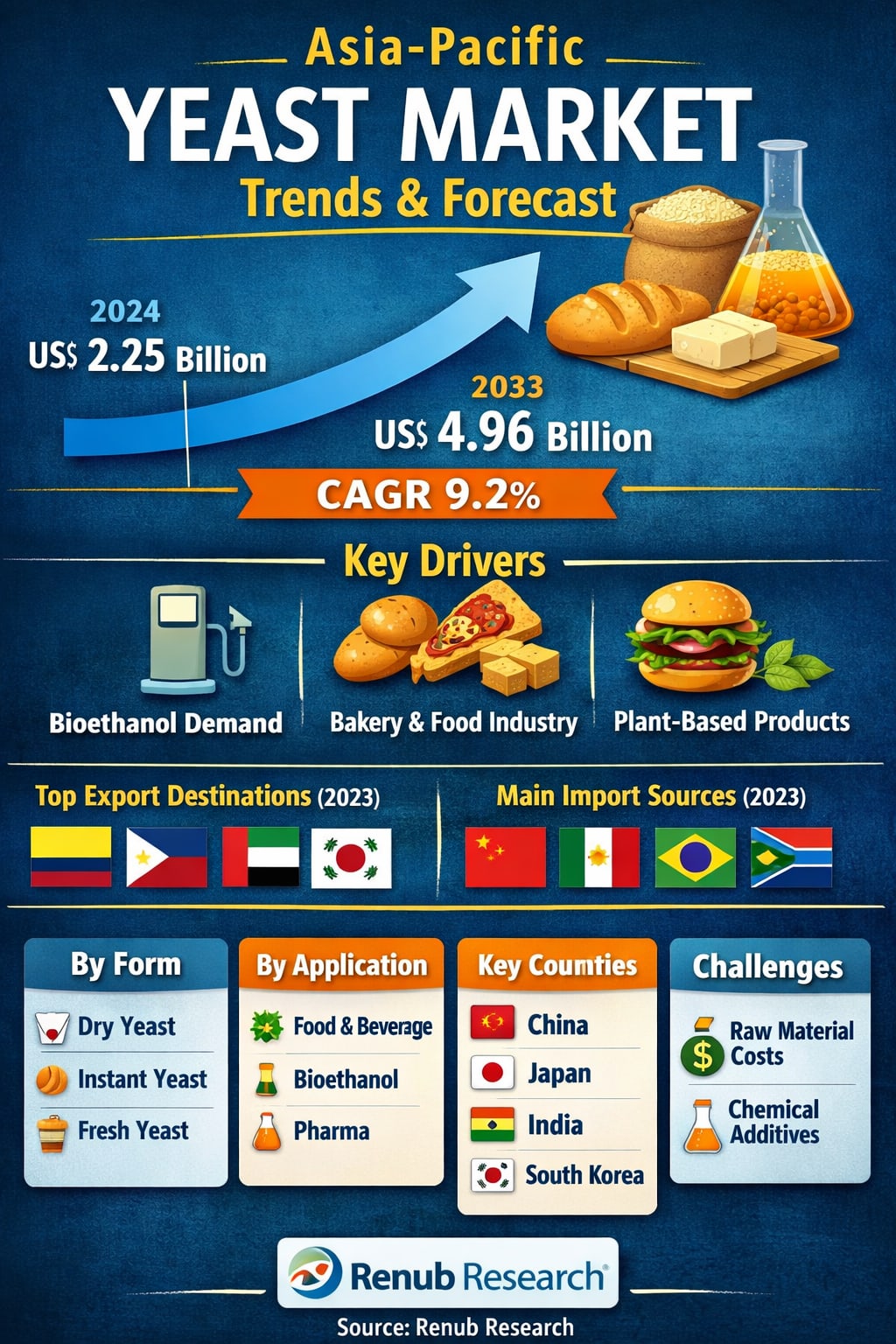
The Asia-Pacific yeast market is entering a decisive growth phase, driven by powerful shifts in food consumption, energy policies, and health-conscious consumer behavior. According to Renub Research, the Asia-Pacific Yeast Market is expected to reach US$ 4.96 billion by 2033, rising from US$ 2.25 billion in 2024, registering a strong CAGR of 9.2% from 2025 to 2033. This impressive trajectory reflects how yeast has moved beyond its traditional role in baking and brewing to become a critical input for bioethanol production, pharmaceuticals, animal feed, and functional nutrition.
Across the region, countries such as China, India, Japan, South Korea, and Southeast Asian economies are witnessing rapid urbanization, rising disposable incomes, and changing dietary patterns. These trends are fueling demand for baked goods, processed foods, alcoholic beverages, and plant-based alternatives—each of which relies heavily on yeast for fermentation, texture, flavor, and nutritional enhancement.
At the same time, government policies promoting renewable energy and sustainable fuels are boosting the use of yeast in bioethanol production. Combined with innovations in yeast strains, fermentation technology, and clean-label food formulation, the market is positioning itself as one of the most dynamic segments within the broader biotechnology and food ingredients landscape of Asia-Pacific.
Market Overview: Why Yeast Matters More Than Ever
Yeast is a microscopic organism, but its economic impact is anything but small. In Asia-Pacific, it plays a vital role in multiple industries—most notably food & beverages, bioethanol, pharmaceuticals, and animal feed. The region’s massive population base and expanding middle class have created a structural rise in demand for bread, pastries, noodles, beer, wine, and other fermented products.
Traditional cuisines also continue to support yeast consumption. From steamed buns and fermented sauces in China to dosa, idli, and bakery products in India, and from sake and miso in Japan to a growing craft beer culture across Southeast Asia, yeast remains deeply embedded in everyday consumption patterns.
Beyond food, yeast has gained importance as a functional and nutritional ingredient. It is rich in B vitamins, amino acids, minerals, and proteins, making it attractive for health supplements, fortified foods, and animal nutrition. Advances in biotechnology have further expanded its application in probiotics, immune-support products, and pharmaceutical formulations.
Despite this strong outlook, the industry faces some hurdles. Fluctuating raw material prices, storage and logistics challenges in tropical climates, and competition from chemical additives continue to shape market dynamics. Still, the long-term fundamentals—urbanization, sustainability goals, and clean-label trends—suggest a resilient and fast-growing market ahead.
Trade Snapshot: India’s Growing Role in the Global Yeast Market
India’s position in the global yeast trade highlights the region’s increasing integration into international supply chains. In 2023, India ranked as the 44th largest exporter of yeast globally, with exports valued at US$ 8.97 million. Yeast stood at 889th among 1,212 exported products from the country that year.
India’s top export destinations for yeast in 2023 included Colombia (US$ 1.77 million), the Philippines (US$ 734k), the United Arab Emirates (US$ 593k), South Korea (US$ 541k), and Nepal (US$ 341k). Over the 2022–2023 period, the UAE, the Philippines, and Colombia emerged as the top three destinations, indicating strengthening trade ties in both emerging and developed markets.
On the import side, India became the 25th largest yeast importer worldwide in 2023, with imports totaling US$ 38 million. Yeast ranked 642nd among 1,208 imported products. The country’s main suppliers were China (US$ 23.2 million), Mexico (US$ 5.79 million), Brazil (US$ 2.05 million), France (US$ 1.28 million), and South Africa (US$ 1.15 million). This import-export dynamic reflects both rising domestic demand and the strategic role of Asia-Pacific in global yeast supply chains.
Key Growth Drivers Shaping the Market
1. Rising Demand in the Food & Beverage Industry
The strongest engine of growth for the Asia-Pacific yeast market remains the food and beverage sector. Urban lifestyles, longer working hours, and changing consumption habits are pushing demand for baked goods, ready-to-eat meals, and convenience foods. Yeast is indispensable in these products, providing leavening, flavor development, and texture.
At the same time, the region’s alcoholic beverage market—particularly beer, wine, and craft beverages—is expanding steadily. Brewing yeast demand is rising not only from large manufacturers but also from small-scale and artisanal producers, especially in China, India, Japan, and Southeast Asia. As consumers become more quality-conscious, the role of specialized yeast strains in enhancing flavor profiles and product consistency becomes even more critical.
2. Expansion of the Bakery Sector
The bakery segment is one of the most visible beneficiaries of economic growth and urbanization in Asia-Pacific. Products such as bread, cakes, pastries, cookies, and buns are no longer limited to urban elites—they are becoming everyday staples across developing markets like India, Indonesia, the Philippines, and Vietnam.
Modern retail chains, quick-service restaurants, and café cultures are accelerating this shift. Home baking, boosted by social media trends and lifestyle changes, is also contributing to higher consumption of both dry and instant yeast. Since yeast is essential for fermentation, leavening, and flavor, the expansion of the bakery sector directly translates into sustained market growth.
3. Shift Toward Natural and Clean-Label Ingredients
Consumers across Asia-Pacific are increasingly scrutinizing food labels and demanding natural, transparent, and minimally processed ingredients. This clean-label movement is pushing manufacturers to replace artificial additives with natural alternatives—and yeast fits perfectly into this trend.
Beyond its functional role, yeast offers nutritional benefits, including B vitamins, proteins, and minerals. It is now widely used in plant-based foods, snacks, soups, sauces, and savory products to enhance flavor naturally without synthetic enhancers. Regulatory pressure for better labeling and healthier formulations is further accelerating this shift, making yeast a strategic ingredient for future-proof food products.
Challenges Facing the Asia-Pacific Yeast Market
1. Fluctuating Raw Material Prices
Yeast production depends heavily on raw materials such as molasses and sugar, which are by-products of the sugar industry. The availability and pricing of these inputs are influenced by seasonal harvests, weather conditions, and global trade policies. For manufacturers, this volatility can lead to unstable production costs and squeezed profit margins.
In countries with less-developed agricultural infrastructure, these challenges are even more pronounced. To maintain stability, companies are increasingly exploring alternative feedstocks, improving process efficiency, and investing in supply chain optimization.
2. Competition from Chemical Additives
Despite the growing popularity of natural ingredients, synthetic additives continue to dominate many food processing applications due to their lower cost, longer shelf life, and ease of use. In price-sensitive markets, these factors often outweigh health considerations, making it difficult for yeast-based solutions to compete purely on cost.
Overcoming this barrier requires stronger consumer education, regulatory support for clean-label products, and continued innovation to improve the performance, stability, and cost-efficiency of yeast-based ingredients.
Country-Level Insights
China Yeast Market
China represents one of the largest and fastest-growing yeast markets in the region. Rapid urbanization, rising incomes, and a booming processed food sector are driving strong demand in baking, brewing, and food fermentation. Traditional products such as fermented sauces and steamed buns continue to support high baseline consumption, while modern bakery and beverage segments are expanding quickly.
The shift toward natural ingredients and clean-label foods is also encouraging the use of yeast over artificial additives. Although challenges such as raw material price volatility and environmental regulations persist, strong domestic demand and export opportunities continue to support long-term growth.
Japan Yeast Market
Japan’s yeast market is characterized by stability, quality focus, and innovation. The country’s rich tradition of fermented foods—such as sake, miso, and soy sauce—ensures consistent demand. In addition, the popularity of artisanal foods and home baking has boosted the use of both fresh and dry yeast.
Health and wellness trends are creating new opportunities in nutritional supplements and functional foods derived from yeast. However, Japan’s mature market and aging population mean that future growth will depend more on product innovation, premiumization, and diversification than on volume expansion alone.
India Yeast Market
India’s yeast market is on a strong upward trajectory, supported by growth in food & beverages, bioethanol, and pharmaceuticals. A large population, rising incomes, and changing dietary habits are fueling demand for bakery products and fermented foods. At the same time, government initiatives promoting biofuels are increasing industrial demand for yeast in ethanol production.
The growing interest in health, nutrition, and clean-label products is also boosting yeast-based supplements and functional ingredients. While challenges such as raw material cost fluctuations and environmental regulations remain, robust domestic consumption and export potential continue to underpin market growth.
South Korea Yeast Market
South Korea’s yeast market is benefiting from rising demand across food & beverages, biofuels, and health-related products. A strong café culture, growing interest in baking, and expanding processed food consumption are driving steady growth.
Consumers are increasingly drawn to natural and functional ingredients, supporting the use of yeast in supplements and fortified foods. As in other countries, cost pressures and environmental regulations pose challenges, but innovation and premium product development are helping the market move forward.
Market Segmentation: How the Industry Is Structured
By Form
Dry Yeast
Instant Yeast
Fresh Yeast
Others
By Application
Food
Beverages
Bioethanol
Pharmaceuticals
Feed
By Country
China
Japan
India
South Korea
Thailand
Malaysia
Indonesia
Australia
New Zealand
Rest of Asia Pacific
Competitive Landscape: Key Companies in Focus
The Asia-Pacific yeast market features a mix of global food and ingredient giants. Key players covered in the competitive analysis include:
General Mills Inc.
Dun & Bradstreet Holdings
Danone SA
Sensient Technologies Corporation
Associated British Foods PLC
Koninklijke DSM N.V.
Kerry Group Plc.
These companies are focusing on product innovation, expansion into health and nutrition segments, sustainability initiatives, and strategic partnerships to strengthen their regional presence. Investments in R&D and advanced fermentation technologies are also playing a crucial role in maintaining competitive advantage.
Final Thoughts: A Market Built on Fermentation, Innovation, and Sustainability
The Asia-Pacific yeast market is no longer just about bread and beer. With Renub Research projecting growth from US$ 2.25 billion in 2024 to US$ 4.96 billion by 2033, at a CAGR of 9.2%, the industry is clearly entering a transformative phase.
Driven by food innovation, renewable energy policies, clean-label trends, and rising health awareness, yeast is becoming a strategic ingredient across multiple industries. While challenges such as raw material volatility and competition from chemical additives remain, the long-term outlook is firmly positive.
In a region where population growth, urbanization, and sustainability goals intersect, yeast is proving to be a small organism with a very big economic future.
About the Creator
Keep reading
More stories from shibansh kumar and writers in Trader and other communities.
Asia-Pacific Viscosupplementation Market Trends & Summary (2025–2033)
Introduction: A Market Lubricated by Demographics and Innovation The Asia-Pacific viscosupplementation market is entering a decisive growth phase, shaped by powerful demographic shifts, evolving patient preferences, and continuous innovation in orthopedic care. According to Renub Research, the Asia-Pacific Viscosupplementation Market is expected to reach US$ 3.80 billion by 2033, up from US$ 1.60 billion in 2024, growing at a robust CAGR of 10.1% from 2025 to 2033.
By shibansh kumarabout 11 hours ago in Trader
Philippines Online Food Delivery Market 2026: Powered by Digital Adoption and Changing Consumer Habits
Philippines Online Food Delivery Market Overview The Philippines online food delivery market size is emerging as a high-growth segment within the country’s digital economy, offering consumers unprecedented access to convenient, app-based meal ordering and delivery services. According to the latest IMARC Group analysis, the market was valued at USD 4.8 billion in 2025 and is projected to expand to USD 11.3 billion by 2034, registering a compound annual growth rate (CAGR) of 9.71 % between 2026 and 2034.
By Manisha Dixita day ago in Trader
North America Tuna Market Size, Trends, Growth, Latest Insights and Forecast to 2033
How the North America Tuna Market Reflects Changing Food Habits and Sustainability Concerns Tuna has long been a staple in North American kitchens. From canned tuna sandwiches to restaurant-grade sushi, it occupies a unique place in the region’s food culture. The North America tuna market is shaped not only by consumer demand but also by environmental awareness, global trade networks, and evolving dietary preferences.
By Jackson Watson3 days ago in Trader




Comments
There are no comments for this story
Be the first to respond and start the conversation.