
ATM Managed Services Market Size and Forecast 2025–2033 | Renub Research
Outsourcing, AI Integration, and Real-Time Monitoring Reshape the Global ATM Managed Services Industry

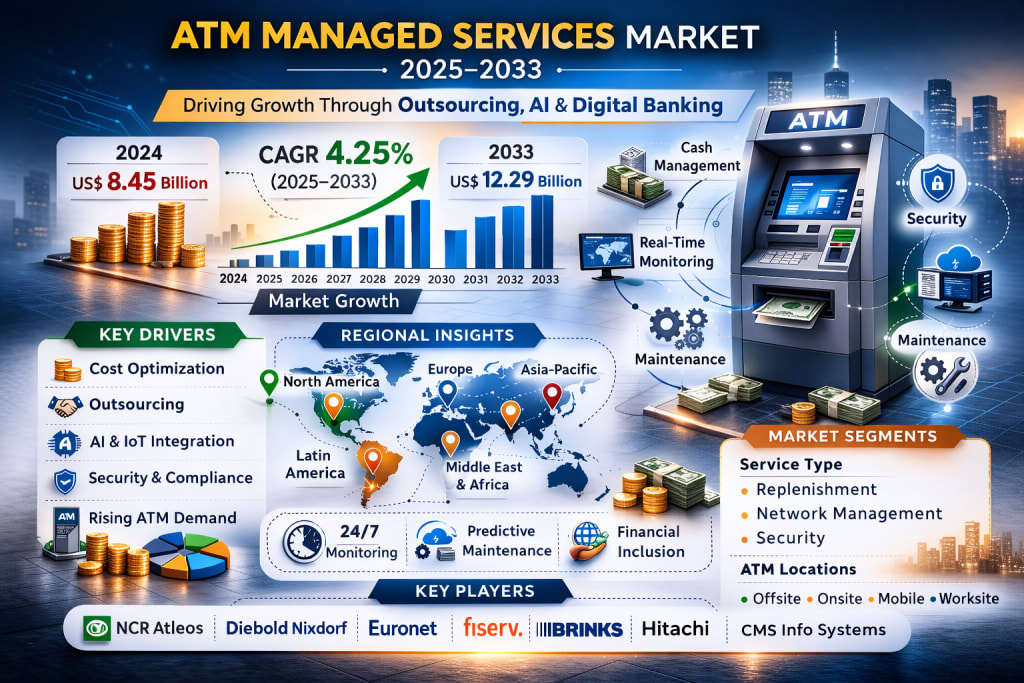
Global ATM Managed Services Market Outlook
The ATM Managed Services Market is expected to reach US$ 12.29 billion by 2033, rising from US$ 8.45 billion in 2024, registering a CAGR of 4.25% from 2025 to 2033, according to Renub Research. This steady growth reflects a broader transformation underway in the global banking and financial services industry, where institutions are increasingly shifting from in-house infrastructure management to specialized outsourcing models.
ATM managed services cover a wide range of operational activities including cash replenishment, incident management, network monitoring, security management, and overall lifecycle maintenance of ATM networks. As banks and financial institutions face mounting pressure to reduce costs, improve uptime, strengthen security, and enhance customer experience, outsourcing these functions to expert service providers has become a strategic priority rather than a tactical choice.
At the same time, the ATM ecosystem itself is evolving. Once viewed simply as cash-dispensing machines, ATMs are now multi-functional self-service terminals supporting deposits, fund transfers, bill payments, and account services. This increased complexity makes professional management not only desirable, but essential.
Market Size and Growth Forecast by Renub Research
Renub Research estimates that the global ATM managed services market will grow from US$ 8.45 billion in 2024 to US$ 12.29 billion by 2033, driven by a 4.25% CAGR during 2025–2033. This growth trajectory is supported by several long-term structural trends:
Rising cost-cutting pressures in the banking sector
Increasing outsourcing of non-core operations
Wider adoption of digital banking and hybrid service models
Growing demand for real-time monitoring and predictive maintenance
Integration of AI and IoT technologies into ATM networks
Heightened focus on security, compliance, and fraud prevention
Expansion of ATM networks in developing and semi-urban regions
Rather than declining in relevance, ATMs are being repositioned as part of a broader omnichannel banking strategy, especially in regions where cash usage remains significant and branch rationalization is ongoing.
Global ATM Managed Services Industry Overview
The global ATM managed services industry is witnessing a structural shift as financial institutions aim to streamline operations, reduce operational risk, and improve service reliability. Managing large, geographically dispersed ATM networks internally requires significant investment in staff, technology, logistics, and compliance frameworks. Outsourcing these responsibilities to specialized providers allows banks to convert fixed operational costs into more predictable service-based expenditures.
Technological innovation has further accelerated this trend. The integration of artificial intelligence (AI), Internet of Things (IoT), and advanced analytics enables service providers to offer real-time monitoring, predictive maintenance, and intelligent cash forecasting. These capabilities significantly reduce downtime, improve customer satisfaction, and enhance overall network efficiency.
In parallel, rising concerns around fraud, cyber threats, and physical security are pushing banks to rely on managed service providers that can deliver standardized, compliant, and continuously updated security frameworks. The result is a growing preference for end-to-end ATM managed services solutions that cover everything from hardware maintenance to software updates, security monitoring, and cash logistics.
Key Factors Driving the ATM Managed Services Market
1. Focus on Core Competencies
One of the strongest drivers behind the adoption of ATM managed services is the banking sector’s renewed focus on core business priorities. Financial institutions today are under pressure to innovate in digital banking, improve customer experience, and launch new financial products at speed. Managing ATM infrastructure internally can divert valuable time, capital, and technical resources away from these strategic goals.
By outsourcing ATM operations, banks can transfer responsibility for maintenance, software upgrades, cash replenishment, and compliance monitoring to specialized service providers. This not only improves operational efficiency but also enables banks to reallocate internal resources toward digital transformation, data-driven services, and customer engagement initiatives.
2. Rising ATM Footprint
Despite the growth of digital payments, the global ATM footprint continues to expand, particularly in emerging markets and underserved rural areas. Financial inclusion initiatives, government-backed banking programs, and the need for accessible self-service banking are driving new ATM deployments across Asia-Pacific, Latin America, and parts of the Middle East and Africa.
Managing a larger network of ATMs increases operational complexity. Each additional machine requires installation, monitoring, cash management, security oversight, and technical support. ATM managed services providers offer scalable solutions that allow banks to expand their networks without proportionally increasing internal operational burdens. As a result, the growth of ATM networks directly fuels demand for professional managed services.
3. Technological Advancements
Technology is reshaping the way ATM networks are managed. The use of AI, IoT, and predictive analytics enables service providers to move from reactive to proactive management models. Real-time monitoring systems can detect anomalies, predict hardware failures, and optimize maintenance schedules before issues impact customers.
AI-driven insights also play a growing role in fraud detection, security threat assessment, and cash demand forecasting. IoT sensors can monitor temperature, connectivity, and hardware health, reducing the risk of unexpected outages. These technological capabilities not only improve service quality but also help banks reduce costs and improve customer trust.
Challenges in the ATM Managed Services Market
Service Reliability and Downtime
In the ATM managed services market, uptime is everything. Customers expect 24/7 access to cash and banking services, and even short disruptions can damage customer satisfaction and brand reputation. Ensuring consistent service availability across large and geographically dispersed networks is a significant operational challenge.
Unplanned outages caused by hardware failures, network issues, or software glitches can lead to lost transaction revenue and customer dissatisfaction. Managed service providers must therefore invest heavily in real-time monitoring systems, skilled support teams, and robust service-level agreements (SLAs) to minimize downtime and ensure rapid issue resolution.
Cash Management Logistics
Cash management remains one of the most complex aspects of ATM operations. Providers must strike a careful balance between ensuring sufficient cash availability and avoiding excessive idle cash in machines, which increases security risks and operational costs.
Accurate forecasting based on historical transaction data, seasonal trends, and regional usage patterns is essential. In addition, coordinating secure cash transportation, especially in remote or high-risk areas, adds another layer of logistical complexity. Despite advances in analytics, cash logistics remains a resource-intensive but critical function within ATM managed services.
Regional Market Overview
The ATM managed services market shows varying growth patterns across regions, shaped by differences in banking infrastructure, digital adoption, and financial inclusion initiatives.
United States ATM Managed Services Market
In the United States, a mature banking sector and strong focus on cost optimization and operational efficiency are driving demand for ATM managed services. Banks are increasingly outsourcing ATM operations to improve uptime, reduce maintenance costs, and enhance service quality.
The integration of AI-driven predictive maintenance, real-time monitoring, and advanced security systems is becoming standard practice. Regulatory compliance and rising concerns around cybersecurity also encourage financial institutions to partner with specialized service providers that can ensure adherence to industry standards.
Germany ATM Managed Services Market
Germany’s ATM managed services market is growing steadily, supported by a strong banking system and increasing demand for efficient, secure, and cost-effective ATM operations. Financial institutions are turning to specialized providers to manage complex ATM networks and reduce operational overhead.
The adoption of AI, IoT, and predictive maintenance technologies is improving service reliability and security. The expansion of smart and brown-label ATMs, along with rising expectations for customer experience and regulatory compliance, continues to support market growth.
China ATM Managed Services Market
China represents one of the fastest-growing markets for ATM managed services, driven by its vast banking network and rapid digital transformation. As ATM deployments expand across both urban and rural regions, financial institutions are increasingly outsourcing management functions to improve efficiency and control costs.
Technologies such as AI, IoT, and real-time monitoring systems are playing a key role in enhancing performance, security, and user experience. Government support for financial inclusion and secure banking practices further strengthens the outlook for managed services in China’s evolving financial ecosystem.
Saudi Arabia ATM Managed Services Market
Saudi Arabia’s ATM managed services market is growing steadily alongside the country’s expanding banking infrastructure and rising adoption of digital banking. Financial institutions are outsourcing ATM operations to improve efficiency, manage costs, and meet growing transaction volumes.
Government initiatives promoting financial inclusion, combined with widespread debit card usage, are supporting higher ATM utilization. The market features a mix of international and local service providers offering cash management, maintenance, and monitoring solutions, positioning Saudi Arabia as a stable growth market in the region.
Market Segmentation
By Service Type
ATM Replenishment and Currency Management
Incident Management
Network Management
Security Management
Other Service Types
By ATM Location
Offsite ATMs
Onsite ATMs
Mobile ATMs
Worksite ATMs
By Region
North America
United States
Canada
Europe
France
Germany
Italy
Spain
United Kingdom
Belgium
Netherlands
Turkey
Asia Pacific
China
Japan
India
Australia
South Korea
Thailand
Malaysia
Indonesia
New Zealand
Latin America
Brazil
Mexico
Argentina
Middle East & Africa
South Africa
Saudi Arabia
United Arab Emirates
Competitive Landscape and Company Analysis
The ATM managed services market is characterized by the presence of global technology providers, cash logistics specialists, and regional service companies. Key players covered in the market include:
NCR Atleos
Diebold Nixdorf, Inc.
Euronet Worldwide, Inc.
Fiserv, Inc.
AGS Transact Technologies Ltd.
Brink’s Incorporated
Hitachi, Ltd.
CMS Info Systems Limited
These companies compete on the basis of service reliability, technological capabilities, geographic coverage, and end-to-end service offerings. Strategic partnerships, technology upgrades, and expansion into emerging markets remain central to their growth strategies.
Strategic Trends Shaping the Market
Several strategic trends are shaping the future of ATM managed services. Banks are increasingly looking for integrated, end-to-end service models rather than fragmented, multi-vendor arrangements. This shift favors large providers with the ability to deliver comprehensive solutions across hardware, software, security, and cash management.
Another important trend is the growing use of data analytics and AI to optimize operations, reduce costs, and improve customer experience. As ATMs become smarter and more connected, managed services will evolve from simple maintenance contracts into strategic, technology-driven partnerships.
Final Thoughts
The global ATM managed services market is entering a phase of steady, technology-driven growth, supported by rising outsourcing, expanding ATM networks, and increasing operational complexity. With the market expected to grow from US$ 8.45 billion in 2024 to US$ 12.29 billion by 2033 at a CAGR of 4.25%, the long-term outlook remains positive.
Rather than becoming obsolete, ATMs are being repositioned as a critical component of omnichannel banking strategies, especially in regions where cash usage and self-service banking remain essential. Managed services providers will play a central role in ensuring that these networks remain secure, reliable, efficient, and future-ready in an increasingly digital financial landscape.
About the Creator
JPMorgan Chase Stock Analysis: Is JPMorgan Still the Strongest Bank Stock for Long-Term Investors?
Introduction JPMorgan Chase stock is often considered the benchmark for the global banking industry. As the largest bank in the United States by assets, JPMorgan Chase plays a central role in consumer banking, corporate finance, investment banking, and global markets. Investors frequently turn to JPMorgan during periods of economic uncertainty because of its scale, diversified revenue streams, and disciplined risk management. The key question remains whether JPMorgan stock can continue delivering consistent long-term value in a changing economic and regulatory environment.
By Hammad Nawaz3 days ago in Trader




Comments
There are no comments for this story
Be the first to respond and start the conversation.