
Australia O-Ring Seals Market Size and Forecast 2025–2033
Industrial resilience, material innovation, and sustainability push steady growth across Australia’s sealing solutions industry

Australia O-Ring Seals Market Overview
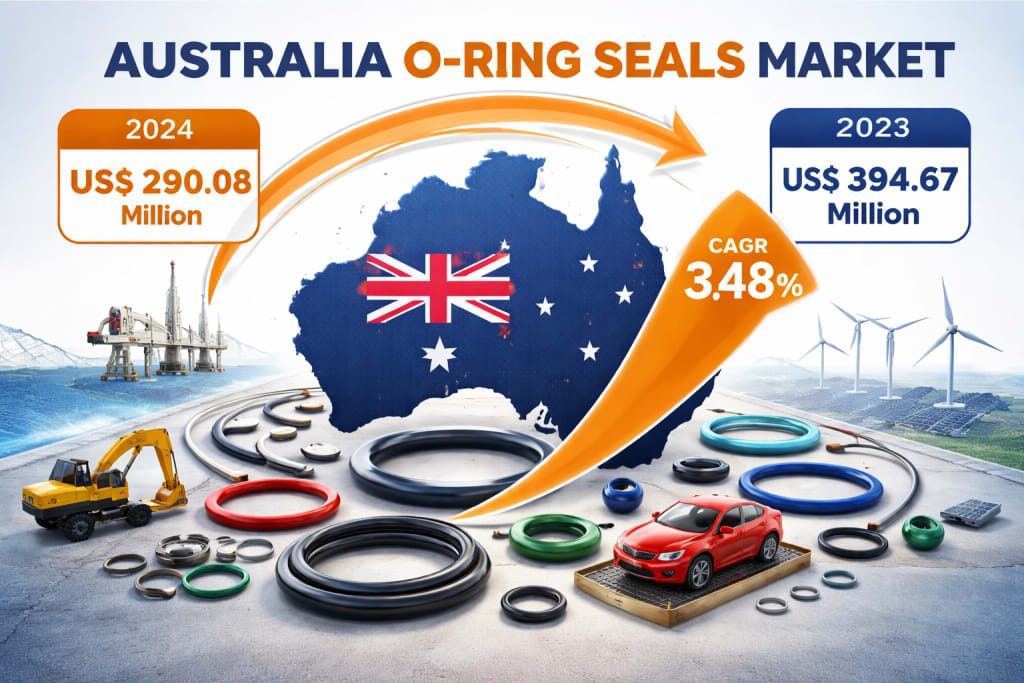
The Australia O-ring seals market is steadily emerging as a vital component of the country’s broader industrial and manufacturing ecosystem. According to Renub Research, the Australia O-ring seals market is expected to reach US$ 394.67 million by 2033, growing from US$ 290.08 million in 2024, at a compound annual growth rate (CAGR) of 3.48% from 2025 to 2033. This growth trajectory reflects the increasing importance of reliable sealing solutions across key industries such as mining, oil and gas, automotive, manufacturing, energy, food processing, and healthcare.
O-ring seals may appear to be small, simple components, but their role in modern industry is anything but minor. These circular elastomeric seals are critical for preventing leaks, maintaining pressure, and ensuring the safe and efficient operation of machinery and equipment. From heavy mining equipment in Western Australia to advanced manufacturing lines and automotive systems, O-rings are essential to keeping operations running smoothly and safely.
Australia’s industrial landscape provides a strong foundation for this market. The country’s resource-rich economy, particularly in mining and energy, continues to require robust and durable sealing solutions capable of performing under extreme conditions such as high pressure, high temperature, and exposure to aggressive chemicals. At the same time, growth in infrastructure projects, renewable energy installations, and advanced manufacturing is expanding the application base for high-performance O-ring seals.
Another important factor shaping the market is the rising focus on operational efficiency and cost control. Industries are increasingly prioritizing components that can reduce maintenance downtime, extend equipment life, and improve overall system reliability. High-quality O-ring seals, engineered with advanced materials and precise manufacturing techniques, directly support these goals. As a result, demand is shifting toward more durable, application-specific, and performance-optimized sealing solutions.
Sustainability and regulatory compliance are also becoming central themes in the Australian O-ring seals industry. With stricter environmental and safety regulations, manufacturers and end users alike are paying closer attention to material choices, production processes, and lifecycle performance of sealing products. This is encouraging innovation in eco-friendly materials, recyclable elastomers, and energy-efficient manufacturing practices, further reshaping the competitive landscape of the market.
Industry Landscape: A Critical Component of Industrial Reliability
Australia’s O-ring seals industry operates at the intersection of traditional heavy industry and modern, technology-driven manufacturing. Sectors such as mining, oil and gas, construction, and automotive continue to represent major sources of demand due to their reliance on complex mechanical systems that must operate reliably in harsh environments. In these settings, even a minor seal failure can lead to costly downtime, safety risks, and environmental damage.
The mining and energy sectors, in particular, are major consumers of high-performance O-rings. Equipment used in extraction, processing, and transportation is exposed to extreme mechanical stress, temperature fluctuations, and corrosive substances. This has driven consistent demand for seals made from advanced elastomers and thermoplastics that can withstand such conditions over long operating cycles.
Meanwhile, the growth of automation and smart manufacturing is changing how O-rings are specified and used. As Australian manufacturers adopt more automated production lines and precision machinery, the need for seals with tighter tolerances, lower friction, and longer service life is increasing. In many applications, sealing components are no longer treated as simple consumables but as strategic parts of system design that contribute directly to efficiency, safety, and performance.
The automotive sector also plays a meaningful role in shaping demand. The gradual shift toward electric and hybrid vehicles is introducing new sealing requirements, particularly in battery systems, thermal management, and power electronics. These applications often require O-rings with superior resistance to heat, chemicals, and electrical components, pushing manufacturers to innovate in both material science and product design.
Key Factors Driving the Australia O-Ring Seals Market Growth
Technological Advancements and Material Innovation
One of the most important growth drivers in the Australian O-ring seals market is continuous progress in material science and manufacturing technology. Traditional rubber compounds are increasingly being complemented or replaced by high-performance materials such as fluorocarbon, silicone, perfluoroelastomers, and advanced thermoplastic elastomers. These materials offer superior resistance to chemicals, extreme temperatures, pressure, and mechanical wear.
For industries such as mining, oil and gas, and automotive manufacturing, these improvements translate directly into longer service life, better reliability, and lower maintenance costs. O-rings that can perform consistently under harsh conditions reduce the frequency of replacements and unplanned shutdowns, delivering clear economic benefits to operators.
In addition, advances in precision manufacturing, quality control, and testing methods are allowing suppliers to produce seals with tighter tolerances and more consistent performance. This is especially important for applications in aerospace, healthcare, and high-end manufacturing, where even small deviations can have serious consequences. As a result, technological innovation is not only expanding the performance envelope of O-rings but also strengthening their role as critical, high-value components in complex systems.
Automation and the Rise of Smart Manufacturing
The adoption of Industry 4.0 principles and smart manufacturing systems across Australia is creating new opportunities for the O-ring seals market. Automated machinery, robotics, and high-speed production lines place greater demands on sealing components, which must operate reliably under continuous motion, vibration, and varying loads.
In these environments, O-rings need to deliver low friction, high wear resistance, and consistent sealing performance over long periods. This has encouraged the development of application-specific seals designed for dynamic conditions, as well as experimental concepts such as sensor-integrated seals that can support predictive maintenance and real-time system monitoring.
For manufacturers, this shift means that O-rings are increasingly being selected not just for basic compatibility, but for their contribution to overall system efficiency, uptime, and data-driven maintenance strategies. This trend is particularly visible in advanced manufacturing, automotive production, and food processing, where reliability and hygiene standards are especially strict.
Rising Maintenance and Replacement Needs
Australia’s extensive base of industrial equipment and infrastructure is another steady driver of demand for O-ring seals. Over time, seals naturally degrade due to wear, heat, pressure, and chemical exposure. Regular replacement is essential to prevent leaks, maintain safety, and avoid costly equipment failures.
Industries such as manufacturing, water treatment, mining, and energy production rely heavily on routine maintenance schedules, creating a stable aftermarket for replacement O-rings. At the same time, many companies are shifting toward preventative and predictive maintenance strategies, which emphasize timely component replacement before failures occur. This approach not only reduces downtime but also increases the importance of reliable, high-quality sealing solutions.
As a result, the replacement market is not just about volume, but also about quality and performance. End users are increasingly willing to invest in better materials and more durable designs if it means longer service intervals and improved operational reliability.
Challenges in the Australia O-Ring Seals Market
Environmental Regulations and Compliance Costs
While sustainability is creating new opportunities, it also presents challenges for manufacturers. Australia’s stricter environmental regulations are pushing companies to adopt cleaner production processes, reduce emissions, and use more sustainable materials. Although these changes are beneficial in the long term, they often require significant upfront investment in research, equipment, and process redesign.
For small and medium-sized enterprises, these compliance costs can be particularly burdensome. Meeting regulatory requirements may increase production costs, extend development timelines, and add administrative complexity. Even so, companies that successfully adapt can benefit from improved brand reputation, better access to environmentally conscious customers, and stronger long-term competitiveness.
Competition from Low-Cost Imports
Another major challenge for the Australian O-ring seals market is competition from low-cost imports, especially from Asian manufacturing hubs. These products often enter the market at significantly lower prices, putting pressure on local manufacturers to compete on cost as well as quality.
While cheaper imports may appeal to price-sensitive buyers, they can sometimes fall short in terms of material quality, consistency, and long-term performance. Local producers, therefore, must focus on differentiation through reliability, customization, technical support, and value-added services. However, ongoing price pressure can squeeze margins and limit the resources available for research, development, and sustainability initiatives.
Market Segmentation: Understanding Where Growth Comes From
By Type
The Australian O-ring seals market is segmented into Synthetic Rubber and Thermoplastic Elastomer. Synthetic rubber continues to hold a strong position due to its proven performance, versatility, and cost-effectiveness across a wide range of applications. Meanwhile, thermoplastic elastomers are gaining traction because of their superior processing flexibility, recyclability, and performance in demanding environments.
As industries seek more sustainable and high-performance solutions, the balance between these two material categories is likely to evolve, with advanced elastomers playing a growing role in specialized applications.
By Application
O-ring seals in Australia are used across a broad spectrum of industries, including:
Electrical and Electronic Products
Aerospace Equipment
Energy
Food and Beverages
Healthcare and Medical
Automotive and Transportation
Machinery Manufacturing
Others
Each of these sectors has unique performance, safety, and regulatory requirements, which in turn drive demand for different materials, designs, and quality standards. The diversity of applications helps stabilize the market, as growth in one sector can offset slower performance in another.
Competitive Landscape and Company Analysis
The Australian O-ring seals market features a mix of global leaders and established industrial suppliers. Key companies operating in this space include:
AB SKF
NOK Corporation
Zhongding Group
ElringKlinger AG
Freudenberg & Co. KG
Hutchinson SA (TotalEnergies SE)
Parker Hannifin Corporation
These companies compete on factors such as product quality, material innovation, application expertise, global supply capabilities, and customer support. Many are investing heavily in research and development to create seals that meet evolving performance and sustainability requirements. Strategic partnerships, capacity expansions, and product portfolio upgrades are common as players seek to strengthen their positions in both the OEM and aftermarket segments.
Outlook: A Market Built on Reliability and Innovation
Looking ahead, the Australia O-ring seals market is set to continue its steady expansion through 2033, supported by industrial growth, infrastructure development, and ongoing technological progress. While the projected CAGR of 3.48% reflects a mature and stable market rather than explosive growth, it also highlights the essential, non-cyclical nature of sealing solutions across the economy.
As industries place greater emphasis on efficiency, safety, and sustainability, the role of high-performance O-rings will only become more important. Manufacturers that can combine material innovation, reliable quality, and environmentally responsible practices are likely to be best positioned to capture future opportunities.
Final Thoughts
The Australia O-ring seals market may not always be in the spotlight, but it plays a quietly critical role in keeping the nation’s industries running. From mining and energy to healthcare and advanced manufacturing, these small components deliver outsized value by ensuring safety, efficiency, and reliability.
With the market expected to grow from US$ 290.08 million in 2024 to US$ 394.67 million by 2033, the outlook remains positive and stable. Driven by material innovation, automation, infrastructure investment, and sustainability goals, O-ring seals will continue to be an indispensable part of Australia’s industrial future. For manufacturers, suppliers, and end users alike, the coming years offer a clear message: in a world that demands reliability, even the smallest components matter more than ever.
About the Creator
Sakshi Sharma
Content Writer with 7+ years of experience crafting SEO-driven blogs, web copy & research reports. Skilled in creating engaging, audience-focused content across diverse industries.
Keep reading
More stories from Sakshi Sharma and writers in Trader and other communities.
Australia Goat Milk Market Size and Forecast 2025–2033
Australia Goat Milk Market Overview The Australia Goat Milk Market is gaining steady momentum as consumers increasingly shift toward healthier and more digestible dairy alternatives. According to Renub Research, the market is expected to reach US$ 342.1 million by 2033, up from US$ 231.99 million in 2024, growing at a CAGR of 4.41% from 2025 to 2033. This growth reflects a broader transformation in Australian dietary preferences, where functional nutrition, digestive health, and premium food choices are playing a more influential role in everyday consumption decisions.
By Sakshi Sharmaabout 21 hours ago in Trader
Understanding Bonds: A Beginner’s Guide to Fixed-Income Investing
Introduction Bonds are debt securities issued by governments, corporations, or other entities to raise capital. Investors who buy bonds are essentially lending money in exchange for interest payments and the return of principal at maturity.
By Hammad Nawaz5 days ago in Trader



Comments
There are no comments for this story
Be the first to respond and start the conversation.