
Azodicarbonamide Market Size and Forecast 2026–2034
Industrial Demand Drives Steady Expansion Amid Tightening Global Regulations

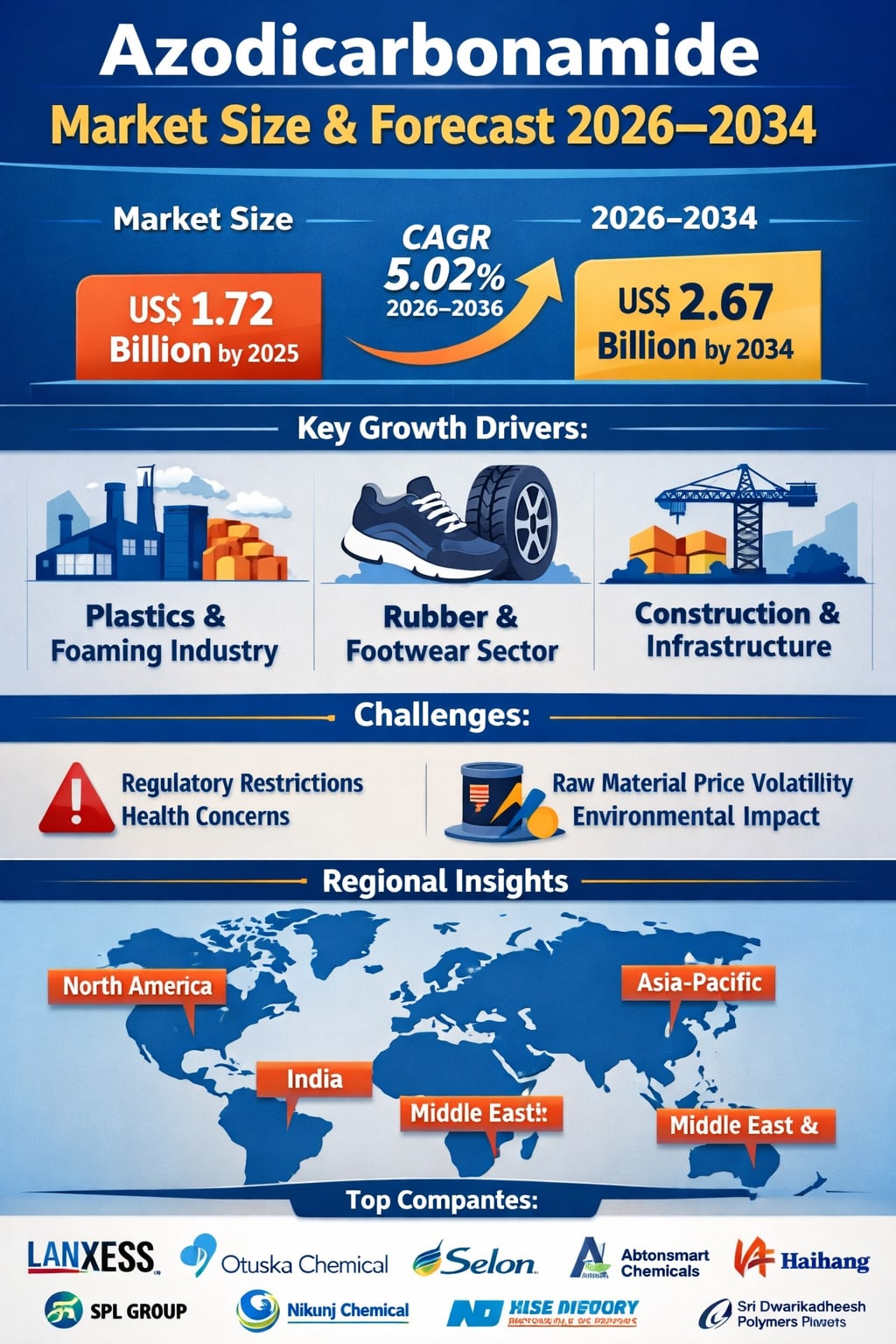
The global Azodicarbonamide (ADA) Market is projected to reach US$ 2.67 billion by 2034, rising from US$ 1.72 billion in 2025, expanding at a CAGR of 5.02% from 2026 to 2034. The steady growth reflects sustained demand from the plastics, rubber, and construction industries, where azodicarbonamide remains a critical blowing agent. While food-related applications face increasing regulatory scrutiny, industrial usage continues to underpin market stability.
As lightweight materials, energy-efficient construction solutions, and advanced foamed polymers gain prominence worldwide, ADA’s industrial relevance remains intact. Emerging economies, particularly in Asia-Pacific, are poised to contribute significantly to future growth, even as developed markets tighten health and environmental regulations.
Azodicarbonamide Industry Overview
Azodicarbonamide (ADA) is a chemical compound widely recognized for its function as a blowing agent in plastics and rubber manufacturing. It appears as a yellow to orange crystalline powder and decomposes upon heating to release gases such as nitrogen and carbon monoxide. This gas-releasing property enables the formation of foamed materials with enhanced structural integrity, lightweight characteristics, and durability.
In the plastics industry, ADA plays a vital role in producing foamed polyvinyl chloride (PVC), polyethylene (PE), and polyurethane (PU) materials. These foams are extensively used in construction insulation panels, flooring underlays, packaging materials, and automotive components. The ability to reduce product weight while maintaining strength and resilience has made ADA indispensable for modern manufacturing.
Within the rubber sector, azodicarbonamide supports vulcanization processes, improving elasticity and mechanical strength in products such as footwear soles, conveyor belts, automotive seals, and industrial rubber components.
In the food industry, ADA has been used as a dough conditioner to strengthen gluten networks and improve bread volume and texture. However, regulatory bans and restrictions in several regions—including the European Union—have curtailed its food-grade applications due to concerns about its breakdown byproduct, semi carbazide (SEM).
Despite regulatory challenges in food applications, ADA’s industrial utility ensures its continued demand globally. As manufacturers seek cost-effective, high-performance blowing agents, azodicarbonamide remains a preferred option.
Key Growth Drivers
1. Rising Demand in Plastics and Foaming Applications
The increasing need for lightweight, durable materials in construction and packaging remains one of the strongest drivers of ADA consumption. Urbanization, infrastructure expansion, and the rise of energy-efficient building standards have intensified the use of insulated panels and foam-based materials.
Foamed plastics help reduce transportation costs, improve insulation performance, and lower overall material usage. In automotive manufacturing, weight reduction directly contributes to fuel efficiency and emission reduction goals. As sustainability initiatives expand, lightweight materials are becoming a strategic necessity rather than an option.
The packaging sector also plays a critical role. Expanding e-commerce activities worldwide have accelerated the demand for protective, lightweight packaging materials—many of which rely on foamed plastic solutions produced using ADA.
2. Growth in the Rubber and Footwear Industries
Azodicarbonamide significantly enhances rubber elasticity and product durability. As global footwear consumption rises—especially in Asia-Pacific and Latin America—ADA demand benefits from consistent growth in shoe sole manufacturing.
Similarly, automotive tire production and industrial rubber components continue to require reliable blowing agents for performance optimization. Emerging economies with expanding middle-class populations are witnessing rising demand for footwear, consumer electronics, and vehicles—all of which utilize rubber components enhanced by ADA.
Industrial machinery, conveyor systems, and construction equipment further contribute to rubber product consumption, reinforcing steady market demand.
3. Expanding Construction and Infrastructure Projects
Infrastructure investments across Asia, the Middle East, and Africa are boosting consumption of insulated panels, foam boards, and lightweight construction materials. Governments worldwide are prioritizing housing, transport, and energy-efficient building solutions, increasing the use of foamed PVC and polyurethane products.
The global push toward sustainable construction also supports materials that improve thermal insulation and reduce energy consumption. ADA-enabled foam materials align with these objectives by offering cost-effective insulation properties.
Challenges Facing the Market
1. Regulatory Restrictions and Health Concerns
One of the primary obstacles in the azodicarbonamide market is regulatory scrutiny, particularly concerning food-grade applications. When used in baking, ADA may convert into semi carbazide (SEM), a compound associated with potential health risks. This has led to bans or restrictions in several countries.
Consumer awareness regarding chemical additives has further intensified demand for clean-label and natural alternatives. In regions like North America and Europe, bakeries increasingly prefer enzyme-based dough conditioners.
Regulatory developments also affect industrial applications, as environmental authorities enforce stricter emission standards for chemical manufacturing facilities.
2. Raw Material Price Volatility
Azodicarbonamide production relies on intermediates such as urea and hydrazine derivatives. Fluctuations in crude oil and natural gas prices influence production costs. Manufacturers must navigate these price variations while maintaining profitability and competitive pricing.
In addition, compliance with environmental regulations requires investment in emission control and waste management systems, increasing operational expenditures.
Regional Market Insights
United States
The United States market remains stable, driven primarily by industrial demand. ADA’s role in insulation materials, automotive components, and packaging ensures consistent consumption. However, food-grade usage has declined due to health concerns and growing consumer preference for natural ingredients.
The U.S. benefits from advanced manufacturing infrastructure and established supply chains, enabling steady industrial growth.
United Kingdom
In the United Kingdom, industrial applications dominate ADA usage. Construction insulation and automotive components sustain demand, while strict regulatory frameworks limit food-grade applications. Environmental compliance standards shape production practices, ensuring responsible handling and emissions management.
India
India represents a high-growth market, supported by rapid industrialization, infrastructure expansion, and automotive manufacturing. The country’s expanding construction sector significantly boosts demand for foamed plastic products.
While food applications face scrutiny, industrial usage remains strong, positioning India as a key regional consumer within Asia-Pacific.
United Arab Emirates
The United Arab Emirates (UAE) market benefits from infrastructure development and its role as a regional logistics hub. Construction projects and packaging demand support industrial consumption. Food-grade usage remains limited due to health awareness and regulatory considerations.
Recent Developments
Regulatory changes continue to reshape the global landscape:
February 2025: China removed azodicarbonamide from its list of approved food additives under GB 2760-2024, reinforcing its transition toward industrial-only applications.
July 2024: The Codex Committee on Food Additives agreed to withdraw the international endorsement of azodicarbonamide (INS 927a), signaling growing global regulatory alignment.
These developments indicate a long-term shift away from food applications while preserving industrial demand.
Market Segmentation
By Type:
Food Grade
Industrial Grade
By Application:
Plastic and Rubber Industry
Food and Beverage Industry
Leather and Textile Industry
Others
By Region:
North America (United States, Canada)
Europe (France, Germany, Italy, Spain, United Kingdom, Belgium, Netherlands, Turkey)
Asia-Pacific (China, Japan, India, Australia, South Korea, Thailand, Malaysia, Indonesia, New Zealand)
Latin America (Brazil, Mexico, Argentina)
Middle East & Africa (South Africa, Saudi Arabia, United Arab Emirates)
Key Players Analysis
Major companies operating in the azodicarbonamide market include:
Lanxess AG
Otsuka Chemical Co. Ltd
Jiangxi Selon Industrial Co. Ltd
Abtonsmart Chemicals (Group) Co. Ltd
Haihang Industry Co. Ltd
SPL Group
Nikunj Chemical Limited
Sri Dwarikadheesh Polymers Pvt. Ltd.
These players focus on product innovation, compliance with evolving regulations, capacity expansion in emerging markets, and strengthening global distribution networks. Many manufacturers are investing in environmentally friendly production technologies to address sustainability concerns.
Competitive Landscape
The market demonstrates moderate fragmentation, with strong participation from Asia-Pacific manufacturers due to cost advantages and growing regional demand. European and North American companies emphasize compliance, product quality, and advanced processing technologies.
Strategic partnerships, distribution expansion, and research into alternative blowing agents remain central competitive strategies.
Future Outlook
Between 2026 and 2034, the azodicarbonamide market is expected to maintain steady growth, supported primarily by industrial applications. While food-grade demand declines due to regulatory tightening, expanding construction, automotive, and packaging sectors will continue driving industrial consumption.
Asia-Pacific is projected to remain the dominant region, fueled by infrastructure growth and manufacturing expansion. Emerging markets across Africa and the Middle East are also expected to contribute incremental demand.
Technological advancements in foam production and increasing preference for lightweight, high-performance materials will further reinforce ADA’s industrial significance.
Final Thoughts
The global azodicarbonamide market reflects a balanced narrative of opportunity and regulation. With projected revenues rising from US$ 1.72 billion in 2025 to US$ 2.67 billion by 2034, the industry demonstrates resilience despite regulatory challenges in food applications.
Industrial demand—particularly in plastics, rubber, construction, and packaging—remains the backbone of market growth. As sustainability and efficiency shape manufacturing priorities worldwide, azodicarbonamide’s role in lightweight and high-performance materials ensures its continued relevance in the global chemicals industry.


Comments
There are no comments for this story
Be the first to respond and start the conversation.