
Belts and Wallets Market Size and Forecast 2026–2034
Fashion Meets Function: How Lifestyle, Branding, and E-Commerce Are Reshaping the Global Accessories Industry

Belts and Wallets Market Overview
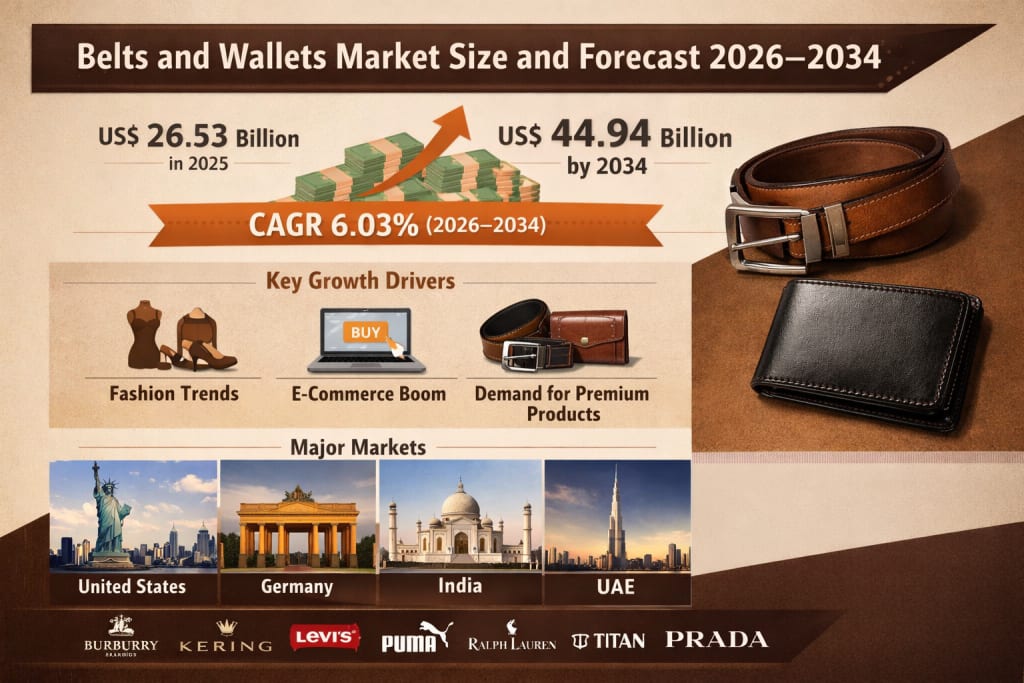
The global belts and wallets market is steadily transforming from a purely utility-driven segment into a fashion-forward, lifestyle-oriented industry. According to Renub Research, the Belts and Wallets Market is expected to reach US$ 44.94 billion by 2034, growing from US$ 26.53 billion in 2025, at a CAGR of 6.03% from 2026 to 2034. This growth reflects not only rising consumer spending power but also a deeper shift in how accessories are perceived across demographics.
Belts and wallets today serve a dual purpose: they are essential daily-use products and powerful expressions of personal style. From minimalist leather wallets and premium designer belts to eco-friendly and tech-enabled accessories, the category has expanded well beyond its traditional boundaries. Global brands, regional players, and local manufacturers compete across a wide range of price points, materials, and designs to cater to diverse consumer preferences.
The market’s evolution is being shaped by several converging trends, including increasing fashion consciousness, rapid growth in e-commerce, premiumization of everyday accessories, and the influence of social media and celebrity culture. In addition, innovation in materials—such as sustainable leather alternatives and recycled fabrics—along with functional upgrades like RFID protection and modular designs, is redefining consumer expectations.
Geographically, Asia-Pacific is emerging as a high-growth region due to urbanization, a growing middle class, and rising brand awareness. Meanwhile, North America and Europe continue to represent strong markets, especially in premium and luxury segments. As lifestyle patterns change and fashion cycles accelerate, the belts and wallets industry is positioned for consistent, long-term growth across both developed and emerging economies.
Belts and Wallets Industry Dynamics
The belts and wallets industry sits at the intersection of fashion, functionality, and personal identity. What was once considered a low-involvement purchase has now become a curated decision influenced by brand image, material quality, design aesthetics, and even ethical sourcing.
Consumers increasingly look for accessories that align with their broader lifestyle choices—whether that means investing in luxury craftsmanship, opting for minimalist and practical designs, or choosing sustainable and cruelty-free materials. This shift has encouraged brands to diversify their portfolios, introducing collections that cater to different use cases such as formal wear, casual fashion, travel, and everyday utility.
Another defining feature of the market is the speed at which trends circulate. Social media platforms, influencers, and celebrity endorsements can rapidly turn a specific design or brand into a must-have item. As a result, companies are under constant pressure to innovate, refresh collections, and shorten product development cycles while maintaining quality and brand consistency.
Growth Drivers for the Belts and Wallets Market
Rising Fashion Consciousness and Lifestyle Trends
One of the strongest growth drivers for the belts and wallets market is the increasing fashion awareness among consumers worldwide. Accessories are no longer treated as mere add-ons; they are now central elements of personal style and self-expression. Urbanization, exposure to global fashion trends, and the influence of social media have significantly changed how people perceive everyday accessories.
Millennials and Gen Z consumers, in particular, are highly responsive to trends promoted by influencers, celebrities, and fashion brands. They tend to update their accessories more frequently to match seasonal styles, outfits, and social occasions. Limited-edition collections, brand collaborations, and designer-led capsule ranges further stimulate demand and create a sense of exclusivity.
As fashion becomes more integrated into daily life, brands that offer variety in terms of design, color, texture, and styling are better positioned to capture consumer attention and drive repeat purchases.
Growth of E-Commerce and Digital Retail Platforms
The rapid expansion of e-commerce has fundamentally changed how belts and wallets are marketed and sold. Online platforms give consumers access to a vast selection of products, brands, and price ranges, along with the ability to compare features, read reviews, and discover new trends instantly.
For brands, digital retail channels provide an opportunity to reach customers beyond traditional brick-and-mortar stores, especially in smaller cities and emerging markets. Personalization features such as monogramming, custom colors, and size options are increasingly offered online, enhancing the customer experience and perceived product value.
Social commerce, influencer marketing, and mobile shopping apps have further strengthened the role of digital channels in driving sales. The convenience, variety, and accessibility of online shopping continue to make e-commerce a key engine of growth for the global belts and wallets market.
Increasing Demand for Premium and Branded Accessories
Rising disposable incomes and changing consumer aspirations are fueling strong demand for premium and branded belts and wallets. Many consumers now view these accessories as long-term investments rather than simple utility items. Brand reputation, craftsmanship, material quality, and design heritage play a crucial role in purchasing decisions, particularly in the mid-to-high-end segments.
Luxury and premium brands differentiate themselves through superior materials such as genuine leather, refined metal hardware, and advanced synthetic fabrics. At the same time, functional enhancements—like RFID-blocking technology, slim-profile designs, and multi-compartment layouts—add to the overall value proposition.
In emerging markets, growing exposure to international brands and lifestyle trends is accelerating the shift toward branded products, supporting both volume growth and higher average selling prices across the market.
Challenges in the Belts and Wallets Market
Intense Competition and Market Fragmentation
The global belts and wallets market is highly competitive and fragmented, with numerous international, regional, and local players operating across different price segments. This intense competition puts pressure on pricing strategies, marketing budgets, and product differentiation efforts.
Established brands must continuously invest in innovation and branding to maintain their market position, while smaller players often struggle to gain visibility in a crowded retail and digital landscape. The presence of counterfeit and unbranded products, especially in price-sensitive markets, further complicates the competitive environment by eroding brand value and consumer trust.
Additionally, rapidly changing fashion trends require companies to be agile and responsive, increasing the complexity and cost of product development and inventory management.
Fluctuating Raw Material Costs and Supply Chain Risks
Another major challenge for the industry is the volatility in raw material prices and ongoing supply chain uncertainties. Leather, synthetic materials, metals, and specialized components are all subject to price fluctuations driven by factors such as environmental regulations, trade policies, and global economic conditions.
Dependence on international suppliers can expose manufacturers to shipping delays, logistics disruptions, and geopolitical risks. The growing demand for sustainable and ethically sourced materials adds another layer of complexity, as certified alternatives can be more expensive and less widely available.
Managing costs while maintaining quality and supply reliability remains a critical balancing act for companies operating in the belts and wallets market.
Regional Market Insights
United States Belts and Wallets Market
The United States represents a mature yet dynamic market for belts and wallets, supported by strong consumer spending, lifestyle-driven purchasing behavior, and a well-developed retail ecosystem. Consumers increasingly seek accessories that combine style, quality, and functionality, driving demand for both premium and mid-range products.
E-commerce and omnichannel retail strategies play a central role in market growth, while social media and influencer marketing strongly influence consumer preferences. Innovations such as RFID-protected wallets, customizable belts, and eco-friendly materials are particularly appealing to tech-savvy and environmentally conscious buyers.
Germany Belts and Wallets Market
Germany’s market is characterized by a strong emphasis on quality, durability, and craftsmanship. Consumers show a growing preference for premium and sustainable products, reflecting broader environmental awareness and responsible consumption trends.
The expansion of online retail, combined with demand for minimalist and functional designs, continues to support steady market growth. Features like RFID protection, adjustable fittings, and ethically sourced materials are becoming increasingly important differentiators.
India Belts and Wallets Market
India is one of the fastest-growing markets in this segment, driven by urbanization, rising incomes, and a rapidly expanding fashion-conscious middle class. Belts and wallets are increasingly seen as lifestyle accessories rather than purely functional items.
E-commerce platforms, social media influence, and celebrity endorsements play a major role in shaping consumer demand. The market offers a wide spectrum of products, from affordable options to premium branded accessories, making it both competitive and full of growth opportunities.
United Arab Emirates Belts and Wallets Market
The UAE market benefits from high disposable incomes, a strong luxury retail presence, and a fashion-forward consumer base. Belts and wallets are often viewed as status symbols, driving strong demand for premium and designer products.
A well-developed retail infrastructure, combined with growing e-commerce adoption, supports consistent market expansion. Innovation, customization, and high-quality materials remain key factors influencing purchasing decisions.
Recent Developments in the Market
In April 2023, Prada introduced the Re-Nylon Belt made from recycled nylon, reflecting the industry’s shift toward sustainable materials.
In March 2023, Gucci launched the MG Marmont wallet featuring its signature quilted design and premium leather finish.
In January 2023, Louis Vuitton unveiled the LV Volt Belt, inspired by its jewelry collection and featuring a modern metallic buckle design.
These launches highlight how leading brands are combining sustainability, design innovation, and brand identity to strengthen their market positions.
Market Segmentation
By Type:
Belts
Wallets
By Material:
Leather
Non-Leather
By Distribution Channel:
Online
Offline
By End User:
Men
Women
By Region:
North America (United States, Canada)
Europe (France, Germany, Italy, Spain, United Kingdom, Belgium, Netherlands, Turkey)
Asia Pacific (China, Japan, India, Australia, South Korea, Thailand, Malaysia, Indonesia, New Zealand)
Latin America (Brazil, Mexico, Argentina)
Middle East & Africa (South Africa, Saudi Arabia, United Arab Emirates)
Key Players in the Market
Burberry Group plc
Kering SA
Levi Strauss & Co.
Puma SE
Ralph Lauren Corporation
Titan Company Ltd
PVH Corp.
Prada S.p.A.
These companies are analyzed across business overview, leadership, recent developments, SWOT analysis, and financial insights, highlighting their strategic positioning within the global market.
Final Thoughts
The global belts and wallets market is evolving into a vibrant, style-driven, and innovation-focused segment of the fashion accessories industry. With the market projected to grow from US$ 26.53 billion in 2025 to US$ 44.94 billion by 2034, the outlook remains highly positive, supported by lifestyle changes, digital retail expansion, and rising demand for premium and functional accessories.
As consumers continue to seek products that blend fashion, utility, and personal identity, brands that invest in design innovation, sustainability, and strong digital engagement will be best positioned to succeed. In an era where even everyday accessories make a statement, the belts and wallets market is set to remain a key beneficiary of global fashion and lifestyle trends.
About the Creator
Online Event Ticketing Market Size and Forecast 2025–2033
Online Event Ticketing Market: A Digital Gateway to Live Experiences The global entertainment industry is in the middle of a powerful digital transformation, and few segments reflect this shift as clearly as online event ticketing. From concerts and sports matches to movies and live performances, the way people discover, purchase, and access events has changed dramatically over the past decade. What was once dominated by physical box offices and long queues has now become a mobile-first, app-driven experience built around speed, convenience, and personalization.
By shibansh kumar6 days ago in Trader
Australia Power Transformer Market 2026: Grid Modernisation, Renewable Integration and High-Voltage Infrastructure Growth
Australia Power Transformer Market Overview Australia’s power transformer market is expanding steadily as the country accelerates investments in electricity transmission infrastructure, renewable energy integration and grid modernisation initiatives. Power transformers play a critical role in high-voltage electricity transmission by stepping voltage levels up or down, ensuring efficient long-distance power delivery and stable distribution across industrial, commercial and residential networks. With Australia pursuing ambitious decarbonisation targets and deploying large-scale solar, wind and storage assets, demand for advanced transformer solutions is strengthening across transmission and utility networks.
By Amyra Singh3 days ago in Trader



Comments
There are no comments for this story
Be the first to respond and start the conversation.