
Chile Salmon Market Size Forecast 2025–2033: Riding the Global Wave of Sustainable Seafood Demand
Rising exports, sustainability initiatives, and strong global appetite for healthy protein are propelling Chile’s salmon industry toward a US$ 399.37 million valuation by 2033.

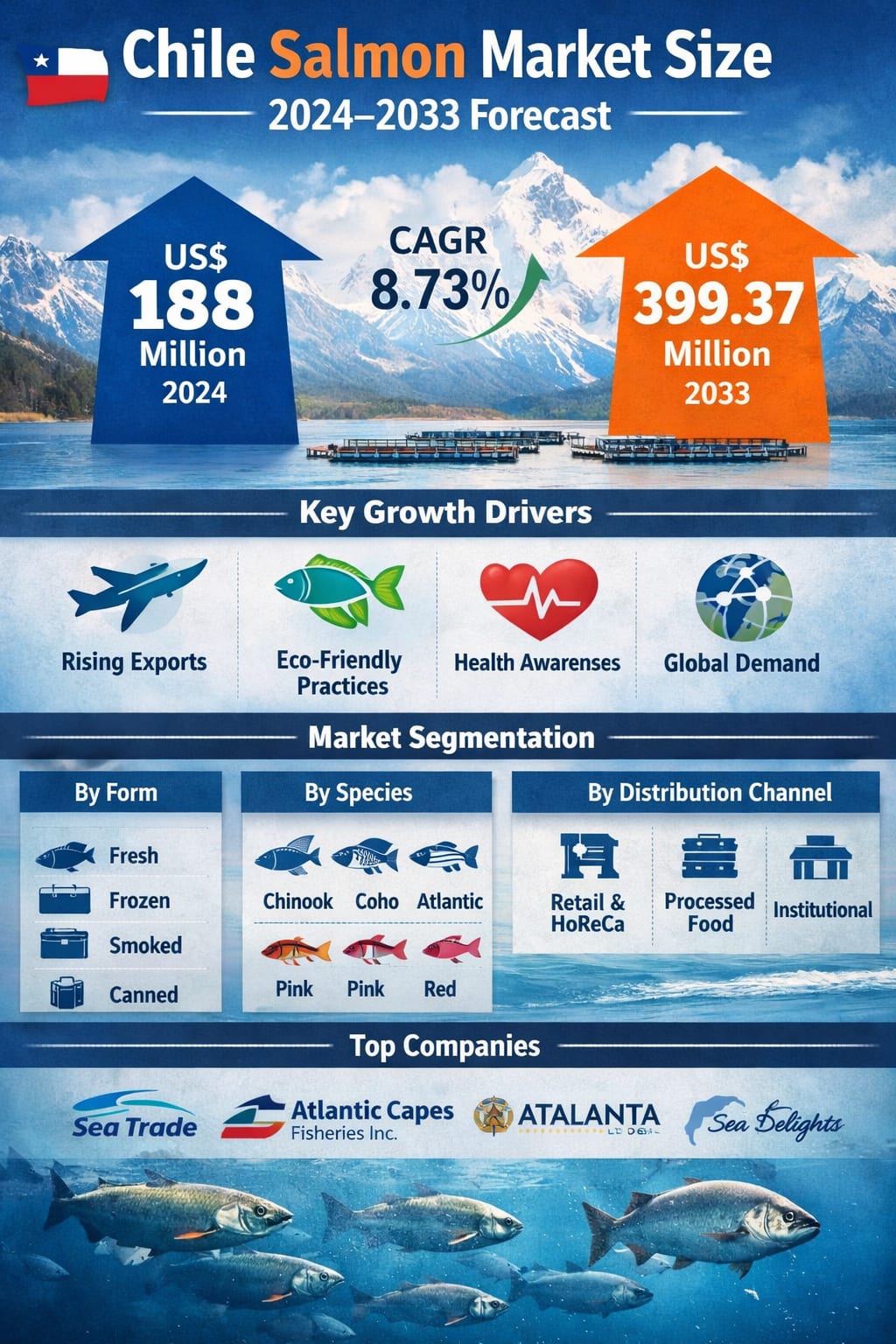
Chile Salmon Market Outlook: A Growing Powerhouse in Global Seafood
According to Renub Research’s latest industry outlook, the Chile Salmon Market is projected to grow from US$ 188 million in 2024 to US$ 399.37 million by 2033, expanding at a compound annual growth rate (CAGR) of 8.73% from 2025 to 2033. This robust growth trajectory reflects not only rising global demand for seafood but also Chile’s strengthening position as one of the world’s most important salmon-producing nations.
Salmon has become one of the most sought-after fish globally, prized for its rich nutritional profile, appealing taste, and versatility in cooking. From sushi and sashimi to smoked fillets and canned products, salmon has secured a permanent place in both premium dining and everyday household meals. For Chile, this global appetite has translated into a powerful export-driven industry that continues to attract investment, innovation, and regulatory attention.
Chile’s salmon sector has evolved far beyond a traditional aquaculture industry. Today, it represents a strategic pillar of the national economy, combining advanced farming technologies, export-oriented production, and increasing emphasis on sustainability and quality standards. With rising health awareness, improving cold-chain logistics, and expanding international trade networks, the Chilean salmon market is well-positioned to remain one of Latin America’s most dynamic food industries over the next decade.
Understanding Salmon and Its Global Appeal
Salmon is an anadromous fish, meaning it migrates from freshwater to the sea and then returns to freshwater to spawn. Naturally found in the North Atlantic and Pacific Oceans, salmon has gained worldwide popularity due to its high protein content, rich omega-3 fatty acids, essential vitamins, and minerals. These nutritional benefits have made salmon a staple in health-conscious diets across North America, Europe, and increasingly, Asia.
Consumers today are more mindful about what they eat, and seafood—particularly salmon—has benefited from this shift. Compared to red meat, salmon is widely perceived as a cleaner, healthier source of protein, supporting heart health and overall well-being. This perception has driven consistent growth in demand across retail, food service, and processed food industries.
Chile, with its long coastline and favorable marine conditions, has successfully positioned itself as a leading supplier to this growing global market. Through continuous improvements in breeding, feeding, disease control, and logistics, the country has built a reputation for reliable, large-scale salmon production that meets international quality standards.
Chile Salmon Industry Overview: From Regional Producer to Global Leader
The Chilean salmon industry has transformed into one of the most important aquaculture sectors in the world. Today, Chile ranks among the top global producers and exporters of farmed salmon, supplying major markets such as the United States, Japan, China, and Brazil.
The industry’s success is built on several pillars: favorable natural conditions, strong export infrastructure, continuous technological upgrades, and supportive government policies. Over the years, Chilean producers have invested heavily in modern farming systems, biosecurity measures, and processing facilities to meet the growing and increasingly sophisticated demands of international buyers.
Moreover, the expansion of cold-chain logistics and efficient supply chains has made it possible for Chilean salmon to reach distant markets in fresh, frozen, smoked, and processed forms. This logistical strength is a key competitive advantage, enabling Chile to serve both premium and mass-market segments worldwide.
Market Size and Growth Forecast: Strong Momentum Ahead
Renub Research estimates that the Chile Salmon Market will nearly double in value over the forecast period, rising from US$ 188 million in 2024 to US$ 399.37 million by 2033, at a CAGR of 8.73% between 2025 and 2033. This growth is driven by a combination of rising global seafood consumption, expanding export markets, technological advancements in aquaculture, and increasing investment in sustainable production practices.
Unlike many traditional food sectors that grow slowly, salmon farming in Chile is benefiting from structural global trends. These include the shift toward healthier diets, the expansion of middle-class consumers in Asia, and the growing preference for high-quality animal protein with lower environmental footprints compared to red meat.
At the same time, Chile’s industry is becoming more sophisticated, moving beyond volume growth toward higher value-added products, better branding, and stronger compliance with international sustainability standards. This strategic evolution supports both revenue growth and long-term market resilience.
Key Growth Drivers of the Chile Salmon Market
1. Rising Global Demand for Healthy Seafood
One of the most important drivers of the Chilean salmon market is the surging global demand for healthy, high-protein seafood. Salmon, in particular, has become a favorite among health-conscious consumers due to its omega-3 fatty acids and cardiovascular benefits.
In many developed markets, consumers are actively reducing red meat consumption and replacing it with fish and other lean protein sources. This shift has created a steady and expanding demand base for salmon, benefiting major producing countries like Chile. As awareness of nutrition and wellness continues to grow worldwide, salmon’s position as a premium yet accessible protein source is expected to strengthen further.
2. Expanding Export Markets
Exports are the backbone of Chile’s salmon industry. Salmon represents a significant share of the country’s total exports, second only to copper in terms of export value. Major destinations such as the United States, Japan, Brazil, and China rely heavily on Chile for consistent, high-quality salmon supply.
Chile’s ability to meet strict international quality and safety standards has helped it maintain strong trade relationships and expand into new markets. Initiatives aimed at improving sustainability, traceability, and product quality further enhance the country’s competitiveness on the global stage.
As global seafood trade continues to grow, Chile is strategically positioned to capture a larger share of international demand, especially in fast-growing Asian markets.
3. Government Support and Regulatory Framework
Government support plays a critical role in shaping the future of Chile’s salmon industry. Public-private collaborations involving regulatory bodies and industry associations focus on improving fish health, reducing antibiotic use, and strengthening biosecurity measures.
Such initiatives not only enhance the sustainability of the industry but also help maintain Chile’s reputation in environmentally sensitive markets like North America and Europe. By aligning domestic regulations with international standards, Chile ensures long-term access to global markets and builds greater trust among consumers and importers.
4. Technological Advancements in Aquaculture
Continuous innovation in breeding, feeding systems, disease management, and monitoring technologies has significantly improved productivity and efficiency in Chilean salmon farming. Modern aquaculture techniques allow producers to optimize growth cycles, reduce losses, and improve overall fish health.
These technological improvements also support the industry’s sustainability goals by reducing environmental impact and enhancing resource efficiency. Over time, this combination of higher productivity and better environmental performance strengthens both profitability and global competitiveness.
5. Improved Logistics and Cold Chain Infrastructure
The expansion of cold-chain logistics has been a game-changer for the Chilean salmon industry. Efficient storage, transportation, and distribution systems ensure that salmon products reach international markets in optimal condition, whether fresh, frozen, or processed.
This logistical capability allows Chile to serve distant markets reliably, reduce waste, and support the growth of value-added product segments such as smoked and ready-to-eat salmon.
Challenges Facing the Chile Salmon Market
1. Climate Change and Environmental Pressures
Climate change poses a serious challenge to salmon farming in Chile. Rising water temperatures, changing ocean conditions, and increased frequency of extreme weather events can stress fish populations and make them more vulnerable to diseases and parasites.
These environmental pressures can lead to higher mortality rates, lower yields, and increased production costs. Producers must invest continuously in adaptive strategies, monitoring systems, and resilient infrastructure to mitigate these risks and maintain stable output.
2. Reputation and Sustainability Concerns
The Chilean salmon industry has faced criticism in the past related to environmental impact, disease outbreaks, and antibiotic use. In today’s market, consumers and importers increasingly demand transparency, traceability, and strong sustainability credentials.
Negative publicity can affect market access and pricing, especially in environmentally conscious regions. To remain competitive, Chilean producers must continue investing in sustainable practices, improving animal welfare, and reducing their environmental footprint.
Recent Developments in the Chile Salmon Industry
The industry has seen several important developments in recent years that highlight its strategic direction:
March 2024: Eleven salmon producers in Chile partnered with government and industry organizations to increase vaccine availability and reduce antibiotic use in salmon farming. This initiative aims to improve disease prevention and promote more sustainable production practices.
October 2023: Chile strengthened its trade relationship with China to expand exports of Coho salmon. Chile is currently the world’s leading producer of Coho salmon, accounting for a dominant share of global production.
March 2023: Aqua Chile announced a significant investment in land-based salmon farming projects in the United States, reflecting a broader industry trend toward more sustainable and environmentally controlled aquaculture systems.
These developments underscore the industry’s focus on sustainability, innovation, and global market expansion.
Market Segmentation: Understanding the Structure of Demand
By Form
Fresh
Frozen
Smoked
Canned
Others
By Species
Chinook Salmon
Coho Salmon
Pink Salmon
Red Salmon
Silverbrite Salmon
Salmon Salar
By Distribution Channel
Retail
HoReCa & Wholesale
Processed Food Industry
Other Institutional Customers
This diverse segmentation reflects the wide range of consumer preferences and end-use applications for salmon products, from fresh fillets in supermarkets to processed ingredients in the food industry.
Competitive Landscape and Key Players
The Chile salmon market features a mix of domestic and international players focused on production, processing, and export. Companies are increasingly competing on quality, sustainability, and reliability of supply rather than just volume.
Key players analyzed in the market include:
Sea Trade
Atlantic Capes Fisheries, Inc.
Atalanta Corporation
Ideal Foods Ltd
Sea Delights
Each company is evaluated based on company overview, key personnel, recent developments and strategies, and sales performance, providing a comprehensive view of the competitive environment.
Final Thoughts: A Market with Strong Long-Term Potential
The Chile Salmon Market stands at the intersection of powerful global trends: rising demand for healthy protein, expanding international seafood trade, and increasing emphasis on sustainable food production. With the market expected to grow from US$ 188 million in 2024 to US$ 399.37 million by 2033, Chile’s salmon industry is clearly on a strong upward trajectory.
While challenges such as climate change and sustainability concerns remain, ongoing investments in technology, regulation, and responsible farming practices are helping the industry adapt and evolve. Supported by strong export demand, government initiatives, and improving infrastructure, Chile is well-positioned to maintain its status as one of the world’s leading salmon producers.




Comments
There are no comments for this story
Be the first to respond and start the conversation.