
Could you take out personal loans while being on benefits
Personal loans are possible to use when you are on benefits, but they should be used with caution. They could trap you in a debt spiral.

Unemployment is unexpected even though part of you is prepared for it; after all, no job is secured. Financial experts suggest that you must stash away some money for unforeseen circumstances like this. They suggest that you must have at least three months’ worth of living expenses. The higher, the better.
However, sometimes savings are not sufficient to meet your regular expenses when you are out of work. Your unemployment period may be extended for more than the expected time. The first thing you need to do is to apply for unemployment benefits as soon as you are eased out. It is vital to meet the terms and conditions to qualify for these benefits.
Savings in combination with unemployment benefits could help you endure your time. There are a few direct lenders who sign off on loans for people on benefits, provided you promise to discharge the debt on time.
Such loans are small emergency loans. The money is lent to you after a perusal of your credit report and repaying capacity. Though you do not have a full-time job, you still need to have some income source to repay the debt. It is good if you have a part-time income such as rent, dividends, etc. Otherwise, your benefits will be regarded as your income.
Unemployed loans are part of personal loans
Some people consider personal loans to meet unexpected expenses while being between jobs. Personal loans are known by many names, and when they are offered when you are out of work, they are called loans for the unemployed.
As you are out of work, the amount of money will not be more than £500. The application is processed based on the financial details you provide in your application form. Approval is made on the same day. Bear in mind your credit score will be thoroughly checked. Your bad credit rating will not preclude your application from being accepted, but interest rates will not be attractive. Lenders charge subprime borrowers high interest rates.
Personal loans could be expensive
Bear in mind that the amount of these loans is small and must be discharged in full on the due date. Normally, the repayment term does not extend more than 14 days. In some cases, it could be a month. As the whole debt is to be paid off in fell one swoop, it could be quite challenging for you to arrange funds from your current budget.
Your savings could significantly drop, and unemployment benefits might not be enough to clear dues. As a result, there is a high probability of falling behind on the payment. If it happens so, the loan will be rolled over, and interest penalties and late payment fees will be accrued. It will mushroom the total cost of the debt. Over time, the amount quickly accumulates, and you will find yourself in an abyss of debt.
Use loans as a last resort
While you could easily take out personal loans when you are unemployed, they could be extremely expensive. They could potentially tie you to an ongoing cycle of debt. Loans are not bad as long as you employ them to meet unexpected expenses.
However, at the same time, you should borrow money with caution. You are already unemployed, which means money is tight. If you borrow money, you do not just have to pay back the principal amount but the interest as well. Of course, you would not be able to pay interest when you were not in a position to pay the principal from your pocket.
You should generally prefer your savings in order to meet all your expenses. It is a good idea if you have stashed away money to meet emergencies. It would be much easier to meet all your expenses, including small emergencies if your safety net were larger. You should always try to save a large amount.
The larger money you set aside, the better it is. A golden rule of thumb says that you should always focus on building at least six months’ worth of living costs.
Some practical ways to improve your savings
Here are some methods to increase your savings:
- You should try to cut back on your expenses. Make sure that you trim down your discretionary expenses. For instance, less money should be spent on eating out, takeaways, and night entertainment.
- Try to increase your income methods. Most people struggle to discharge their debt because of a lack of money. You should either find a job with a higher salary or consider grabbing a part-time job. The more money you earn, the larger your savings will be.
- If you are already in debt, unemployment could be a turn of a screw. In this situation, you have to meet not only your current obligations but also unexpected expenses. You might have to downsize your lifestyle to endure this situation. Be prepared to move to a smaller house, or if you have a spare room, try to consider letting it out. Generating rent from your house would help a lot with keeping up with debt payments. You can also rent your garage or parking lot if you need to.
- Save money on your daily spending. For instance, at the time of buying groceries, you should always focus on the price per unit. Buy generic products rather than branded ones.
- Avoid impulsive shopping. It may cost you a lot of money in the long run. You should always try to pause for at least 48 hours before shopping for anything that is not urgent.
The final word
It is possible to take out personal loans despite being unemployed. These loans are called unemployed loans, too. However, they can be quite expensive, especially if your credit rating is not perfect.
You should always try to rely on your savings to make ends meet unless you land a new job. If you come across some unexpected expenditure and your emergency cushion is not sufficient, make sure you take out these loans when you are certain about your repaying capacity.
About the Creator
Elizabeth Jones
I'm Elizabeth Jones, a Marketing Specialist at AnnuityLoans. I help guide individuals through the process of securing online loans by providing clear, informative advice.
Keep reading
More stories from Elizabeth Jones and writers in Trader and other communities.
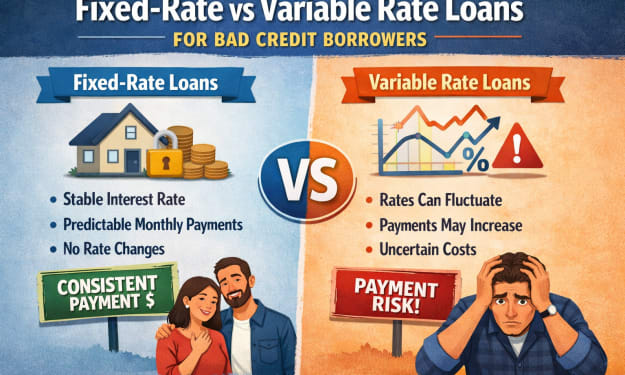
Fixed-Rate vs Variable Rate Loans for Bad Credit Borrowers
The credit score would influence the interest rate charged to you by lenders. Bad credit translates to increased interest rates and nothing beyond that. You will pay a higher price for the same loan than a person with good credit would.
By Elizabeth Jonesa day ago in Trader
Australia Electric Iron Market Poised for Strong Growth on the Back of Urban Lifestyles and Smart Innovation
The Australia electric iron market reached approximately USD 41.8 Million in 2025 and is projected to grow to USD 97.1 Million by 2034, expanding at a CAGR of 9.81% during the forecast period of 2026–2034. This striking growth reflects robust consumer demand for modern, efficient home appliances and an evolving retail environment where convenience and technology are increasingly central to purchase decisions.
By Rashi Sharma3 days ago in Trader
Philippines Alcoholic Beverage Market 2026: Changing Drinking Habits, Premiumisation & Social Consumption
Philippines Alcoholic Beverage Market Overview The Philippines alcoholic beverage market is evolving steadily as consumer tastes, social behaviours, and purchasing channels adapt to a more modern, urban, and lifestyle-driven environment. Traditionally shaped by beer and locally popular spirits, the market today reflects broader experimentation with premium products, flavoured beverages, and health-conscious drinking choices. The Philippines alcoholic beverage market size reached USD 7.2 Billion in 2025. Looking forward, IMARC Group expects the market to reach USD 8.6 Billion by 2034, exhibiting a growth rate (CAGR) of 2.00% during 2026-2034.
By Manisha Dixit7 days ago in Trader


Comments
There are no comments for this story
Be the first to respond and start the conversation.