
Fixed-Rate vs Variable Rate Loans for Bad Credit Borrowers
Fixed-rate loans offer stable payments while variable rates start lower. Learn which loan type suits your budget and risk level when you have poor credit.

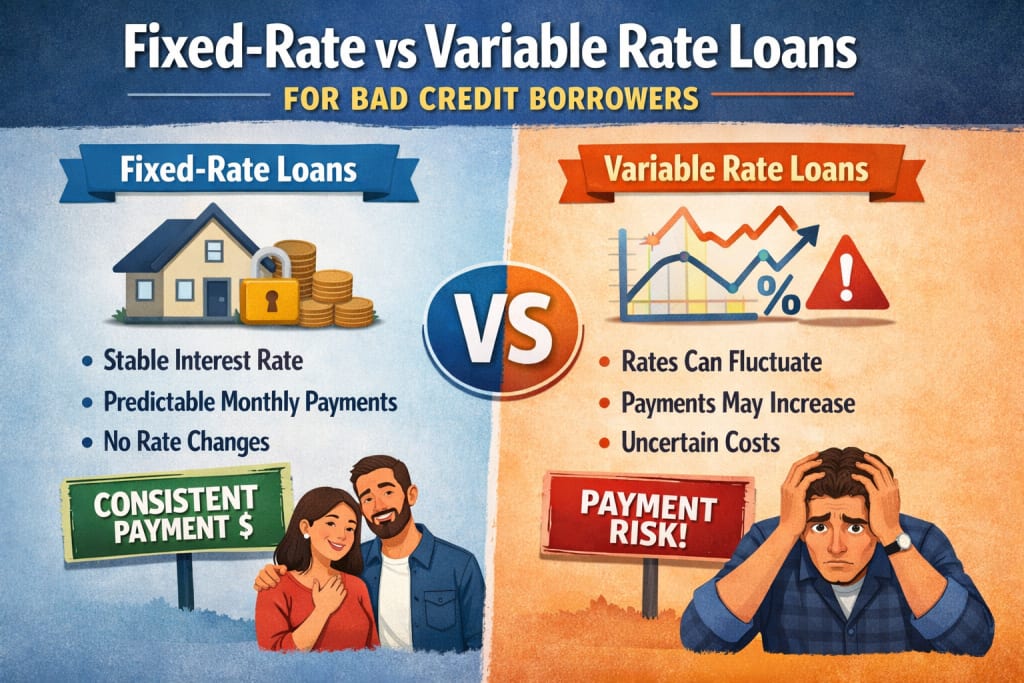
The credit score would influence the interest rate charged to you by lenders. Bad credit translates to increased interest rates and nothing beyond that. You will pay a higher price for the same loan than a person with good credit would.
You will have to decide on fixed and variable rates. It has an immediate effect on your monthly budget and the overall repayment amount you will have to pay. One possibility has guarantees; the other has possible savings.
To complicate your situation, you may choose an incorrect type of loan. In case you decide to use the variable rate, and you are unable to manage increases in payment, you may fail to make payments. This adds to greater debt and further ruins your credit report.
There is still a choice with poor credit. You have both fixed and variable loans. The conditions will not be the same as those of those having flawless credit history, yet you can secure approval.
What is a Fixed-Rate Loan?
A fixed-rate loan gives you certainty. Your interest rate stays the same throughout your entire loan term. Your monthly payment will be the same on day one and in your final month.
Most lenders offer fixed terms ranging from 12 months to 60 months for personal loans. Your rate gets locked in the moment you sign your loan agreement. You'll continue paying your original rate until the loan ends, even if market rates drop.
Fixed-rate options come with slightly higher starting rates. The lenders charge this premium because they're taking on the risk of interest rate changes for the whole term.
- Great for people who hate financial surprises
- Helps with strict budgeting and money planning
- Shields you during times of economic uncertainty
- Sometimes comes with slightly higher fees upfront
You can easily get loans for bad credit from direct lenders. These lenders make all decisions themselves rather than passing your application to other companies. They often provide same-day decisions once you've completed your application. Many direct lenders look beyond your credit score to assess your current situation.
What is a Variable Rate Loan?
Your interest rate moves up or down based on either broader economic factors or your lender's internal decisions. Your monthly payment amount can increase or decrease throughout your loan term.
In the UK, you'll have two main variable loan types. The tracker loans follow the Bank of England base rate plus a set percentage. The standard Variable Rate (SVR) loans allow lenders to change rates at their discretion.
The lenders must send a written notice, 14 days before the new rate takes effect, before changing your rate.
- Could save money if interest rates fall
- Often have more flexible early repayment terms
- May offer features like payment holidays not found with fixed rates
- Sometimes include interest rate caps to limit increases
- Have lower setup fees than equivalent fixed loans
How Bad Credit Affects Your Rate Options?
Many lenders simply won't offer either type of loan to borrowers with poor credit histories. For fixed-rate products, bad credit borrowers face APRs ranging from 19% up to 49%. The variable rates for poor credit start lower, generally between 15% and 40% APR.
The direct lenders can give loans to bad-credit borrowers. These specialist lenders understand that past financial problems don't always predict future behaviour.
You can even add a guarantor to your loan application. This can improve your options. Your rates might drop by 5% to 15% when someone with better credit agrees to back your loan.
Which Lenders Offer Each Type in the UK?
The diverse lending market has many options for borrowers.
1. High-Street Alternative Lenders
These lenders operate similarly to banks but with more flexible criteria. They offer both fixed and variable products to bad credit borrowers. Their application processes have automated and human checks. They make decisions within 24-48 hours.
2. Online Specialist Lenders
The online lenders usually offer streamlined applications with quick decisions. Most provide fixed-rate products with clearly defined terms. Some also offer variable options.
3. Credit Unions and Community Lenders
These not-for-profit organisations often work with bad credit borrowers who live or work in specific areas. Their rates may be capped lower than commercial lenders, though loan amounts tend to be smaller.
4. Short-Term Lenders
This lender offers both fixed and variable options for very short durations, under 12 months. You can apply for loans for bad credit from direct lenders. Many offer both online and phone applications for your convenience. They provide clear, upfront information about all costs and charges.
What are the Main Factors to Help You Choose?
Many key factors should guide your decision to ensure you get the right loan for your situation.
Current Bank of England trend - You can watch where interest rates are heading. The fixed rates offer protection if they're rising. The variable rates might save money long-term if they fall.
Monthly income stability - You can consider how predictable your income is.
Loan term length - The long-term loans face more market exposure. A five-year variable loan might see multiple rate changes, while a one-year loan has less time for shifts.
Budget flexibility - You can assess how much wiggle room you have monthly. The tight budgets need fixed rates to prevent payment shocks.
Risk tolerance - You should be honest about your comfort with uncertainty. Some borrowers sleep better knowing just what they'll pay each month.
Early repayment plans - You can check penalties if you might pay off the loan early. The variable loans have lower early repayment charges.
Payment jump tolerance - You can consider if you could handle a £50-100 monthly payment increase if rates rise.
Conclusion
The decision on whether to use fixed and variable rates should be directed by your personal circumstances. Before making the decision, you can think about your job security, housing, etc.
It is also possible to compare the total cost of credit (TCC) of both options. You can know what will happen should rates increase by 2, 5 or even 10 per cent, throughout your term, and the variable rates may be lower at the start.
Either way you go, it is more important to pay at the right time than the type of loan. The fixed and the variable loans report to the credit reference agencies. It is also useful in repairing your score.
The most suitable option has the right balance between the need to be certain and possible savings. The decision that you make must be based on the reality of your financial situation as well as the degree of comfort with risk.
About the Creator
Elizabeth Jones
I'm Elizabeth Jones, a Marketing Specialist at AnnuityLoans. I help guide individuals through the process of securing online loans by providing clear, informative advice.
Keep reading
More stories from Elizabeth Jones and writers in Trader and other communities.
Could you take out personal loans while being on benefits
Unemployment is unexpected even though part of you is prepared for it; after all, no job is secured. Financial experts suggest that you must stash away some money for unforeseen circumstances like this. They suggest that you must have at least three months’ worth of living expenses. The higher, the better.
By Elizabeth Jones11 months ago in Trader
United States Diabetes Market Size, Trends, Growth & Forecast 2034: A Transforming Healthcare Landscape
The United States diabetes market is entering a new era of transformation. With millions of Americans living with diabetes and prediabetes, the condition remains one of the most pressing public health challenges in the country. However, alongside rising prevalence comes rapid innovation — from advanced insulin therapies to AI-powered glucose monitoring systems.
By Adil Ali Khan2 days ago in Trader



Comments
There are no comments for this story
Be the first to respond and start the conversation.