
Dental Insurance Market Size, Growth & Forecast 2025–2033 | Renub Research
From Preventive Care to Financial Protection: How Dental Insurance Is Reshaping Global Oral Healthcare

Introduction: A Market Built on Smiles—and Economics
The global dental insurance market is no longer a niche segment of the broader healthcare industry. It has evolved into a major financial and public health pillar, driven by rising awareness of oral hygiene, increasing treatment costs, and the growing realization that oral health is deeply connected to overall well-being.
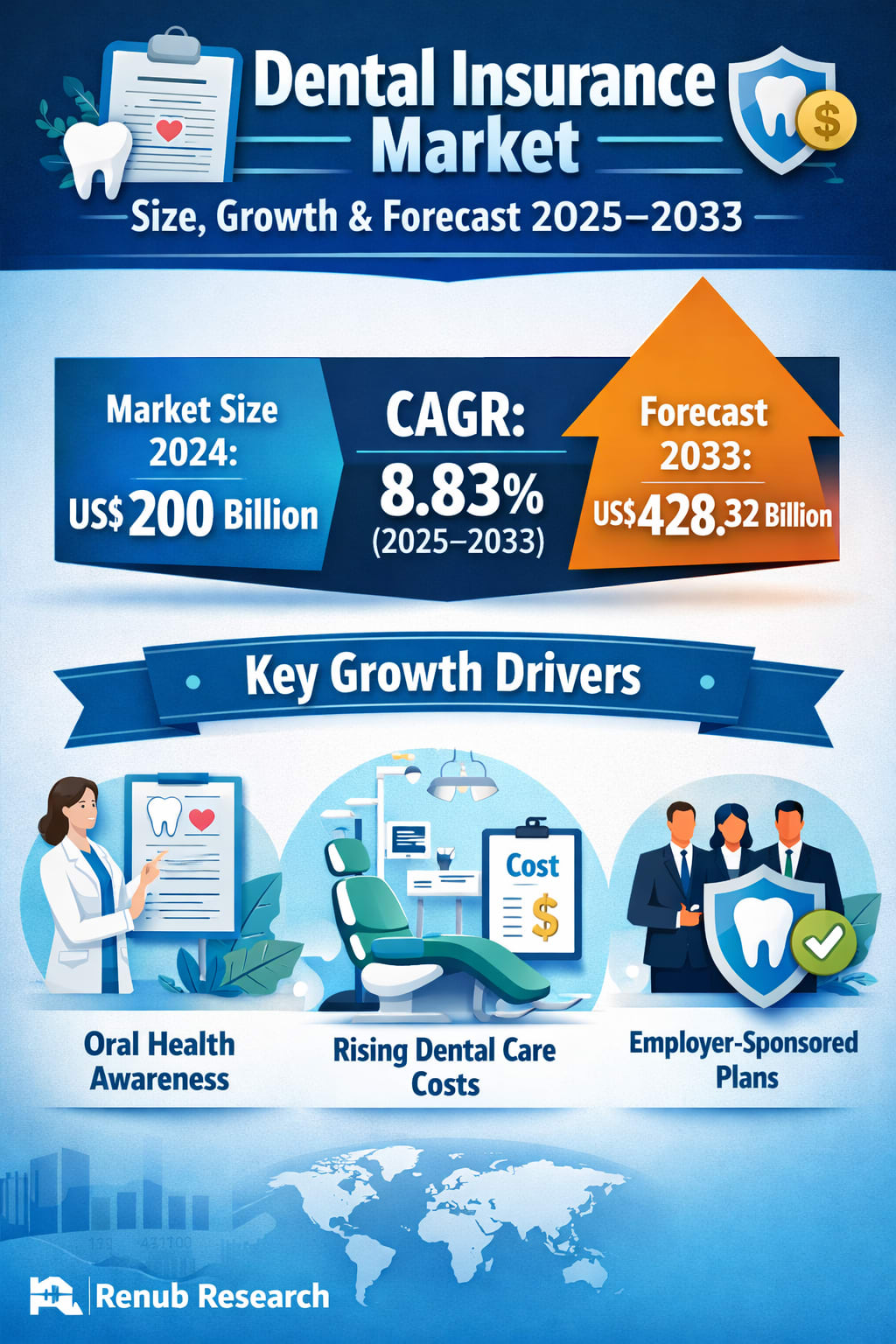
According to Renub Research, the Dental Insurance Market was valued at US$ 200 billion in 2024 and is projected to reach US$ 428.32 billion by 2033, expanding at a compound annual growth rate (CAGR) of 8.83% from 2025 to 2033. This impressive growth trajectory reflects a global shift in how individuals, employers, and governments perceive dental care—not as a luxury, but as a necessary component of comprehensive healthcare.
Once considered optional, dental insurance is increasingly being viewed as essential financial protection against rising treatment costs, from routine cleanings to complex procedures such as implants, orthodontics, and oral surgeries. As healthcare systems worldwide push toward preventive care models, dental insurance is emerging as a critical enabler of early diagnosis, regular check-ups, and long-term cost control.
Understanding Dental Insurance: More Than Just a Safety Net
Dental insurance is a form of health coverage designed to help individuals manage the cost of oral healthcare. Most plans cover preventive services such as cleanings, examinations, and X-rays, while also partially covering more advanced procedures like fillings, root canals, crowns, and, in some cases, orthodontic treatments.
Typically, these policies operate through provider networks, fixed premiums, deductibles, and annual coverage limits. While plan structures vary across insurers and regions, the fundamental goal remains the same: to make dental care more accessible and financially manageable for individuals and families.
The growing popularity of dental insurance is closely linked to the broader recognition that oral health is not isolated from general health. Conditions such as gum disease have been associated with diabetes, cardiovascular diseases, and other systemic health issues. As a result, preventive dental care is increasingly seen as a smart investment rather than an avoidable expense.
Key Growth Drivers in the Dental Insurance Market
1. Rising Awareness of Oral Health
Public awareness about the importance of dental care has increased significantly over the past decade. Oral diseases affect an estimated 3.5 billion people worldwide, with untreated tooth decay being the most common condition. Governments, healthcare providers, and global organizations continue to run awareness campaigns emphasizing the importance of daily oral hygiene and regular dental check-ups.
Initiatives such as World Oral Health Day on 20 March play a crucial role in reinforcing these messages. The 2025 campaign, in particular, focuses on encouraging small daily habits that contribute to long-term oral health. As more people understand the link between oral health and overall well-being, demand for dental insurance continues to rise.
2. Escalating Cost of Dental Treatments
Dental care is becoming increasingly expensive, especially for advanced procedures such as implants, orthodontics, and surgical interventions. Even routine services like cleanings and fillings can accumulate into substantial out-of-pocket expenses over time.
Dental insurance helps spread these costs through predictable premiums, making regular dental visits more affordable and financially less stressful. This cost-buffering effect is one of the strongest motivators behind the growing adoption of dental insurance worldwide.
In March 2025, Overjet, a global leader in dental AI, announced the launch of the Dental Clarity Network (DCN)—an initiative aimed at improving transparency and reducing friction between payers and providers using advanced technology. Such innovations further highlight how the ecosystem is evolving to make dental care more efficient and patient-friendly.
3. Expansion of Employer-Sponsored Dental Plans
Employer-sponsored dental insurance remains one of the most powerful growth engines of the market, particularly in developed economies such as the United States, Canada, and parts of Europe. Dental benefits are now considered a key component of competitive compensation packages.
Group plans generally offer lower premiums and broader coverage, encouraging higher enrollment rates among employees. As companies increasingly focus on employee well-being, retention, and productivity, dental coverage is becoming a standard benefit rather than an optional perk.
Challenges Facing the Dental Insurance Industry
1. Limited Benefits and High Out-of-Pocket Costs
Despite its advantages, many dental insurance plans come with limitations such as annual coverage caps, waiting periods, and partial reimbursements—especially for cosmetic or complex procedures. This often leaves policyholders with significant out-of-pocket expenses even after paying premiums.
The lack of standardization across plans also creates confusion and dissatisfaction among consumers, which can hinder long-term adoption and renewal rates.
2. Low Penetration in Developing Regions
In many developing countries, dental insurance remains underutilized due to low awareness, affordability concerns, and mistrust of insurance providers. In regions where public healthcare systems do not adequately cover dental care, individuals often either avoid treatment or pay entirely out-of-pocket.
Improving insurance literacy, offering affordable plans, and leveraging digital distribution channels will be essential to unlocking growth in these underpenetrated markets.
Market Segmentation: Understanding Where the Growth Lies
Dental PPO (Preferred Provider Organization) Plans
PPO dental plans are among the most popular options due to their flexibility and extensive provider networks. They offer partial coverage for out-of-network care while incentivizing the use of in-network providers through lower costs. The ability to self-refer to specialists without requiring a primary dentist referral makes PPO plans particularly attractive to both individuals and employers.
Dental Indemnity Plans
Indemnity plans, often referred to as traditional dental insurance, allow policyholders to visit any dentist of their choice. These plans typically reimburse a percentage of treatment costs after deductibles. While they are more expensive, they appeal to consumers who prioritize flexibility over cost savings. Although their popularity has declined compared to managed care plans, they still maintain a loyal niche user base.
Preventive Dental Insurance
Preventive-focused plans emphasize coverage for routine services such as cleanings, exams, X-rays, and fluoride treatments. These policies align with the global shift toward preventive healthcare, benefiting both insurers—through lower long-term claim costs—and consumers—through better long-term oral health outcomes. Families with children and young adults are particularly drawn to these plans.
Demographic Insights: Adults Lead the Market
The adult segment dominates the dental insurance market due to higher prevalence of dental issues such as cavities, gum disease, and tooth loss. Adults are also more likely to require expensive procedures like crowns, root canals, and implants.
With limited public dental coverage in many countries, especially post-retirement, private dental insurance becomes a necessity rather than a choice. Additionally, growing awareness of the link between oral and systemic health further supports higher insurance uptake among adults.
Regional Spotlight: Key Markets Shaping the Industry
United States: The Global Leader
The United States represents the largest dental insurance market globally, supported by a mature insurance ecosystem, high treatment costs, and widespread employer-sponsored coverage. Most American employees receive dental benefits as part of their compensation packages, while private insurers offer a wide range of individual and family plans.
In March 2024, MetLife introduced the MetLife SpotLite on Oral HealthSM program, a value-based initiative designed to help employees identify high-quality dental providers through a streamlined digital experience. This move reflects the industry’s growing focus on quality, outcomes, and patient-centric care.
France: The Power of Supplemental Coverage
In France, dental insurance primarily functions as a supplement to the public healthcare system, which only partially reimburses dental expenses. Private “mutuelles” cover the remaining costs, making them essential for comprehensive care—especially for orthodontics and prosthetics.
In December 2024, AXA Global Healthcare launched a digital platform combining insurance services with healthcare delivery, including virtual consultations and wellness tracking. Such innovations are helping modernize the French dental insurance landscape and improve user experience.
India: A Market with Massive Untapped Potential
India’s dental insurance market is still in its early stages, but the growth potential is enormous due to its large population, rising incomes, and increasing awareness of oral health. Currently, most dental expenses are paid out-of-pocket, creating strong demand for affordable insurance solutions.
In March 2025, Toothlens, in partnership with Star Health and Vizza Broking Services, launched India’s first cashless Dental OPD insurance program—marking a major step toward mainstreaming dental coverage in the country.
Saudi Arabia: Driven by Healthcare Reforms
Saudi Arabia is witnessing rising demand for dental insurance, supported by higher healthcare spending, government reforms, and employer-sponsored coverage. Under the Vision 2030 initiative, healthcare privatization and insurance sector reforms are boosting market adoption.
In June 2024, Bupa Arabia introduced a new digital service allowing employees to upgrade coverage and choose hospital room categories via a mobile app—highlighting the region’s push toward digital-first insurance experiences.
Competitive Landscape: Key Players at the Forefront
The global dental insurance market is highly competitive, with major players focusing on digital innovation, network expansion, and value-based care models. Key companies include:
Cigna
AXA
AFLAC Inc.
Allianz SE
Aetna
Ameritas Life Insurance Corp
UnitedHealthcare Services Inc.
MetLife Services & Solutions
These companies are analyzed across four strategic viewpoints: Overview, Key Persons, Recent Developments & Strategies, and Revenue Analysis, reflecting their efforts to strengthen market positions and adapt to evolving consumer expectations.
Market Segmentation Overview
By Coverage:
Dental PPO
Dental HMO
Dental Indemnity Plans
Others
By Type:
Preventive
Basic
Major
By Demographics:
Senior Citizens
Adults
Minors
By Geography:
North America (US, Canada)
Europe (France, Germany, Italy, Spain, UK, Belgium, Netherlands, Turkey)
Asia Pacific (China, Japan, India, South Korea, Thailand, Malaysia, Indonesia, Australia, New Zealand)
Latin America (Brazil, Mexico, Argentina)
Middle East & Africa (Saudi Arabia, UAE, South Africa)
Final Thoughts: A Market with Strong, Sustainable Momentum
The dental insurance market is on a powerful growth trajectory, supported by rising healthcare awareness, increasing treatment costs, and the global shift toward preventive care. With the market expected to grow from US$ 200 billion in 2024 to US$ 428.32 billion by 2033, the industry is set to play an even more critical role in shaping the future of oral healthcare.
While challenges such as limited benefits and low penetration in developing regions remain, ongoing digital innovation, policy reforms, and expanding employer-sponsored coverage are steadily addressing these gaps. For insurers, healthcare providers, and policymakers alike, dental insurance is no longer just a financial product—it is a cornerstone of modern, preventive healthcare systems worldwide.
About the Creator
Tom Shane
Tom Shane is a content writer specializing in SEO-driven blogs, product descriptions, and thought leadership. He crafts engaging, research-backed content that connects with audiences and drives results.
GCC Catheter Market Trends & Summary: A High-Growth Healthcare Story Shaping the Region’s Medical Future
The Big Picture: A Market on a Strong Growth Trajectory The Gulf Cooperation Council (GCC) catheter market is entering a decisive phase of expansion, driven by structural changes in healthcare delivery, demographic shifts, and the region’s aggressive investment in modern medical infrastructure. According to Renub Research, the GCC catheter market was valued at USD 579.83 million in 2024 and is projected to reach USD 1,281.33 million by 2033, growing at a robust compound annual growth rate (CAGR) of 9.21% from 2025 to 2033.
By Sakshi Sharma5 days ago in Trader
United States Orthodontics Market Size and Forecast 2025–2033
Introduction: A Smile-Driven Market Enters a High-Growth Phase The United States Orthodontics Market is undergoing a remarkable transformation, driven by changing consumer attitudes toward dental aesthetics, rapid technological innovation, and broader access to specialized dental care. In 2024, the market was valued at US$ 2.04 billion, and it is projected to reach US$ 5.02 billion by 2033, expanding at a robust CAGR of 10.5% during the forecast period from 2025 to 2033.
By shibansh kumarabout 11 hours ago in Trader
📢 Raise Your Voice Thread: 02/19/2026
Our “Raise Your Voice Threads” are hosted most alternating Thursdays at 12PM ET to offer creators more avenues to uncover exceptional stories on Vocal. As we are continuously searching for fresh creators and inspiring stories, this thread provides an opportunity to exchange and discuss the stories that have moved and motivated us on Vocal.
By Raise Your Voice by Vocalabout 3 hours ago in Resources


Comments
There are no comments for this story
Be the first to respond and start the conversation.