
Dietary Supplements Market Size and Forecast 2025–2033: The Global Shift Toward Preventive Health
Driven by rising health awareness, aging populations, and innovation in nutrition, the global dietary supplements industry is entering a decisive decade of growth.

Introduction: A Market Built on Modern Health Priorities
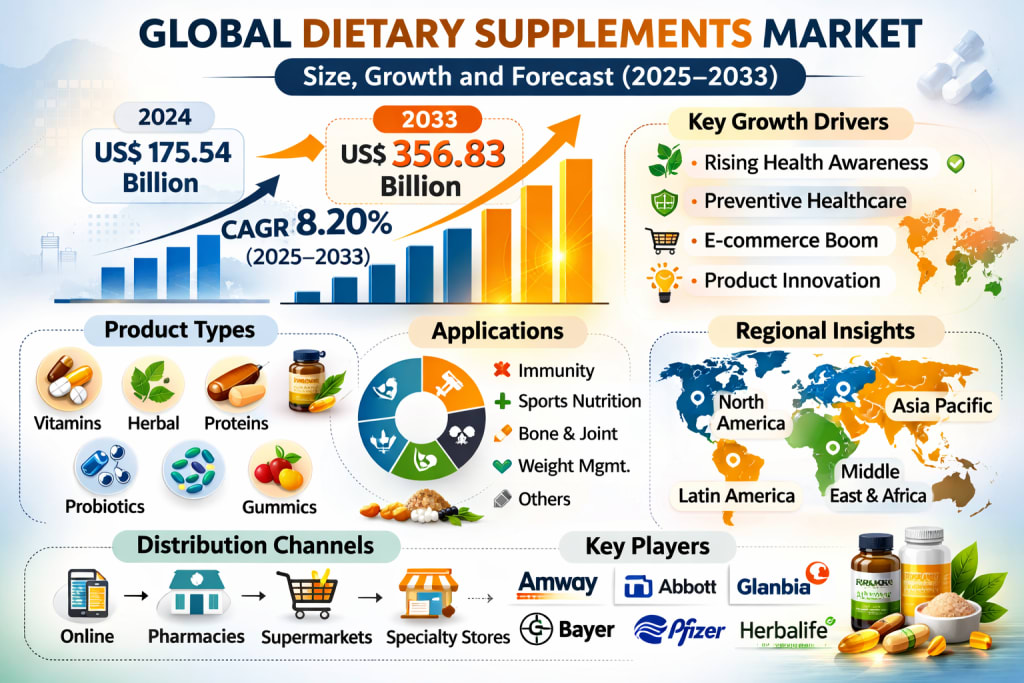
According to Renub Research’s latest industry assessment, the global Dietary Supplements Market is expected to grow from US$ 175.54 billion in 2024 to US$ 356.83 billion by 2033, registering a compound annual growth rate (CAGR) of 8.20% from 2025 to 2033. This impressive expansion reflects a fundamental change in how consumers across the world think about health, wellness, and long-term disease prevention.
Dietary supplements—ranging from vitamins and minerals to herbal extracts, probiotics, proteins, and fatty acids—have evolved from niche wellness products into mainstream health essentials. Once seen mainly as add-ons for athletes or individuals with deficiencies, supplements are now part of everyday routines for millions of people seeking better immunity, stronger bones, improved digestion, enhanced mental performance, and overall well-being.
The growth of this market is being shaped by multiple long-term forces: increasing health awareness, aging populations, rising rates of lifestyle-related diseases, expanding e-commerce, and continuous innovation in formulations and delivery formats. Together, these trends are transforming the dietary supplements industry into one of the most dynamic segments of the global health and nutrition economy.
Market Overview: What Are Dietary Supplements and Why Do They Matter?
Dietary supplements are products designed to complement the daily diet by providing essential nutrients or other beneficial compounds. They can include vitamins, minerals, amino acids, enzymes, herbs, fatty acids, probiotics, and various plant-based or bioactive ingredients. These products are available in multiple forms such as tablets, capsules, soft gels, powders, gummies, and liquids, making them accessible to a wide range of consumer preferences.
People use dietary supplements for several reasons: to address nutritional deficiencies, support immune health, improve energy levels, maintain bone and joint health, enhance athletic performance, or manage specific health concerns. While supplements are not intended to replace a balanced diet, they play an increasingly important role in bridging nutritional gaps—especially in fast-paced, urban lifestyles where dietary habits are often inconsistent.
From a market perspective, the dietary supplements industry sits at the intersection of healthcare, nutrition, fitness, and consumer wellness. This unique positioning allows it to benefit from both medical trends, such as preventive healthcare, and lifestyle trends, such as fitness, clean eating, and personalized nutrition.
Key Growth Drivers Shaping the Global Market
1. Rising Health Awareness and Preventive Healthcare
One of the strongest drivers of the dietary supplements market is the global shift toward preventive healthcare. Consumers are becoming more proactive about managing their health, rather than waiting to treat illnesses after they occur. This change in mindset has significantly boosted demand for products that support immunity, heart health, bone strength, mental well-being, and overall vitality.
The COVID-19 pandemic further accelerated this trend by highlighting the importance of immune health and overall resilience. Since then, consumers have continued to prioritize wellness, creating long-term demand for supplements that support daily health maintenance. Companies are responding with innovative products tailored to specific health needs, reinforcing the role of supplements in everyday health routines.
2. Expansion of E-commerce and Digital Health Retail
The rapid growth of e-commerce has transformed how consumers discover, compare, and purchase dietary supplements. Online platforms offer unmatched convenience, wider product selection, detailed ingredient information, and easy access to customer reviews. This has made supplements more accessible not only in urban centers but also in semi-urban and remote areas.
Digital channels also enable brands to build direct relationships with consumers through subscriptions, personalized recommendations, and targeted wellness programs. Social media and influencer marketing further amplify brand visibility and consumer trust. As a result, online platforms are becoming one of the most powerful distribution channels in the global supplements market.
3. Product Innovation and Personalized Nutrition
Innovation is a central pillar of growth in the dietary supplements industry. Companies are investing heavily in new formulations, clean-label ingredients, plant-based options, and more convenient delivery formats such as gummies, liquid shots, and dissolvable powders. These innovations make supplements easier to consume and more appealing to younger demographics.
Another major trend is personalized nutrition—products designed to meet individual needs based on age, lifestyle, fitness goals, or specific health conditions. This shift from one-size-fits-all solutions to targeted wellness products is expanding the market by attracting new consumer segments and increasing long-term customer engagement.
Challenges Facing the Dietary Supplements Industry
Quality Control and Consistency Issues
Despite strong growth, the dietary supplements market faces ongoing challenges related to quality control. Variations in raw materials, inconsistent manufacturing practices, and limited standardization can lead to differences in product potency, purity, and safety. These issues can undermine consumer trust and, in some cases, pose health risks.
Ensuring strict adherence to good manufacturing practices (GMP) and improving transparency in sourcing and testing are essential for maintaining the industry’s credibility and long-term growth.
Regulatory Gaps and Uneven Standards
Regulatory frameworks for dietary supplements vary widely across regions and are often less stringent than those for pharmaceutical products. This creates gaps in product labeling, safety claims, and quality standards. In some markets, this allows low-quality or misleading products to reach consumers, potentially harming both public health and industry reputation.
Stronger, more harmonized regulatory oversight is necessary to protect consumers, support responsible manufacturers, and sustain trust in the global supplements market.
Regional Market Insights
Mexico Dietary Supplements Market
Mexico’s dietary supplements market is expanding steadily, driven by increasing health awareness, rising disposable incomes, and a growing aging population. Demand is particularly strong for products supporting immunity, digestion, and general wellness. Vitamins, minerals, and herbal supplements dominate the market, with pharmacies and online platforms playing a growing role in distribution.
The introduction of scientifically backed ingredients and functional components highlights Mexico’s rising importance within the broader Latin American health and wellness landscape.
Germany Dietary Supplements Market
Germany represents one of Europe’s more mature and stable supplements markets. Growth is supported by an aging population, strong health consciousness, and widespread interest in preventive healthcare. Consumers commonly use supplements to address nutritional gaps, support chronic condition management, and maintain overall wellness.
Tablets and capsules remain the most popular formats, while pharmacies, supermarkets, and online platforms form a well-balanced distribution network. Protein supplements, vitamins, and combination products continue to see strong demand.
India Dietary Supplements Market
India is one of the fastest-growing markets for dietary supplements, fueled by rapid urbanization, lifestyle changes, and increasing awareness of preventive healthcare. Consumers are turning to supplements to manage stress, improve immunity, and compensate for nutritional gaps caused by busy lifestyles.
There is also strong demand for herbal, plant-based, and traditional formulations, reflecting cultural preferences and perceptions of safety. The rapid expansion of e-commerce has further boosted accessibility and market penetration across the country.
Saudi Arabia Dietary Supplements Market
Saudi Arabia’s dietary supplements market is experiencing strong growth, supported by lifestyle changes, government health initiatives, and increasing interest in fitness and wellness. Consumers are using supplements to support general health, manage chronic conditions, and address nutritional deficiencies.
Protein supplements, vitamins, and combination products are particularly popular, while capsules and tablets remain the preferred formats. Pharmacies, supermarkets, and online platforms all play important roles in product distribution, contributing to steady market expansion.
Recent Developments in the Industry
The dietary supplements market continues to evolve through new product launches and formulation upgrades. Recent developments reflect a strong focus on mental wellness, cognitive health, and improved nutrient absorption:
May 2025: Awshad introduced CalmaGummies, designed to support mental clarity, relaxation, and sleep quality using full-spectrum hemp extract.
March 2025: Life Time expanded its LTH supplement range with NOURISH, a drinkable multivitamin and greens powder offering enhanced nutrient density.
February 2025: Fenix Health Science upgraded its Mineral, Omega, and Neuro product lines, focusing on improved absorption and cognitive support.
These developments highlight the industry’s shift toward functional, targeted, and science-backed nutrition solutions.
Market Segmentation Overview
The global dietary supplements market is broadly segmented by:
By Form:
Tablets, Capsules, Soft Gels, Powders, Gummies, Liquids, Others
By Type:
Herbal Supplements/Botanicals, Vitamins, Minerals, Probiotic Supplements, Blended Vitamin and Minerals, Fatty Acids, Protein and Amino Acids, Others
By Application:
General Well-being, Sports Nutrition, Immune Support, Bone & Joint Health, Digestive Health, Weight Management, Other Applications
By End Use:
Adults, Geriatric, Pregnant Women, Children, Infants
By Distribution Channel:
Supermarkets/Hypermarkets, Pharmacies, Online Platforms, Specialty Stores, Others
By Region:
North America, Europe, Asia Pacific, Latin America, Middle East & Africa
Competitive Landscape
Leading companies in the global dietary supplements market include:
Amway Corporation
Abbott Nutrition
Glanbia PLC
Bayer AG
Pfizer Inc.
Suntory Holdings Ltd
Herbalife Nutrition
Haleon Plc
Otsuka Holdings Co. Ltd
The Bountiful Company
These companies compete through product innovation, brand trust, global distribution networks, and strategic investments in research and development.
Final Thoughts: A Decade of Opportunity for Global Wellness
The global dietary supplements market is entering a powerful growth phase, driven by long-term shifts in consumer behavior toward preventive healthcare, personalized nutrition, and everyday wellness. With the market projected to more than double from US$ 175.54 billion in 2024 to US$ 356.83 billion by 2033, the industry is clearly positioned as a cornerstone of the modern health economy.
While challenges around quality control and regulation remain, continued innovation, stronger standards, and expanding digital access are expected to strengthen consumer trust and market stability. As health awareness continues to rise across both developed and emerging economies, dietary supplements are set to play an even more central role in how people manage their health in the years ahead.
About the Creator
Disney Stock Analysis: Can Disney Sustain Growth in Streaming, Theme Parks, and Media Empire?
Introduction Disney stock has long been considered a cornerstone of the entertainment and media sector. The Walt Disney Company operates a diverse portfolio that includes theme parks, film studios, media networks, and streaming platforms. For investors, Disney stock offers exposure to a globally recognized brand with multiple revenue streams, strong content franchises, and long-term growth potential. However, challenges in streaming competition, theme park economics, and media consumption trends require careful consideration.
By Hammad Nawaz4 days ago in Trader



Comments
There are no comments for this story
Be the first to respond and start the conversation.