
Electric Vehicle Aftermarket Size and Forecast 2025–2033 | Renub Research
From Charging Tech to Battery Services, How the EV Aftermarket Is Becoming the Backbone of the Electric Mobility Revolution

Electric Vehicle Aftermarket Market
The global automotive industry is in the middle of its most dramatic transformation in over a century, and electric vehicles (EVs) are at the heart of it. As governments, manufacturers, and consumers accelerate the shift away from internal combustion engine (ICE) vehicles, a powerful secondary ecosystem is rising alongside: the electric vehicle aftermarket.
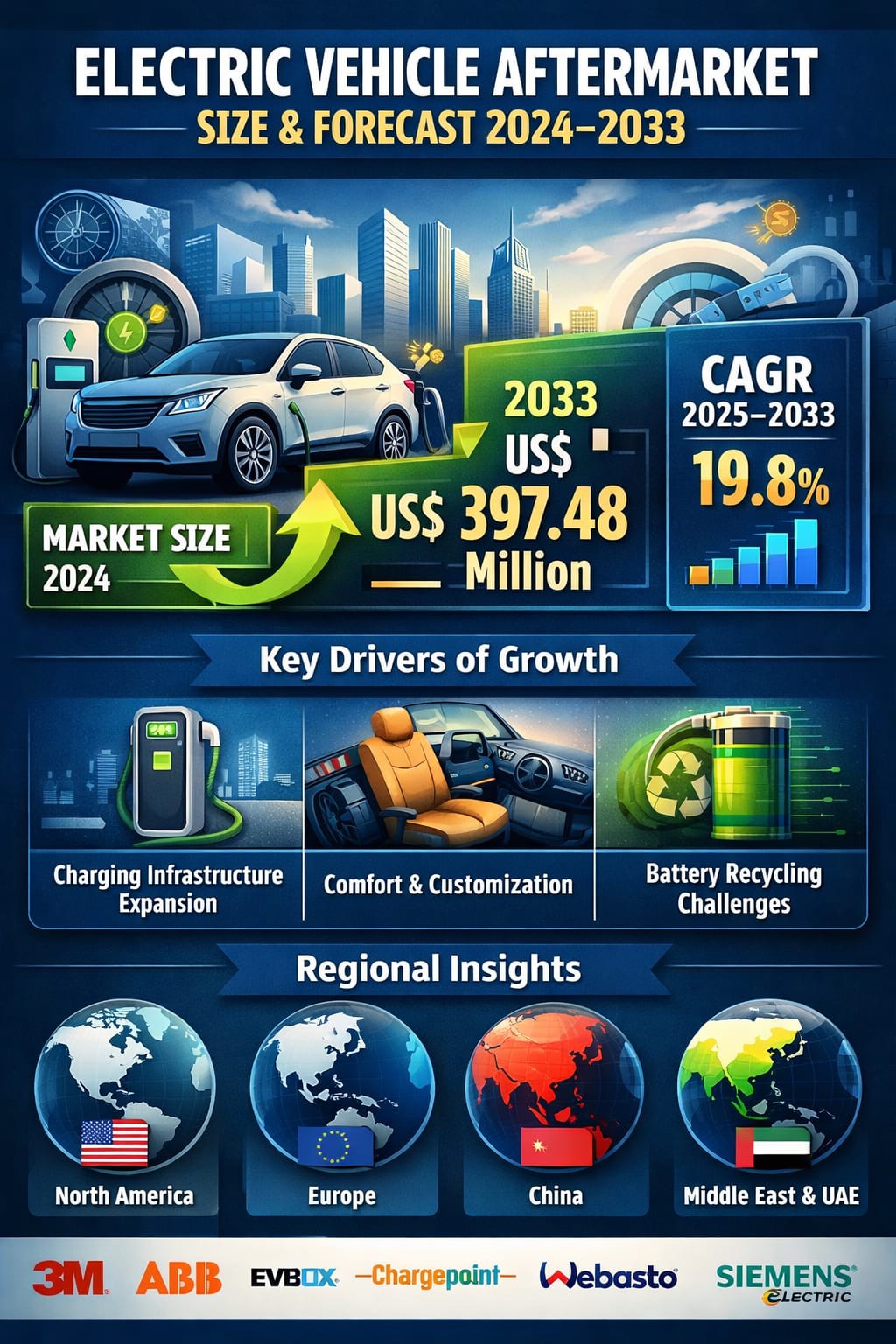
According to Renub Research, the Electric Vehicle Aftermarket is expected to reach US$ 397.48 million by 2033, growing from US$ 78.2 million in 2024, at a robust CAGR of 19.8% from 2025 to 2033. This rapid expansion reflects not only the surging adoption of EVs worldwide, but also the growing need for specialized parts, software upgrades, diagnostics, charging solutions, and maintenance services tailored to electric mobility.
North America currently holds a strong share of this evolving market, driven by robust EV sales, supportive government regulations, and a well-established automotive service ecosystem. High consumer awareness, rising investments in EV infrastructure, and the presence of major automotive and technology companies are further accelerating the development of the EV aftermarket.
Unlike traditional vehicles, electric cars depend heavily on software, advanced electronics, and complex battery systems. This has reshaped the concept of “aftermarket” from being just about spare parts to becoming a sophisticated mix of hardware, software, digital services, and energy solutions.
Global Electric Vehicle Aftermarket Industry Overview
EV sales are rising steadily as countries around the world push for cleaner and more sustainable transportation systems. Governments are introducing incentives, setting emission reduction targets, and in some cases planning long-term bans on ICE vehicles. As the number of electric vehicles on the road grows, so does the demand for aftermarket services that support them throughout their lifecycle.
The EV aftermarket now covers a wide spectrum: replacement components, routine and specialized maintenance, advanced diagnostics, software updates, performance upgrades, and charging-related solutions. Unlike conventional vehicles, EVs rely extensively on software for safety systems, energy management, user interfaces, and performance monitoring. Owners increasingly look for updates that fix bugs, add new features, improve range efficiency, or enhance driving experience.
Telematics and connected vehicle technologies are also reshaping the aftermarket by enabling data-driven diagnostics and predictive maintenance. This means workshops and service providers can detect issues before they become serious, reducing downtime and improving reliability—especially important for commercial and fleet operators.
The United States has emerged as a key market due to the growth of modular repair solutions, which allow complex electric components to be serviced more efficiently and at lower cost. In 2024, for example, ZF Aftermarket launched 25 Electric Axle Drive Repair Kits in the U.S. and Canada, enabling workshops to service EVs without removing the entire electric drive. Such innovations boost workshop productivity and reduce vehicle downtime, especially when combined with targeted high-voltage training programs for technicians.
At the same time, logistics companies, municipal transport systems, and delivery fleets are increasingly shifting to electric vehicles. These operators prioritize uptime, reliability, and predictable maintenance costs, which is driving demand for structured maintenance contracts, reliable spare parts supply, and predictive servicing solutions within the aftermarket.
Key Factors Driving the Electric Vehicle Aftermarket Growth
Solutions for Charging and Infrastructure Expansion
As EV adoption accelerates, the demand for convenient and accessible charging solutions continues to rise. Aftermarket companies are capitalizing on this by offering a wide range of charging-related products, including advanced home chargers, portable chargers, fast-charging upgrades, and even wireless charging solutions.
The aftermarket also plays a critical role in enhancing charging capabilities, such as reducing charging time and improving compatibility with different charging standards. These solutions complement government and private sector investments in charging infrastructure, creating a mutually reinforcing ecosystem that supports both EV adoption and aftermarket growth.
According to the U.S. Department of Energy, the number of EV charging ports listed in the Station Locator increased by 6.3% in the second quarter of 2024, with private ports expanding by 4.4% and public ports by 6.5%. As more drivers switch to EVs, the need for flexible, reliable, and faster charging options continues to push the EV aftermarket toward innovation.
Improvements to Comfort and Aesthetics
Today’s EV owners are not just buying transportation—they are buying a personalized mobility experience. This has created strong demand for customization options in the aftermarket, ranging from body modifications and custom paint jobs to personalized lighting and interior upgrades.
Comfort-focused enhancements such as premium seating, upgraded sound systems, and advanced infotainment solutions are also gaining popularity. These upgrades allow owners to tailor their vehicles to their lifestyle while improving overall driving comfort and enjoyment.
The broader EV market itself is expanding rapidly, with global EV sales growing by around 25% to reach approximately 17 million units in 2024. As EV designs continue to differ from traditional vehicles, aftermarket providers are stepping in to fill gaps and offer customization options that enhance both comfort and visual appeal.
Technological Developments and Personalization Opportunities
Continuous innovation in EV technology is another major growth driver for the aftermarket. As manufacturers introduce new models and improved components, aftermarket companies respond with advanced products and services that enhance performance, battery efficiency, and charging capabilities.
Battery technology, in particular, is a crucial area. As improved battery packs become more widely available—offering longer range and better durability—aftermarket demand grows for upgrades, replacements, and performance optimization solutions. The International Energy Agency reported that global battery production capacity reached 3 TWh in 2024, highlighting the scale and momentum of this transformation.
This fast-paced technological environment creates healthy competition among aftermarket providers, encouraging them to continuously innovate and deliver better, more specialized solutions for EV owners.
Challenges in the Electric Vehicle Aftermarket
Battery Disposal and Recycling
One of the most pressing challenges facing the EV aftermarket is the recycling and disposal of used batteries. EV batteries have a finite lifespan, and improper disposal can lead to serious environmental risks, including soil contamination and hazardous chemical leaks.
As the global EV fleet grows, the number of end-of-life batteries will increase significantly. Building an efficient, large-scale recycling infrastructure is essential to recover valuable materials such as lithium, nickel, and cobalt while minimizing environmental harm. However, battery recycling remains complex, costly, and technologically demanding, making it a critical challenge for the industry’s long-term sustainability.
Competition from Traditional Auto Parts Ecosystems
The well-established ICE vehicle aftermarket still represents strong competition. Decades of infrastructure development have created deeply entrenched supply chains, service networks, and customer habits around conventional vehicles.
For the EV aftermarket, building a similarly extensive ecosystem takes time and investment. Many traditional service providers may lack the tools, training, or infrastructure required for EV maintenance, while EV-specific parts manufacturers still face challenges in scaling their supply chains. This competitive pressure can slow down the pace at which the EV aftermarket matures and standardizes.
Electric Vehicle Aftermarket Overview by Regions
The EV aftermarket is expanding globally, with different regions showing distinct strengths and priorities. North America and Europe are focusing heavily on software updates and charging infrastructure, while Asia—especially China—benefits from strong EV manufacturing ecosystems. The Middle East, including the UAE, is also making progress through policy support and sustainability initiatives.
United States Electric Vehicle Aftermarket
In the United States, the EV aftermarket is evolving rapidly as electric vehicle adoption accelerates. The market includes EV chargers, batteries, components, accessories, and specialized maintenance services designed specifically for electric vehicles.
As the EV population grows, so does the need for software updates, replacement parts, and advanced diagnostics. Innovations such as performance upgrades, personalized interiors, and improved charging systems are becoming increasingly common.
Sustainability is also playing a growing role. The rise of recycled and remanufactured EV parts supports a circular economy, reduces waste, and aligns with broader environmental goals. Since the passage of the Inflation Reduction Act, more than USD 45 billion has been allocated to domestic production of EV batteries, modules, and chargers, strengthening the aftermarket supply chain and boosting local manufacturing.
Digital integration is another major trend, with remote diagnostics, predictive maintenance, and online marketplaces making aftermarket services more accessible and efficient for consumers.
United Kingdom Electric Vehicle Aftermarket
The UK’s EV aftermarket is transforming alongside the country’s push toward cleaner transportation. Demand is growing for advanced charging systems, battery replacements, performance upgrades, and interior customizations.
Software-based services are also gaining traction, including digital road trip assistance, smart parking solutions, and connected vehicle services that enhance the overall ownership experience. Environmental sustainability remains a core focus, encouraging the adoption of eco-friendly practices and recycling programs within the aftermarket.
However, challenges such as standardization and compatibility of parts remain, requiring ongoing coordination between manufacturers, service providers, and regulators.
China Electric Vehicle Aftermarket
China’s position as a global leader in EV manufacturing and adoption has fueled rapid growth in its EV aftermarket. With millions of EVs already on the road, demand is surging for battery replacements, charging solutions, software updates, and specialized maintenance services.
OEMs such as NIO and BYD are playing an increasingly active role in the aftermarket, offering integrated services like battery swapping and roadside assistance. At the same time, independent players are expanding their service networks to meet rising demand.
Digital services, including smart parking and travel assistance, are further reshaping the landscape. Despite challenges related to infrastructure and standardization, China’s EV aftermarket is expected to remain a global trendsetter.
United Arab Emirates Electric Vehicle Aftermarket
The UAE’s commitment to sustainability and green mobility is driving steady growth in its EV aftermarket. Government initiatives such as the National Electric Vehicles Policy and the Dubai Green Mobility Strategy 2030 aim to accelerate EV adoption and expand charging infrastructure.
Incentives including free parking, toll exemptions, and reduced registration fees for EV owners support this transition. However, challenges remain, including the need for broader consumer awareness, expanded service networks, and a well-trained technical workforce. Addressing these issues will be essential for the UAE to achieve its ambitious EV goals.
Recent Developments in the Electric Vehicle Aftermarket Industry
In April 2025, Polestar announced the introduction of battery health certifications and incentives to boost confidence in the used EV market, addressing concerns around battery degradation and improving transparency for buyers.
In October 2024, Hyundai Motor Co. and Kia Corp. formed a strategic partnership to advance lithium iron phosphate battery cathode material manufacturing technologies in South Korea, strengthening their position in the evolving battery ecosystem.
In September 2024, Siemens revealed plans to further strengthen its eMobility business to capitalize on opportunities in the rapidly expanding EV infrastructure market.
Market Segmentations
By Replacement Parts:
Tire, Battery, Brake Parts, Filters, Body Parts, Lighting & Electronic Components, Wheels, Others
By Vehicle Type:
Passenger Car, Commercial Vehicle
By Distribution Channel:
Authorized Service Centers (OEMs), Premium Multi-brand Service Centers, Digital Aggregators, Others
By Region:
North America (United States, Canada)
Europe (France, Germany, Italy, Spain, United Kingdom, Belgium, Netherlands, Turkey)
Asia Pacific (China, Japan, India, Australia, South Korea, Thailand, Malaysia, Indonesia, New Zealand)
Latin America (Brazil, Mexico, Argentina)
Middle East & Africa (South Africa, Saudi Arabia, United Arab Emirates)
Company Analysis
Key players covered include:
3M, ABB Ltd, EVBox Group, ChargePoint Inc., Webasto SE, Siemens AG, Bosch Automotive Service Solution Inc., Schneider Electric SE
Each is actively investing in charging solutions, energy management systems, digital services, and EV-specific components to strengthen their position in the fast-evolving aftermarket ecosystem.
Final Thoughts
The electric vehicle aftermarket is no longer a niche extension of the automotive industry—it is becoming a strategic pillar of the global transition to clean mobility. With the market projected to grow from US$ 78.2 million in 2024 to US$ 397.48 million by 2033 at a CAGR of 19.8%, the opportunities ahead are substantial.
As EV adoption accelerates, the aftermarket will play a crucial role in ensuring performance, reliability, customization, and sustainability throughout the vehicle lifecycle. From charging infrastructure and battery services to software upgrades and digital diagnostics, this ecosystem is shaping the future of how we own, maintain, and experience electric vehicles.
About the Creator
Tom Shane
Tom Shane is a content writer specializing in SEO-driven blogs, product descriptions, and thought leadership. He crafts engaging, research-backed content that connects with audiences and drives results.
Australia Off-Grid Solar Energy Market 2026 to More Than Double on Rising Remote Power Demand
Australia Off-Grid Solar Energy Market Overview The Australia off-grid solar energy market size is emerging as one of the country’s most dynamic renewable segments, combining sustainability, energy security, and economic opportunity. In 2025, the market was valued at USD 62.5 million, and it is forecast to reach USD 146.3 million by 2034, growing at a strong compound annual growth rate (CAGR) of 9.91 % between 2026 and 2034, according to the latest IMARC Group data.
By Amyra Singh8 days ago in Trader
Australia Frozen Food Market Expected to Reach USD 8.3 Billion by 2034 as Convenience and Innovation Drive Demand
The Australia frozen food market is experiencing significant growth as consumer lifestyles shift toward convenience, quality, and variety in meal solutions. According to the latest IMARC Group data, the market reached USD 4.7 billion in 2025 and is projected to expand to USD 8.3 billion by 2034, representing a compound annual growth rate (CAGR) of 6.43% during 2026–2034.
By Amélie Belle4 days ago in Trader
I Don't Need My Phone... Wait, Is That Actually True?
My parents gave me my first cell phone when I was twelve years old. It wasn't a fancy iPhone or anything, not even close. Just a simple black flip phone for when I needed to call or text them after school.
By Madison "Maddy" Newton7 days ago in Humans


Comments
There are no comments for this story
Be the first to respond and start the conversation.