
Auto Parts Manufacturing Market Size, Growth & Forecast 2025–2033 | Renub Research
How Electrification, Sustainability, and Global Vehicle Demand Are Reshaping the Future of the Automotive Components Industry

Auto Parts Manufacturing Market
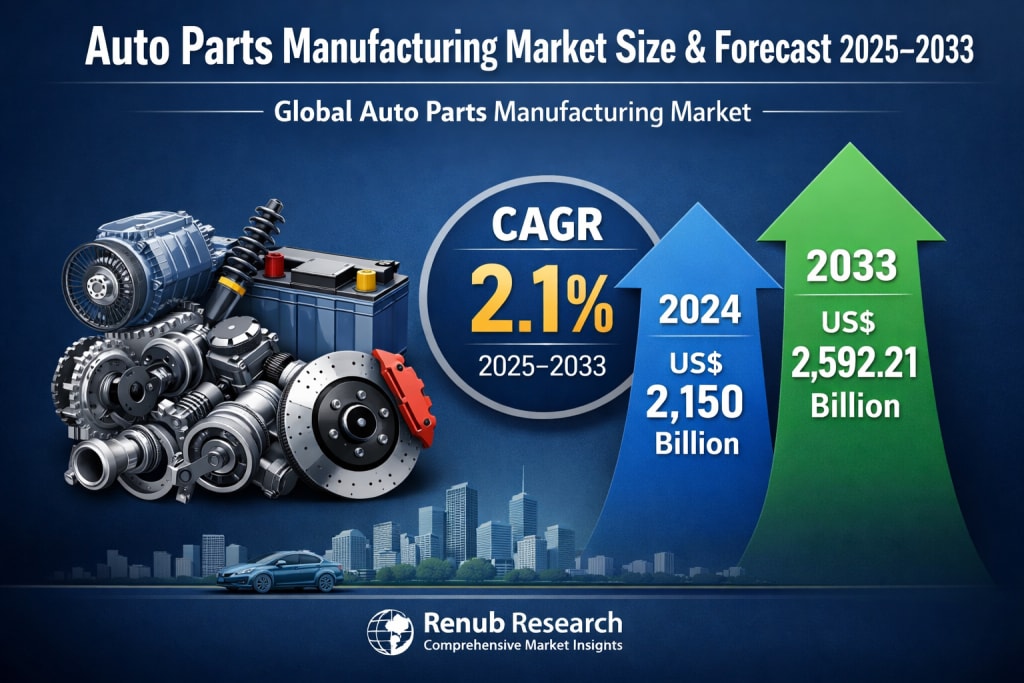
The Global Auto Parts Manufacturing Market is on a steady growth trajectory, reflecting the ongoing transformation of the automotive industry worldwide. According to Renub Research, the market is expected to reach US$ 2,592.21 billion by 2033, up from US$ 2,150 billion in 2024, expanding at a CAGR of 2.1% from 2025 to 2033.
This growth is being driven by multiple converging forces: rising global vehicle demand, supportive government policies for automotive manufacturing, and consumers’ increasing expectations for comfort, connectivity, and convenience in vehicles. At the same time, the industry is undergoing a fundamental shift toward electrification, digitalization, and sustainability, reshaping how auto components are designed, produced, and supplied.
Auto parts manufacturing sits at the very core of the automotive value chain. From batteries and braking systems to filters, underbody components, and cooling systems, every modern vehicle depends on a complex network of specialized suppliers. As vehicles become more technologically advanced and environmentally conscious, the importance of this sector continues to grow—both in economic scale and strategic relevance.
Global Auto Parts Manufacturing Industry Overview
Auto parts manufacturing is a cornerstone of the global automotive ecosystem. The industry is responsible for producing thousands of components that collectively determine a vehicle’s performance, safety, efficiency, and comfort. These range from traditional mechanical systems such as engines, transmissions, suspension, and braking systems to advanced electronic components, sensors, and software-integrated modules.
Modern manufacturers rely heavily on computer-aided design (CAD), advanced manufacturing systems, and automation technologies to meet the strict quality and precision standards set by automakers. Close collaboration between original equipment manufacturers (OEMs) and component suppliers ensures that parts integrate seamlessly into vehicle platforms, whether for mass-market passenger cars or specialized commercial vehicles.
The global auto parts industry is evolving alongside the broader automotive sector. Increasing vehicle production, especially in emerging markets, is boosting demand for components. Simultaneously, innovation in areas such as electric mobility, advanced driver-assistance systems (ADAS), and connected vehicles is pushing suppliers to invest more heavily in research and development.
Beyond new vehicle production, the automotive aftermarket also plays a critical role, driven by the growing global vehicle fleet and the need to maintain, repair, and upgrade aging vehicles. Together, OEM supply and aftermarket demand form a stable foundation for long-term industry growth.
Key Factors Driving the Auto Parts Manufacturing Market Growth
Electrification of Vehicles
One of the most powerful forces reshaping the auto parts manufacturing landscape is the rapid electrification of vehicles. As governments and consumers push for cleaner transportation, electric vehicles (EVs) are becoming a central focus of automotive strategies worldwide. This transition is creating strong demand for specialized components such as batteries, electric drivetrains, power electronics, and thermal management systems.
Unlike conventional internal combustion engine vehicles, EVs require a completely different set of core components. This shift is opening new growth avenues for suppliers that can deliver high-performance, reliable, and cost-effective electric powertrain parts. Manufacturers are significantly increasing their investments in R&D to improve battery efficiency, extend driving range, and reduce overall system costs.
As EV adoption accelerates across major markets, the demand for these advanced components is expected to rise steadily, making electrification a long-term growth engine for the auto parts manufacturing industry.
Sustainability and Eco-friendly Materials
Sustainability is no longer optional—it has become a strategic priority for the automotive and auto parts industries alike. Stricter environmental regulations, combined with rising consumer awareness, are pushing manufacturers to adopt eco-friendly materials, lightweight designs, and energy-efficient production processes.
The use of recycled, recyclable, and lightweight materials helps reduce a vehicle’s overall weight, improving fuel efficiency and lowering emissions. At the same time, it supports broader environmental goals by cutting down waste and reducing the carbon footprint of manufacturing operations.
For auto parts suppliers, sustainability is also a competitive differentiator. Companies that can demonstrate strong environmental performance often gain an edge in winning contracts from global automakers, many of which have set ambitious carbon neutrality targets. As a result, green manufacturing practices are becoming deeply embedded in the industry’s growth strategy.
Global Expansion and Market Access
The globalization of the automotive industry, particularly into emerging economies, is another major growth driver for the auto parts manufacturing market. Countries such as China, India, and those in Southeast Asia are witnessing rapid urbanization, rising middle-class incomes, and increasing vehicle ownership.
This surge in demand is encouraging automakers and suppliers to establish local manufacturing facilities in these regions. Local production not only reduces logistics costs and supply chain risks but also helps companies respond more quickly to regional market needs and regulatory requirements.
Moreover, as these markets become more integrated into the global automotive supply chain, they are also emerging as important export hubs for auto components, further strengthening the industry’s global footprint.
Challenges in the Auto Parts Manufacturing Market
Labor Shortages and Skill Gaps
Despite strong demand, the industry faces a growing shortage of skilled labor, especially in areas requiring advanced manufacturing capabilities. The increasing use of automation, robotics, and digital manufacturing technologies has raised the bar for workforce skills, creating a gap between industry needs and available talent.
This shortage can slow production, increase operational risks, and limit a company’s ability to scale up or adopt new technologies. To address this, manufacturers are investing more in training, upskilling, and workforce development programs, as well as forming partnerships with educational institutions.
However, bridging the skill gap remains a long-term challenge that will require coordinated efforts across industry, government, and academia.
Competition and Price Pressure
The auto parts manufacturing market is highly competitive, with intense price pressure, especially from low-cost producers in emerging markets. These companies often benefit from lower labor and operational costs, allowing them to offer components at more competitive prices.
For established players, this creates a constant balancing act: reducing costs while maintaining high quality, reliability, and innovation standards. At the same time, automakers themselves are under pressure to control vehicle prices, which further squeezes supplier margins.
To stay competitive, companies are focusing on supply chain optimization, process efficiency, digitalization, and strategic partnerships. However, sustaining profitability in such a price-sensitive environment remains a key challenge.
Auto Parts Manufacturing Market Overview by Regions
The global auto parts manufacturing market is expanding across all major regions, though growth dynamics vary based on local industry structure, technology adoption, and consumer demand.
United States Auto Parts Manufacturing Market
The U.S. market continues to grow steadily, supported by a strong automotive industry, rising EV adoption, and ongoing technological innovation. American suppliers are increasingly focusing on advanced components such as batteries, electric drivetrains, and electronics systems.
Automation and smart manufacturing are also becoming more widespread as companies seek to improve productivity and control costs. While challenges such as labor shortages and supply chain disruptions persist, the U.S. remains a key hub for high-value auto parts manufacturing and innovation.
United Kingdom Auto Parts Manufacturing Market
The UK auto parts sector is undergoing significant transformation, driven by the shift toward electric vehicles and evolving regulatory frameworks. Government support for EV infrastructure and battery production, including investments in gigafactories, is strengthening the local supply chain for electric mobility.
Trade agreements and policy initiatives are also helping improve market access for UK-made components. However, the industry still faces hurdles such as skill shortages and supply chain volatility. Despite these challenges, strategic investments and policy support position the UK market for long-term growth and modernization.
India Auto Parts Manufacturing Market
India is emerging as one of the most dynamic auto parts manufacturing markets, fueled by strong domestic demand, rising vehicle production, and a rapidly expanding aftermarket. Government initiatives such as the Production Linked Incentive (PLI) scheme are encouraging local manufacturing and innovation, particularly in EV-related components.
Indian suppliers are also strengthening their presence in global export markets, enhancing the country’s role in the international automotive supply chain. While challenges remain in terms of technology adoption and workforce skills, India’s long-term growth prospects in this sector remain highly promising.
United Arab Emirates Auto Parts Manufacturing Market
The UAE auto parts manufacturing market is gaining momentum due to rising vehicle ownership, technological advancement, and supportive government policies. Initiatives such as “Make it in the Emirates” and the broader “Operation 300bn” strategy aim to boost local industrial production and reduce reliance on imports.
Thanks to its strategic geographic location, the UAE also serves as a key trade and logistics hub, facilitating access to both regional and global markets. As the market develops, greater emphasis is being placed on innovation, sustainability, and advanced manufacturing technologies.
Market Segmentation
By Type
Battery
Cooling System
Underbody Component
Automotive Filter
Others
By End User
OEMs
Aftermarket
By Vehicle Type
Passenger Cars
Light Commercial Vehicles
Heavy Commercial Vehicles
Others
Regional Outlook
North America: United States, Canada
Europe: France, Germany, Italy, Spain, United Kingdom, Belgium, Netherlands, Turkey
Asia Pacific: China, Japan, India, Australia, South Korea, Thailand, Malaysia, Indonesia, New Zealand
Latin America: Brazil, Mexico, Argentina
Middle East & Africa: South Africa, Saudi Arabia, United Arab Emirates
Competitive Landscape
The global auto parts manufacturing market is highly competitive, with a mix of multinational giants and specialized regional players. Key companies include:
Aisin Corporation
Akebono Brake Industry Co., Ltd.
Brembo S.p.A.
Continental AG
DENSO Corporation
Faurecia SE
General Motors Company
Magna International Inc.
These companies focus on innovation, strategic partnerships, capacity expansion, and sustainability initiatives to strengthen their market positions. Areas such as electrification, lightweight materials, and smart manufacturing are central to their long-term strategies.
Final Thoughts
The Global Auto Parts Manufacturing Market is entering a new era defined by technological transformation, sustainability, and shifting mobility trends. With the market projected to grow from US$ 2,150 billion in 2024 to US$ 2,592.21 billion by 2033 at a CAGR of 2.1%, the industry’s future looks stable and strategically important.
Electrification, eco-friendly materials, and expanding vehicle demand in emerging markets are reshaping the competitive landscape, while challenges such as labor shortages and price pressure are pushing manufacturers to become more efficient and innovative.
For companies that can adapt to these changes, invest in advanced technologies, and align with global sustainability goals, the coming decade offers significant opportunities. The auto parts manufacturing industry will not just support the future of mobility—it will actively help define it.
About the Creator
Tom Shane
Tom Shane is a content writer specializing in SEO-driven blogs, product descriptions, and thought leadership. He crafts engaging, research-backed content that connects with audiences and drives results.
Australia Freight and Logistics Market 2026: Set to Surge to USD 140.6 Billion by 2034
Australia Freight and Logistics Market Overview The Australia Freight and Logistics Market — encompassing the transport of goods and the management of supply chains — is experiencing steady expansion amid strong economic and trade momentum. According to the latest IMARC Group analysis, the market reached USD 97.9 billion in 2025 and is forecast to grow to USD 140.6 billion by 2034, exhibiting a compound annual growth rate (CAGR) of 3.98% between 2026 and 2034.
By Amyra Singh6 days ago in Trader



Comments
There are no comments for this story
Be the first to respond and start the conversation.