
Endobronchial Ultrasound Biopsy Market Size and Forecast 2025–2033
Why Minimally Invasive Lung Diagnostics Are Reshaping Global Pulmonary Care

Introduction
The global healthcare industry is undergoing a steady transformation, driven by the demand for faster, safer, and more accurate diagnostic procedures. Among the many technologies redefining modern diagnostics, Endobronchial Ultrasound (EBUS) biopsy has emerged as a critical tool in pulmonary medicine—especially in the diagnosis and staging of lung cancer and other thoracic diseases.
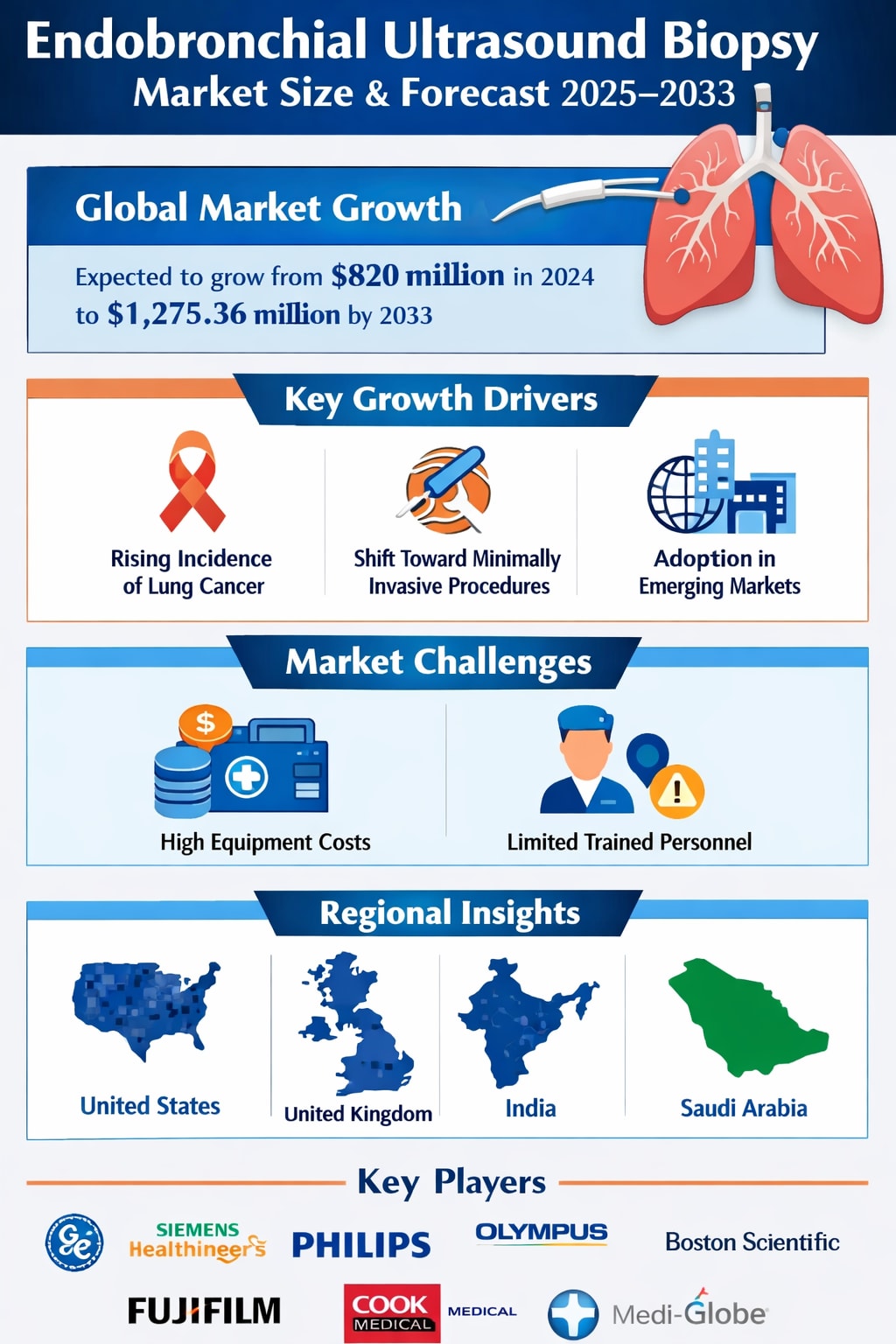
According to Renub Research, the Endobronchial Ultrasound Biopsy Market is expected to reach US$ 1,275.36 million by 2033, up from US$ 820 million in 2024, growing at a compound annual growth rate (CAGR) of 5.03% from 2025 to 2033. This growth reflects a broader shift in global healthcare toward minimally invasive procedures, improved imaging technologies, and the rising burden of respiratory diseases worldwide.
As clinicians, hospitals, and healthcare systems prioritize patient safety, procedural efficiency, and diagnostic accuracy, EBUS-guided biopsy is increasingly becoming a gold standard for evaluating lung lesions and mediastinal lymph nodes. Its ability to combine real-time ultrasound imaging with bronchoscopic access makes it an indispensable tool in modern pulmonary diagnostics.
Market Overview of Endobronchial Ultrasound Biopsy (EBUS)
The market for endobronchial ultrasound biopsy is expanding steadily, supported by multiple clinical and technological trends. EBUS allows physicians to perform minimally invasive biopsies of lung tissue and lymph nodes using real-time ultrasound guidance through the bronchial tree. Compared to traditional surgical biopsies, EBUS significantly reduces patient risk, hospital stay, and recovery time.
One of the most important clinical applications of EBUS is in the diagnosis and staging of non-small cell lung cancer (NSCLC), as well as other thoracic malignancies and infectious or inflammatory conditions. The technique is especially valuable for sampling lesions that are difficult to access through conventional methods, improving both diagnostic accuracy and patient comfort.
Technological progress has further strengthened the market. Advances in imaging resolution, needle guidance systems, and specialized biopsy tools have improved procedural precision and clinical outcomes. Leading medical device companies such as GE Healthcare, Olympus Corporation, Boston Scientific, Medtronic, Cook Medical, FUJIFILM, and Philips are actively investing in research, product development, and clinical collaborations to meet the growing demand for EBUS systems worldwide.
Beyond technology, demographic and epidemiological trends are also playing a major role. The global population is aging rapidly, and respiratory diseases are becoming more common. The World Health Organization estimates that by 2030, the number of people aged 60 and above will reach around 1.4 billion, up from approximately 1.1 billion in 2021. Older populations are more vulnerable to lung cancer, chronic obstructive pulmonary disease (COPD), and other pulmonary conditions, all of which increase the need for advanced diagnostic tools like EBUS.
The Rising Burden of Lung Cancer and Respiratory Diseases
Lung cancer remains one of the leading causes of cancer-related deaths worldwide. Factors such as smoking, air pollution, occupational hazards, and aging populations continue to drive its incidence. According to the American Cancer Society, there are expected to be about 226,650 new cases of lung cancer in the United States in 2025, with approximately 124,730 deaths attributed to the disease.
Early and accurate diagnosis is critical for improving survival rates and selecting the most appropriate treatment strategies. EBUS-guided biopsy plays a crucial role here by enabling precise sampling of lymph nodes and lung lesions, which helps clinicians determine cancer stage and plan targeted therapies.
In addition to cancer, the growing prevalence of tuberculosis (TB), COPD, and other chronic respiratory conditions is further boosting demand for minimally invasive diagnostic procedures. As air pollution, smoking, and urbanization continue to affect respiratory health globally, healthcare systems are increasingly turning to advanced tools like EBUS to improve diagnostic efficiency and patient outcomes.
Key Growth Drivers of the Endobronchial Ultrasound Biopsy Market
1. Rising Incidence of Lung Cancer
The global increase in lung cancer cases is one of the strongest drivers of the EBUS biopsy market. Non-small cell lung cancer, in particular, requires accurate staging to guide treatment decisions such as surgery, chemotherapy, immunotherapy, or targeted therapy. EBUS-guided biopsy offers a reliable, minimally invasive method to obtain tissue samples from mediastinal lymph nodes and lung lesions, reducing the need for more invasive surgical procedures.
As awareness of early diagnosis grows among both clinicians and patients, the demand for EBUS procedures is expected to rise steadily across both developed and emerging healthcare markets.
2. Shift Toward Minimally Invasive Procedures
Modern healthcare increasingly favors procedures that reduce patient trauma, hospital stay, and overall healthcare costs. Traditional surgical biopsies, while effective, often involve higher risks, longer recovery times, and greater resource utilization.
EBUS provides a safer and more efficient alternative. It can often be performed under moderate sedation, allows same-day discharge in many cases, and significantly lowers the risk of complications. This shift toward minimally invasive diagnostics is a major factor accelerating the adoption of EBUS worldwide.
3. Growing Adoption in Emerging Markets
Emerging economies in Asia-Pacific, Latin America, and the Middle East are investing heavily in healthcare infrastructure and advanced medical technologies. As hospitals and diagnostic centers in these regions upgrade their capabilities, the adoption of EBUS systems is increasing.
Rising awareness of lung cancer, improving access to specialized care, and government initiatives to strengthen healthcare systems are all contributing to this trend. Over the next decade, emerging markets are expected to become key growth engines for the global EBUS biopsy industry.
Challenges Facing the EBUS Biopsy Market
High Equipment and Maintenance Costs
One of the biggest barriers to widespread adoption of EBUS technology is its high cost. EBUS systems require significant upfront investment, along with ongoing expenses for maintenance, accessories, and specialized biopsy needles. For smaller hospitals and clinics, especially in resource-limited settings, these costs can be difficult to justify.
In addition, healthcare providers must invest in training programs to ensure that clinicians and technicians can use the equipment effectively, further increasing the overall cost of adoption.
Limited Availability of Trained Professionals
EBUS procedures require skilled pulmonologists and trained support staff who are proficient in both operating the equipment and interpreting complex imaging data. In many regions, especially rural areas and developing countries, there is a shortage of such trained professionals.
This skills gap can limit the availability of EBUS services, affect diagnostic quality, and slow market growth despite rising clinical demand.
Regional Market Insights
United States
The United States represents one of the largest and most advanced markets for EBUS biopsy. The country’s strong healthcare infrastructure, high adoption of medical technologies, and significant burden of lung cancer all support market growth.
According to recent cancer statistics, lung and bronchus cancers continue to account for a substantial share of new cancer cases in the U.S. The growing preference for minimally invasive diagnostic procedures, combined with ongoing technological innovation, positions the U.S. as a global leader in the EBUS biopsy market.
United Kingdom
In the UK, the EBUS biopsy market is expanding due to rising cases of lung disease and strong institutional support for advanced diagnostics. The National Health Service (NHS) and other healthcare providers increasingly recognize the value of EBUS in improving diagnostic accuracy while reducing patient risk.
However, challenges such as equipment costs and the need for specialized training still affect the speed of adoption in some regions. Despite this, continued investment in healthcare technology is expected to support steady market growth.
India
India’s EBUS biopsy market is growing rapidly, driven by expanding healthcare infrastructure, increasing awareness of lung diseases, and rising cancer incidence. Major hospitals and specialty clinics are increasingly adopting EBUS for accurate diagnosis and staging of lung cancer and other respiratory conditions.
Government initiatives aimed at improving healthcare access and quality are also supporting the adoption of advanced diagnostic technologies. Nevertheless, high equipment costs and limited availability of trained professionals remain important challenges in certain parts of the country.
Saudi Arabia
Saudi Arabia is witnessing steady growth in the EBUS biopsy market, supported by healthcare modernization programs and increased investment in advanced medical technologies. Rising awareness of minimally invasive procedures and the growing burden of respiratory diseases are encouraging hospitals and specialty centers to adopt EBUS systems.
While adoption is progressing, challenges such as training requirements and equipment costs still influence the pace of market expansion across different regions of the country.
Recent Developments in the EBUS Biopsy Industry
The industry continues to evolve through product innovation and strategic investments:
October 2024: GE Healthcare announced the expansion of its medical imaging manufacturing operations in Waukesha County, Wisconsin, to meet growing global demand for advanced imaging equipment, including ultrasound systems.
September 2024: FUJIFILM Healthcare Europe introduced compatibility of its ARIETTA 750 FF ENDO ultrasound system with linear bronchoscopes and multiple ultrasound endoscopes, featuring advanced imaging technologies such as improved visualization and enhanced focusing.
October 2023: Praxis received FDA approval for its EndoCore EBUS-TBNA biopsy equipment, designed to improve precision and efficiency in lung biopsy procedures and enhance tissue sampling accuracy.
These developments highlight the industry’s strong focus on innovation, performance improvement, and clinical value.
Market Segmentation
By Product:
EBUS Scopes
EBUS Needles
Ultrasound Processors and Imaging Systems
Accessories
By Application:
Cancer Diagnostic
Infection Diagnostic
Others
By End Use:
Hospitals
Ambulatory Surgical Centers (ASCs)
Specialty Clinics
By Region:
North America (United States, Canada)
Europe (France, Germany, Italy, Spain, United Kingdom, Belgium, Netherlands, Turkey)
Asia Pacific (China, Japan, India, Australia, South Korea, Thailand, Malaysia, Indonesia, New Zealand)
Latin America (Brazil, Mexico, Argentina)
Middle East & Africa (South Africa, Saudi Arabia, United Arab Emirates)
Key Companies Profiled
GE Healthcare
Siemens Healthcare Private Limited
Koninklijke Philips N.V.
Boston Scientific Corporation
Olympus Corporation
Cook Group Incorporated
FUJIFILM Holdings Corporation
Medi-Globe Technologies GmbH
These companies are analyzed across multiple dimensions, including company overview, leadership, recent strategies, revenue performance, and overall market positioning.
Final Thoughts
The Endobronchial Ultrasound Biopsy Market is on a clear growth trajectory, fueled by the rising burden of lung cancer, increasing preference for minimally invasive diagnostics, and continuous technological innovation. With the market projected to grow from US$ 820 million in 2024 to US$ 1,275.36 million by 2033, the role of EBUS in modern pulmonary care is set to become even more critical.
While challenges such as high equipment costs and limited availability of trained professionals remain, ongoing investments in healthcare infrastructure, training, and technology are expected to gradually ease these barriers. As healthcare systems worldwide continue to prioritize early diagnosis, patient safety, and procedural efficiency, EBUS-guided biopsy will remain a cornerstone of advanced respiratory diagnostics in the years ahead.
About the Creator
Australia Courier, Express and Parcel (CEP) Market to Reach USD 17.7 Billion by 2033 on E-Commerce and Tech Adoption
The Australia courier, express and parcel (CEP) market is expanding steadily as digital commerce, delivery expectations, and logistics technologies evolve across the nation. According to IMARC Group, the market was valued at USD 12.8 billion in 2024 and is projected to reach USD 17.7 billion by 2033, reflecting a compound annual growth rate (CAGR) of 3.30% between 2025 and 2033.
By Rashi Sharma30 minutes ago in Trader




Comments
There are no comments for this story
Be the first to respond and start the conversation.