
Energy Drinks Market Trends & Summary: How Functional Beverages Are Powering a US$ 122 Billion Future
From busy professionals to gamers and fitness enthusiasts, energy drinks are evolving into smarter, cleaner, and more functional beverages—reshaping the global drinks industry through 2033.

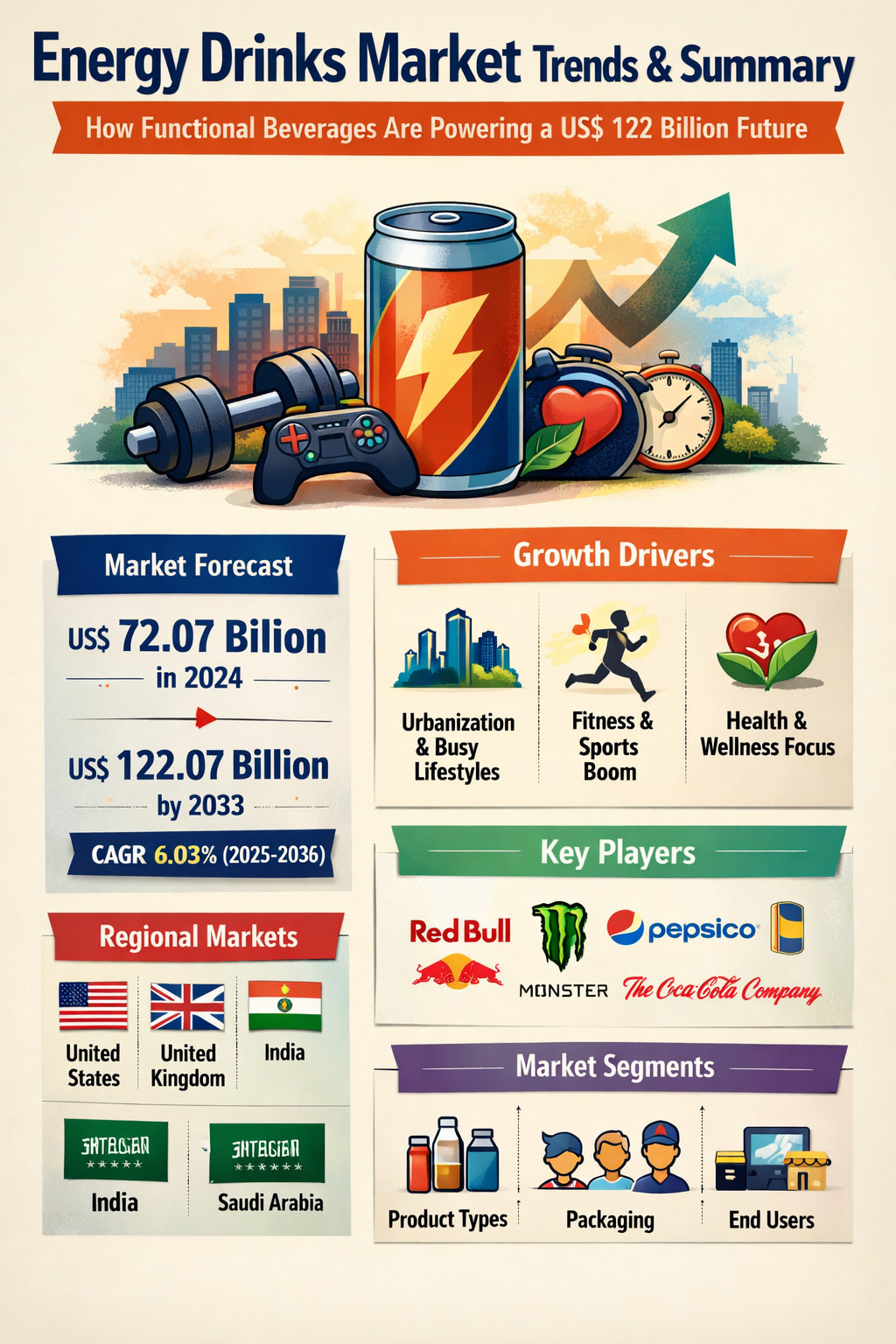
Global Energy Drinks Market Overview
The global energy drinks market is entering a decisive growth phase, driven by lifestyle shifts, changing consumer priorities, and rapid innovation in functional beverages. According to Renub Research, the Energy Drinks Market is expected to reach US$ 122.07 billion by 2033, up from US$ 72.07 billion in 2024, growing at a CAGR of 6.03% from 2025 to 2033. This expansion reflects more than just rising consumption—it signals a structural transformation in how consumers think about energy, performance, and everyday productivity.
Once considered niche or youth-focused, energy drinks have become mainstream across age groups and professions. Today’s consumers include office workers managing long hours, students preparing for exams, gamers seeking sustained focus, and fitness enthusiasts looking for performance support. What’s changing is not only who drinks energy beverages, but why they drink them. The category is no longer just about caffeine boosts; it is increasingly about functionality, convenience, and perceived health benefits.
Modern energy drinks now come in a wide range of formulations—sugar-free, organic, natural, vitamin-enriched, and plant-based. This diversification mirrors broader trends in the food and beverage industry, where consumers are demanding cleaner labels, better ingredients, and products that align with wellness goals. Brands are responding with innovations that combine energy with hydration, mental focus, and endurance support, positioning energy drinks closer to the fast-growing functional beverage segment.
E-commerce and digital retail have further accelerated this shift. Consumers can now discover and purchase niche or premium energy drink brands online, expanding market access far beyond traditional convenience stores. At the same time, sports, fitness, and gaming cultures are playing a powerful role in shaping demand, with sponsorships, influencer marketing, and community-driven branding strategies helping energy drink companies reach highly engaged audiences worldwide.
What’s Driving the Energy Drinks Market Forward?
Urbanization and Hectic Lifestyles
One of the strongest drivers behind the energy drinks market is the pace of modern life. Urbanization, longer working hours, and increasingly demanding schedules have created a constant need for quick and convenient energy solutions. For millions of people, energy drinks fit seamlessly into daily routines—consumed during commutes, work breaks, late-night study sessions, or before workouts.
In fast-growing urban centers across Asia, Africa, and Latin America, this trend is even more pronounced. As more people move into cities and adopt busier lifestyles, the demand for portable, ready-to-drink energy solutions continues to rise. Energy drinks offer a simple promise: alertness, focus, and reduced fatigue in a fast-moving world.
The Expanding Fitness and Sports Ecosystem
The global fitness and sports industry has become a major growth engine for energy drinks. From gym-goers and amateur athletes to professional sports communities, performance-oriented consumers are increasingly turning to energy beverages to support endurance, stamina, and workout intensity.
Energy drink brands have strategically aligned themselves with sports events, fitness influencers, and athletic sponsorships. This association reinforces the idea that these products are not just stimulants, but performance-supporting tools. As wellness culture continues to grow and more consumers invest in active lifestyles, the connection between energy drinks and physical performance is likely to strengthen further.
Rising Health and Wellness Awareness
Paradoxically, growing health awareness—once seen as a threat to energy drinks—has become one of the market’s biggest opportunities. Consumers are no longer satisfied with high-sugar, heavily artificial formulations. Instead, they are seeking cleaner, more functional alternatives.
This shift has fueled the rise of:
Sugar-free and low-calorie energy drinks
Products with natural caffeine sources like green tea, guarana, and yerba mate
Beverages enriched with vitamins, minerals, electrolytes, and antioxidants
Organic and plant-based formulations
Manufacturers are now positioning energy drinks as part of a broader wellness and functional beverage lifestyle, rather than just quick stimulants. This evolution is helping the category appeal to older consumers and health-conscious buyers who previously avoided traditional energy drinks.
Challenges Facing the Energy Drinks Industry
The Consumer Shift Toward Healthier Alternatives
While innovation is creating new opportunities, it is also exposing the industry to new challenges. A growing segment of consumers is moving toward natural juices, functional waters, herbal teas, and other “clean label” beverages. These alternatives often promise hydration, mental clarity, or immune support without the stigma sometimes associated with energy drinks.
To stay competitive, energy drink companies must continue to reformulate, reposition, and communicate their products more clearly. The brands that fail to adapt risk losing relevance in a market that increasingly values transparency, ingredient quality, and long-term health impact.
Intensifying Competition
The energy drinks market is becoming increasingly crowded. Alongside global giants, a wave of regional and startup brands is entering the space with niche positioning—organic, vegan, nootropic, or lifestyle-focused energy drinks. This intensifies competition not just on price, but on branding, distribution, and innovation.
In mature markets like the United States and Western Europe, differentiation is critical. Companies are investing heavily in product design, flavor innovation, and marketing storytelling to stand out in a saturated retail environment. While demand remains strong, maintaining brand loyalty in such a competitive landscape is an ongoing challenge.
Regional Market Perspectives
United States Energy Drinks Market
The U.S. remains one of the most influential and dynamic markets for energy drinks. Busy lifestyles, a strong fitness culture, and a massive gaming and tech community continue to fuel demand. Energy drinks are widely consumed by young adults, professionals, and fitness enthusiasts who value both convenience and performance benefits.
At the same time, American consumers are increasingly drawn to clean-label, low-sugar, and plant-based options. This has pushed both established brands and new entrants to experiment with natural ingredients and functional add-ons. Despite regulatory scrutiny and health debates around caffeine and sugar, demand remains resilient—driven by lifestyle needs and constant product innovation.
United Kingdom Energy Drinks Market
In the UK, energy drinks are experiencing steady growth, supported by urbanization, busy work culture, and rising disposable incomes. Consumers are using these beverages to enhance focus, boost productivity, and support active lifestyles. The market features a wide range of offerings, from classic formulations to sugar-free and vitamin-enriched variants.
Distribution has expanded beyond traditional retail into gyms, convenience stores, and online platforms, making energy drinks more accessible than ever. While health concerns and regulatory discussions continue, ongoing innovation in flavors and formulations is helping the market maintain strong momentum.
India Energy Drinks Market
India represents one of the most promising growth markets for energy drinks. Rapid urbanization, a young population, and rising disposable incomes are transforming energy drinks from a niche product into a mainstream beverage category. Young professionals, students, and fitness-conscious consumers are increasingly adopting these drinks for quick energy and mental alertness.
Both international brands and domestic players are actively expanding their presence through new product launches, aggressive marketing, and wider distribution networks. The diversity of the Indian consumer base is also encouraging companies to experiment with flavors, pricing strategies, and localized branding approaches.
Saudi Arabia Energy Drinks Market
Saudi Arabia’s energy drinks market is growing rapidly, supported by a youthful population, rising interest in fitness, and strong retail infrastructure. Energy drinks are widely available across supermarkets and convenience stores, making them a popular choice among young adults and professionals.
However, the market is also shaped by regulatory measures, including sugar taxes and consumption guidelines. These policies are accelerating the shift toward sugar-free and healthier alternatives. Brands that successfully adapt their portfolios to meet these expectations are likely to sustain growth in the region.
Market Segmentation Snapshot
The global energy drinks market is highly diverse and segmented across multiple dimensions:
By Type:
Alcoholic
Non-Alcoholic
By Product:
Non-Organic
Organic
Natural
By Packaging:
Plastic
Glass
Metal
Others
By End Users:
Kids
Adults
Teenagers
By Gender:
Women
Men
By Distribution Channel:
Convenience Stores
Foodservice
Mass Merchandisers
Supermarkets
Others
By Geography:
Across North America, Europe, Asia Pacific, Latin America, and the Middle East & Africa, including key markets such as the United States, Canada, UK, Germany, France, China, Japan, India, Australia, Brazil, Mexico, Saudi Arabia, UAE, and South Africa.
Competitive Landscape and Key Players
The global energy drinks market is led by a mix of established multinational corporations and innovative regional players. Major companies are focusing on four strategic pillars: brand strength, product innovation, distribution reach, and financial performance.
Key players include:
Aje Group
Red Bull
Congo Brands
Monster Beverage Corporation
PepsiCo, Inc.
National Beverage Corp
Suntory Holdings Limited
The Coca-Cola Company
Campbell Soup Co.
Amway Corporation
These companies are actively investing in new formulations, strategic partnerships, and marketing campaigns to capture evolving consumer preferences and expand their global footprint.
Final Thoughts: A Market Recharging Itself
The global energy drinks market is no longer just about quick caffeine fixes. It is becoming a broader functional beverage ecosystem—one that blends energy, wellness, convenience, and lifestyle branding into a single, powerful proposition. With the market projected to grow from US$ 72.07 billion in 2024 to US$ 122.07 billion by 2033, the opportunity ahead is substantial.
The brands that will win in this next phase are those that understand the new consumer mindset: performance without compromise, energy with purpose, and convenience with consciousness. As health awareness, urban lifestyles, and digital commerce continue to reshape consumption habits, energy drinks are set to remain a central—and increasingly sophisticated—part of the global beverage industry.
About the Creator
Australia Healthcare Services Market — Growth, Forecast & Strategic Outlook 2026–2034
The Australia healthcare services market is expanding steadily as demand for medical, diagnostic and long-term care rises in tandem with demographic shifts and healthcare technology adoption. According to IMARC Group, the market reached USD 215.5 billion in 2025 and is projected to grow to USD 391.9 billion by 2034, representing a compound annual growth rate (CAGR) of 6.66% during 2026–2034.
By Amélie Belle4 days ago in Trader



Comments
There are no comments for this story
Be the first to respond and start the conversation.