
Europe Luxury Hotel Market Size and Forecast 2026–2034
International Tourism, Experiential Travel, and Sustainable Innovation Propel Europe’s Premium Hospitality Boom

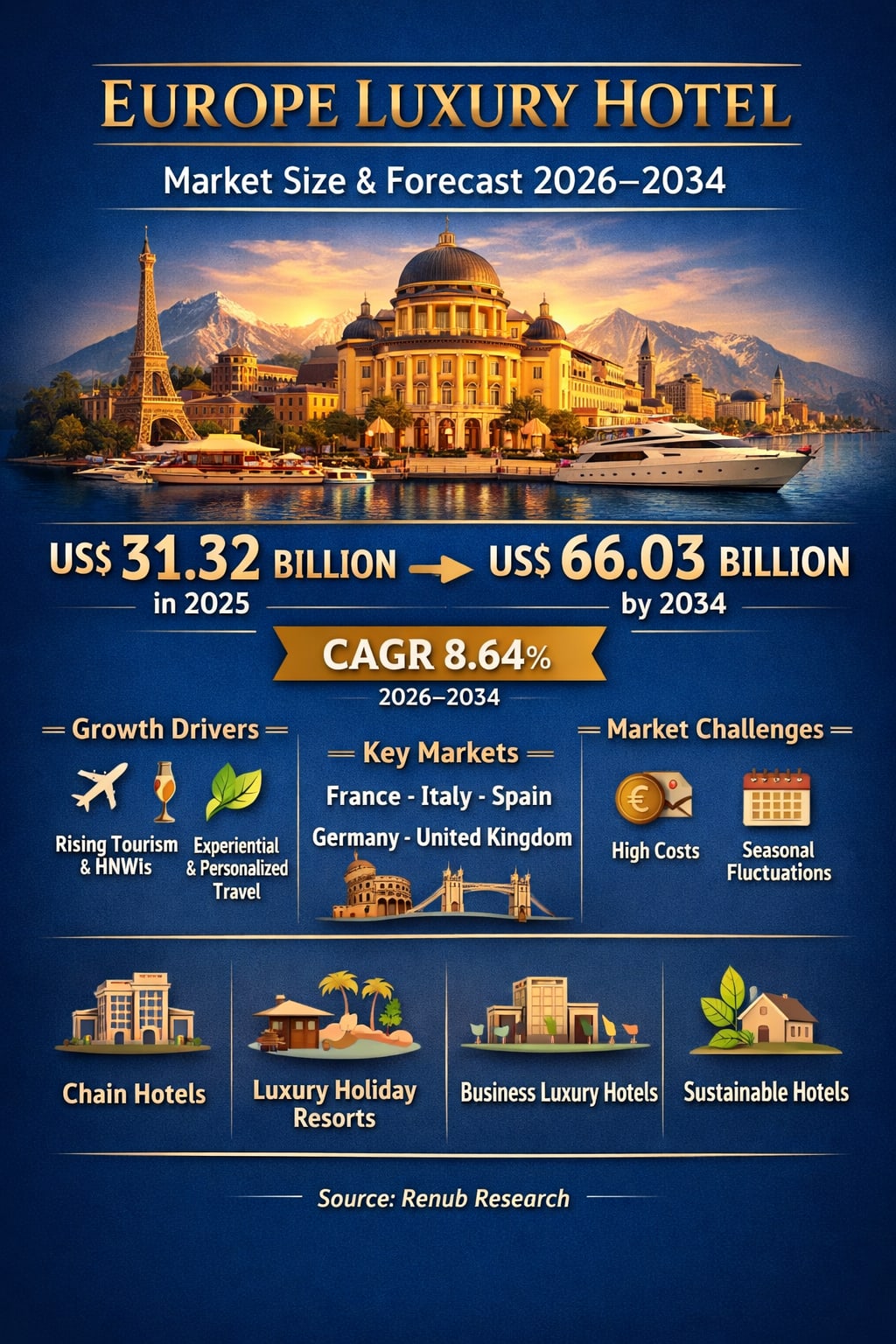
The Europe luxury hotel market is entering a transformative growth phase, driven by international tourism recovery, rising high-net-worth individuals (HNWIs), experiential travel demand, and sustainable hospitality innovation. According to Renub Research, the market is projected to grow from US$ 31.32 Billion in 2025 to US$ 66.03 Billion by 2034, expanding at a CAGR of 8.64% during 2026–2034.
From heritage palaces in Paris to coastal retreats along the Amalfi Coast, Europe continues to set global benchmarks for luxury hospitality. The combination of cultural richness, architectural grandeur, culinary prestige, and technological personalization positions the region as the world’s most desirable luxury travel destination.
France, Italy, Spain, Germany, and the United Kingdom are expected to remain the primary growth engines, supported by brand expansions, sustainability initiatives, and rising discretionary spending among affluent travelers.
Europe Luxury Hotel Market Overview
A luxury hotel represents the highest tier of hospitality, offering premium services, sophisticated interiors, personalized guest experiences, and world-class amenities. These establishments are characterized by:
Exquisite architectural design
Spacious and elegantly furnished rooms
Michelin-level dining experiences
Spa, wellness, and fitness facilities
Concierge and bespoke guest services
Smart-room and AI-enabled personalization
In Europe, luxury hotels often occupy historic palaces, castles, and heritage buildings—blending centuries-old charm with modern sophistication. The continent’s reputation in art, fashion, gastronomy, and culture complements the luxury hospitality concept seamlessly.
The growing preference for experiential travel, sustainable luxury properties, and tech-enabled personalization continues to reshape the competitive landscape.
Growth Drivers of the Europe Luxury Hotel Market
1. Rising International Tourism and High-Net-Worth Travelers
Europe remains the world’s most visited region. In 2025, nights spent at EU tourist accommodation establishments reached 3.08 billion, an increase of 61.5 million compared to the previous year.
The steady rise in high-net-worth individuals (HNWIs) and ultra-high-net-worth millennials is significantly boosting demand for luxury accommodations. These travelers prioritize:
Privacy and exclusivity
Personalized concierge services
Heritage-rich stays
Cultural immersion
Destinations such as Paris, London, Rome, Barcelona, and the French Riviera continue to attract high-spending leisure and business tourists. According to European travel trends in 2025, international arrivals grew 3%, while overnight stays increased 2.7%, demonstrating resilience despite inflationary pressures and rising travel costs.
Luxury hotels are uniquely positioned to serve affluent travelers from North America, the Middle East, and Asia-Pacific, supported by Europe’s strong aviation connectivity and tourism infrastructure.
2. Growth of Experiential and Personalized Luxury Travel
Modern luxury travelers increasingly seek curated experiences rather than just premium accommodation.
European luxury hotels are capitalizing on this shift by offering:
Palace stays and vineyard resorts
Wellness retreats in Alpine settings
Gastronomic journeys
Cultural masterclasses and art tours
Yacht and rail-based luxury itineraries
Advanced digital technologies such as AI-based guest profiling, smart-room automation, and predictive service personalization are enhancing guest satisfaction and encouraging repeat visits.
For example, luxury travel programs launched in 2025 across Europe for 2026 departures reflect growing demand for customized river cruising, small-ship voyages, and boutique rail experiences.
Hotels are now monetizing experiences at premium pricing levels, reinforcing customer loyalty and revenue growth.
3. Expansion of Luxury Brands and Sustainable Hospitality
International hotel chains are aggressively expanding their European luxury portfolios. Major operators including:
Accor
Marriott International Inc.
Hilton Worldwide
Hyatt Corporation
IHG Hotels & Resorts
are investing heavily in renovations, new openings, and brand repositioning across key European cities.
Simultaneously, sustainability has become a core competitive differentiator. Luxury hotels are adopting:
Green building certifications
Renewable energy systems
Locally sourced organic cuisine
Zero-waste initiatives
Community-integrated tourism models
For instance, “Lucknam Park Hotel & Spa” joined the Emblems Collection under Accor, signaling continued brand consolidation and premium repositioning in the United Kingdom’s countryside market.
Sustainable luxury is no longer optional—it is a strategic imperative.
Challenges Facing the Europe Luxury Hotel Market
High Operational and Development Costs
Luxury hotels require significant capital investment in:
Prime real estate
Architectural design and heritage preservation
High-end furnishings
Skilled hospitality workforce
Continuous renovation cycles
Strict European environmental regulations and heritage conservation laws further increase compliance costs. These barriers limit new entrants and favor established brands with strong capital backing.
Economic Uncertainty and Seasonal Demand
Luxury hospitality is sensitive to macroeconomic fluctuations. Inflation, exchange rate volatility, and geopolitical uncertainties can directly impact discretionary travel spending.
Seasonality also affects occupancy rates. While summer months witness peak leisure demand, winter occupancy in certain destinations can decline sharply—except for Alpine ski resorts and urban business hubs.
Hotels must therefore diversify offerings and expand off-season experiential packages to stabilize revenues.
Segment Analysis
Europe Chain Luxury Hotel Market
Chain luxury hotels dominate urban centers and resort hubs by offering standardized quality and global brand recognition.
Key players include:
Best Western
Groupe Du Louvre
Carlson-Rezidor
NH Hotels
Melia International
These operators benefit from loyalty programs, global distribution networks, and centralized reservation systems.
Chain hotels are blending global service standards with localized European architecture and gastronomy, striking a balance between reliability and authenticity.
Europe Luxury Business Hotel Market
Luxury business hotels cater to corporate executives and high-level professionals, particularly in financial and diplomatic hubs such as London, Frankfurt, Zurich, Milan, and Paris.
These properties offer:
Advanced meeting facilities
High-speed connectivity
Executive lounges
Concierge support
Work-leisure hybrid spaces
The resurgence of MICE (Meetings, Incentives, Conferences, Exhibitions) tourism is strengthening year-round occupancy in this segment.
Europe Luxury Holiday Hotel Market
Luxury holiday hotels represent one of the fastest-growing segments.
High-demand destinations include:
The French Riviera
The Amalfi Coast
The Greek Islands
The Swiss Alps
Spain’s Balearic and Canary Islands
These hotels focus on:
Wellness tourism
Culinary experiences
Destination weddings
Private villa accommodations
Eco-luxury concepts
Rising global spending on leisure vacations and honeymoon tourism continues to elevate demand.
Europe Upper-Upscale Hotel Market
Upper-upscale hotels bridge the gap between premium and ultra-luxury segments.
They offer:
Stylish interiors
Quality dining
Competitive pricing
Strong urban accessibility
This segment appeals to affluent millennials, corporate travelers, and short-stay premium tourists seeking value-oriented luxury.
Booking Trends: Direct vs. Travel Agents
Direct Booking Market:
Luxury hotels increasingly promote direct website bookings to reduce commission fees and retain guest data. Incentives include:
Exclusive packages
Loyalty rewards
Flexible cancellation policies
Personalized offers
AI-driven platforms and mobile booking systems are strengthening direct conversion rates.
Travel Agents Market:
Despite digital growth, luxury travel agents remain influential for complex itineraries, destination weddings, and multi-country tours. Personalized advisory services remain highly valued among HNWIs.
Country-Level Insights
United Kingdom Luxury Hotel Market
The United Kingdom benefits from strong international tourism and business travel.
London leads the segment with iconic luxury properties and diplomatic clientele. Regional destinations such as Edinburgh and the Cotswolds are expanding high-end hospitality offerings.
In 2024, Highly Recommended Hotels launched operations with 12 founding members, strengthening the country’s independent luxury network.
France Luxury Hotel Market
France remains synonymous with luxury tourism.
Paris dominates with palace hotels and high-end fashion tourism. The French Riviera, Provence, and the Alps further reinforce leisure luxury.
In 2026, Louis Vuitton will debut its first fully branded hotel in Paris under LVMH, signaling deeper luxury brand integration into hospitality.
Italy Luxury Hotel Market
Italy’s rich cultural heritage and scenic diversity drive strong luxury demand.
Destinations such as Rome, Venice, Florence, Lake Como, Tuscany, and the Amalfi Coast remain globally iconic.
In July 2025, Villa Beatrice joined the Belmond portfolio above Paraggi Bay, reinforcing Italy’s high-end coastal luxury appeal.
Spain Luxury Hotel Market
Spain’s favorable climate and resort infrastructure support sustained growth.
Madrid and Barcelona anchor urban luxury, while Costa del Sol and the Balearic Islands dominate resort tourism.
In February 2025, Kimpton Los Monteros Marbella re-entered the market, restoring one of Spain’s legendary luxury hotels.
Market Segmentation
By Category
Chain
Independent
By Type
Business Hotels
Holiday Hotels
Resorts & Spa
Airport Hotels
Others
By Room Type
Luxury
Upper-Upscale
Upscale
By Booking Type
Direct Booking
Travel Agents
Online Travel Agencies
By Countries
France, Germany, Italy, Spain, United Kingdom, Belgium, Netherlands, Russia, Poland, Greece, Norway, Romania
Competitive Landscape
Leading companies covered with 5 viewpoints (Overview, Key Person, Recent Developments, SWOT Analysis, Revenue Analysis, Key Players Analysis) include:
Accor
Best Western
IHG Hotels & Resorts
Groupe Du Louvre
Carlson-Rezidor
NH Hotels
Hilton Worldwide
Melia International
Marriott International Inc.
Hyatt Corporation
These players are focusing on brand differentiation, sustainable architecture, AI integration, loyalty ecosystems, and portfolio expansion.
Final Thoughts
The Europe luxury hotel market is poised for robust expansion over the next decade. With revenues projected to reach US$ 66.03 Billion by 2034, the industry reflects not only recovery but structural evolution.
Experiential luxury, sustainability, personalization, and strategic brand expansion will define the next growth cycle. As affluent travelers continue to prioritize cultural depth, wellness, and bespoke services, Europe’s luxury hospitality sector remains firmly positioned at the forefront of global tourism innovation.
About the Creator
Canada Construction Market Size Growth, Trends & Forecast 2034
Canada Construction Market Overview The Canada Construction Market is witnessing steady expansion, supported by infrastructure modernization, residential development, commercial expansion, and government-backed investment programs. Construction activities across transportation, energy, institutional, and housing sectors are playing a crucial role in strengthening the country’s economic growth.
By Kim Soo hyun4 days ago in Trader
South East Asia Building Management System Market Size & Forecast 2026–2034
The South East Asia Building Management System (BMS) market is poised for strong and sustained expansion over the coming decade. According to Renub Research, the market is projected to grow from US$ 6.51 Billion in 2025 to US$ 17.64 Billion by 2034, registering a robust CAGR of 11.71% during 2026–2034.
By shibansh kumara day ago in Trader


Comments
There are no comments for this story
Be the first to respond and start the conversation.