
Europe Non-Lethal Weapons Market Trends & Summary (2025–2033)
Why Europe’s push for ethical, technology-driven security is reshaping the future of crowd control and public safety

Europe Non-Lethal Weapons Market: A Market in Transition
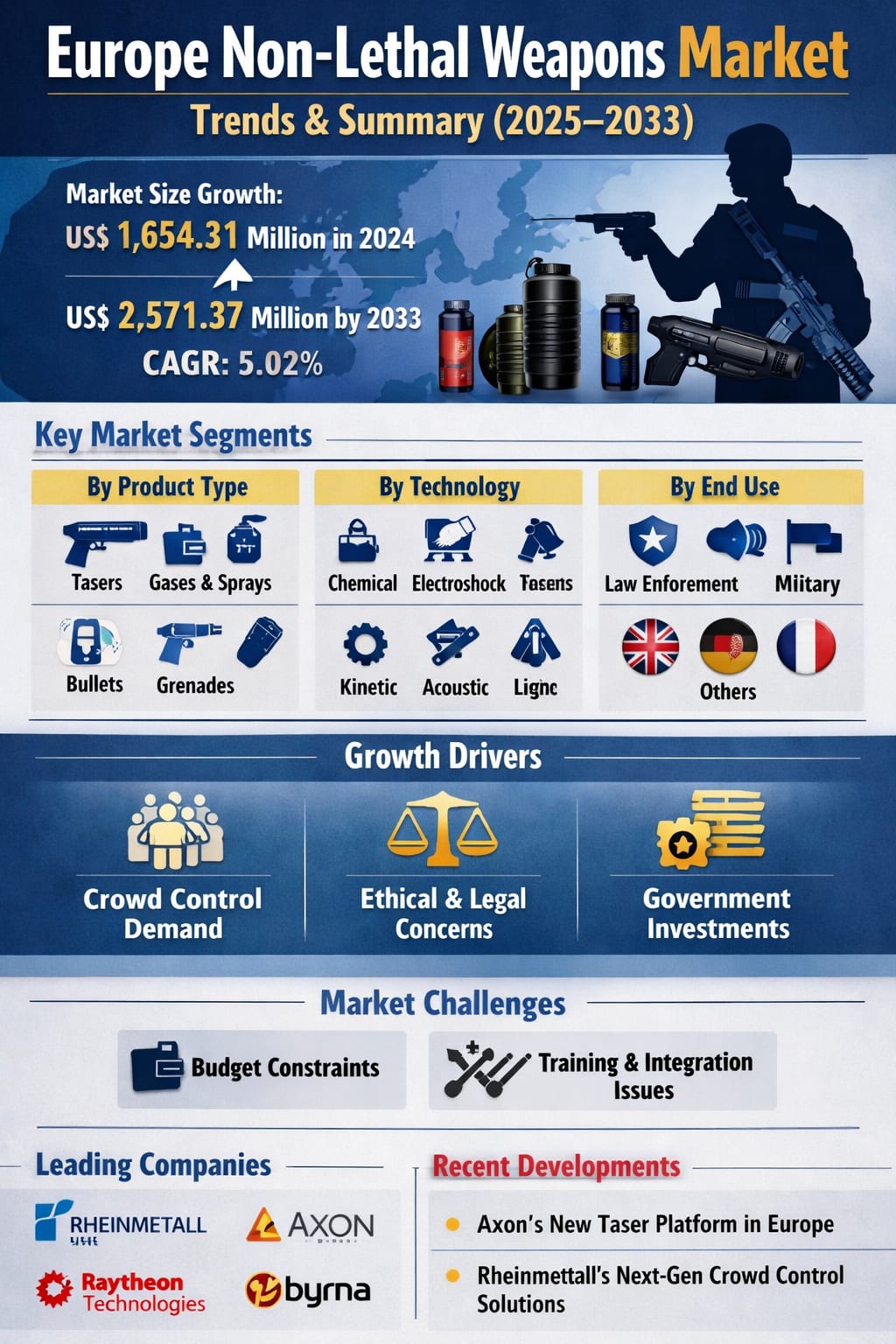
Europe Non-Lethal Weapons Market is expected to reach US$ 2,571.37 million by 2033 from US$ 1,654.31 million in 2024, growing at a CAGR of 5.02% from 2025 to 2033. This steady expansion reflects a fundamental shift in how European governments, law enforcement agencies, and defense organizations approach public safety, security operations, and crowd management.
Non-lethal weapons—often referred to as “less-lethal” weapons—include equipment such as tear gas, pepper spray, rubber bullets, Tasers, acoustic devices, and other tools designed to incapacitate or disperse individuals without causing permanent harm. Across Europe, these systems are increasingly seen as a necessary middle ground between verbal commands and lethal force.
The past decade has seen Europe face a complex mix of challenges: rising urbanization, frequent public demonstrations, geopolitical tensions, terrorism threats, and heightened expectations around human rights and police accountability. Together, these factors have reshaped security policies. Instead of relying primarily on traditional firearms or physical force, authorities are investing in technologies that allow them to control situations more precisely, reduce casualties, and limit long-term injuries.
This shift is not just philosophical—it is also practical. Non-lethal weapons help security forces respond proportionately in volatile environments, especially during protests, riots, border security operations, and high-risk arrests. As societies demand greater transparency and restraint from authorities, non-lethal solutions are becoming a cornerstone of modern European security strategies.
Industry Overview: Balancing Security and Humanity
The Europe non-lethal weapons industry has grown significantly due to rising security concerns and the demand for effective yet compassionate crowd control methods. Police forces, military units, and internal security agencies across the region are increasingly adopting tools such as rubber bullets, tear gas, Tasers, and directed energy devices.
The frequency of public protests, political rallies, and civil unrest has increased in many European countries over the past few years. In such environments, authorities face intense pressure to maintain public order while minimizing harm. Non-lethal weapons provide a critical option: they allow law enforcement to disperse crowds, deter violent behavior, and neutralize threats without resorting to lethal force.
Technological progress has further strengthened this trend. Innovations in electroshock systems, acoustic deterrents, and kinetic impact munitions have made non-lethal weapons more accurate, more controllable, and safer than earlier generations. These improvements reduce the risk of unintended fatalities and serious injuries, which is essential in a region where legal scrutiny and public opinion strongly influence security policies.
At the same time, European governments are increasing investments in modernizing their law enforcement and defense equipment. Non-lethal weapons now feature prominently in procurement programs, particularly for urban policing and peacekeeping roles. This focus aligns with Europe’s broader commitment to human rights, international law, and proportional use of force.
However, the sector is not without challenges. Ethical debates, regulatory oversight, and the high cost of advanced systems continue to shape the market. Public perception can also be a double-edged sword: while non-lethal weapons are seen as safer alternatives, cases of misuse or excessive force can trigger backlash and policy reviews. Despite these constraints, the long-term outlook remains positive as demand for balanced, humane security solutions continues to grow.
Key Growth Drivers in the Europe Non-Lethal Weapons Market
1. Legal and Ethical Considerations
Legal and ethical frameworks play a central role in shaping the adoption of non-lethal weapons across Europe. Both national governments and the European Union emphasize accountability, transparency, and strict adherence to human rights standards. Law enforcement agencies are increasingly required to demonstrate that force is used only when necessary and in a proportionate manner.
Non-lethal weapons fit naturally into this policy environment. They are seen as essential tools for reducing fatalities, long-term injuries, and legal consequences during public order operations. Their use, however, is tightly regulated. Strict guidelines, mandatory training programs, and oversight mechanisms are in place to ensure responsible deployment.
Public debate and media scrutiny continue to influence policy decisions. Every high-profile incident involving police force sparks renewed discussion about acceptable methods of crowd control and suspect apprehension. In this context, non-lethal weapons are not just operational tools—they are also political and ethical instruments that reflect Europe’s broader values around civil liberties and human dignity.
2. Growing Demand for Crowd Control
Across Europe, large-scale demonstrations, political rallies, and social movements have become more frequent. While peaceful in many cases, such gatherings can quickly escalate into confrontations, putting both civilians and law enforcement officers at risk.
This reality has increased the demand for effective crowd control solutions that do not rely on lethal force. Non-lethal tools such as tear gas, rubber bullets, stun grenades, and water cannons allow authorities to disperse crowds, de-escalate tensions, and restore order with reduced risk of permanent harm.
Urbanization has amplified this need. Major European cities regularly host mass events, protests, and high-profile political or cultural gatherings. In these dense environments, the margin for error is small, and the consequences of excessive force can be severe—both in human and political terms. As a result, governments and police departments are prioritizing non-lethal technologies that offer more controlled and graduated responses to unrest.
3. Increased Government Investments
Government funding is another critical driver of market growth. Many European countries are increasing defense and internal security budgets, with a specific focus on modernization and technology upgrades. This includes investments in research and development of next-generation non-lethal weapons.
Advanced systems now incorporate features such as improved targeting accuracy, better range control, digital accountability tools, and integration with broader command-and-control platforms. Some newer solutions also explore the use of directed energy, acoustic deterrents, and smart monitoring systems.
European governments are also encouraging collaboration between defense contractors, technology firms, and research institutions. These partnerships aim to create solutions tailored to urban security challenges while remaining compliant with legal and humanitarian standards. This sustained financial and institutional support strengthens Europe’s position in the global non-lethal weapons market and ensures continued innovation over the forecast period.
Challenges Facing the Market
1. Budget Constraints and Procurement Delays
Despite increased attention to security, many European countries—especially at regional and municipal levels—still face tight budgets. For smaller police forces and local security agencies, the high upfront cost of advanced non-lethal weapons can be difficult to justify.
Beyond purchase prices, there are also ongoing expenses related to maintenance, software updates, and training. These hidden costs make procurement decisions more complex, particularly in times of fiscal pressure.
Additionally, Europe’s procurement processes are often slow and highly regulated. Strict compliance requirements, lengthy approval cycles, and multiple layers of oversight can delay the adoption of new technologies. As a result, some agencies continue to rely on older, less effective equipment, limiting the overall impact of innovation in the sector.
2. Technological Integration and Training Gaps
Modern non-lethal weapon systems are increasingly sophisticated. Features such as AI-assisted aiming, digital reporting, and real-time monitoring require updated infrastructure and new operational procedures. However, not all agencies have the technical capacity or resources to integrate these systems smoothly.
Training is another critical issue. Without proper instruction, even the most advanced tools can be misused or underutilized. Inadequate training increases the risk of operational errors, accidental injuries, or public controversy—all of which can undermine trust in non-lethal solutions.
To fully realize the benefits of new technologies, European countries need sustained investment not only in equipment but also in training programs, digital infrastructure, and organizational change.
Country-Level Market Insights
United Kingdom
The UK holds one of the largest shares in the European non-lethal weapons market. The country places strong emphasis on public safety, accountability, and human rights in policing. Tools such as Tasers, baton rounds, and incapacitant sprays are widely used to manage protests, violent incidents, and high-risk arrests without resorting to lethal force.
The UK government continues to invest in modern policing methods and public order management. Innovation in less-lethal technologies, including smarter and more precise systems, is encouraged. However, the market also faces intense public scrutiny and strict regulatory oversight, making training and responsible use essential.
Germany
Germany’s non-lethal weapons market is expanding as law enforcement agencies seek safer and more effective ways to manage social unrest and public security challenges. German police increasingly rely on Tasers, rubber bullets, and acoustic devices, with a strong focus on minimizing injuries and respecting human rights standards.
The government supports innovation in advanced technologies such as electromagnetic and directed energy systems. Still, high procurement costs, ethical debates, and strict regulations remain key hurdles—especially for smaller agencies. Despite these challenges, steady growth is expected as proportional response strategies become more central to policing.
Turkey
In Turkey, rising public demonstrations and civil disturbances are driving demand for non-lethal crowd control tools. Law enforcement agencies use Tasers, rubber bullets, and acoustic devices to manage large gatherings and maintain public order without escalating to lethal force.
Technological progress is improving the effectiveness of these tools, but challenges remain. Ethical concerns, regulatory oversight, budget limitations, and slow procurement processes can all slow adoption—particularly among smaller agencies. Even so, the need for non-lethal alternatives continues to rise as authorities seek more balanced security responses.
Recent Market Developments
The European non-lethal weapons market has seen notable activity in 2024. In March, Axon Enterprise Inc. introduced a new conducted energy weapon platform designed specifically for European requirements, emphasizing enhanced safety features, improved precision, and strong digital accountability systems for law enforcement use.
In May 2024, Rheinmetall AG announced a strategic agreement with European law enforcement agencies focused on developing next-generation non-lethal crowd control devices. These new systems aim to offer lower risk profiles and higher operational effectiveness, particularly for urban security scenarios.
Such developments highlight the industry’s direction: safer, smarter, and more accountable non-lethal solutions.
Market Segmentation Snapshot
By Product Type:
Gases and sprays
Grenades
Bullets
Taser Guns
Others
By Technology:
Chemical
Electroshock
Mechanical and Kinetic
Acoustic/Light
Others
By End Use:
Law Enforcement
Military
Others
By Country:
France
Germany
Italy
Spain
United Kingdom
Belgium
Netherlands
Turkey
Competitive Landscape
Key companies shaping the European non-lethal weapons market include:
Byrna Technologies Inc.
General Dynamics Corporation
Moog Inc.
Raytheon Technologies Corporation
Rheinmetall AG
Textron Inc.
Combined Systems Inc.
These players compete through product innovation, strategic partnerships, and investments in safer, more accountable technologies tailored to Europe’s strict regulatory environment.
Final Thoughts
The Europe non-lethal weapons market stands at the intersection of security, technology, and ethics. With the market projected to grow from US$ 1,654.31 million in 2024 to US$ 2,571.37 million by 2033 at a CAGR of 5.02%, it is clear that non-lethal solutions will play an increasingly central role in the region’s security strategies.
As public expectations evolve and legal standards tighten, European governments and security agencies are under pressure to find tools that balance effectiveness with responsibility. Non-lethal weapons offer that balance—providing practical solutions for crowd control, public order, and threat management while reducing the risk of irreversible harm.
Challenges remain, particularly around budgets, training, and technology integration. But with continued investment, innovation, and oversight, Europe is steadily building a security framework that prioritizes both safety and human dignity. In the years ahead, non-lethal weapons will not just be an alternative—they will be a cornerstone of modern, accountable security across the continent.
About the Creator
Sakshi Sharma
Content Writer with 7+ years of experience crafting SEO-driven blogs, web copy & research reports. Skilled in creating engaging, audience-focused content across diverse industries.
Keep reading
More stories from Sakshi Sharma and writers in Trader and other communities.
Casino Gambling Market Trends & Summary: A Global Industry in the Fast Lane
Global Casino Gambling Market: A High-Stakes Industry on the Rise The global casino gambling market is undergoing a powerful transformation, driven by legalization, digital platforms, changing social attitudes, and a surge in tourism-led entertainment spending. According to Renub Research, the casino gambling market is expected to grow from US$ 251.33 billion in 2024 to US$ 425.34 billion by 2033, registering a CAGR of 6.02% from 2025 to 2033.
By Sakshi Sharma2 days ago in Trader
Nuveen Agrees £9.9bn Acquisition of Schroders in Landmark Asset Management Deal
Introduction In a move that could reshape the global asset management landscape, US investment manager Nuveen has announced a £9.9 billion deal to acquire UK-based Schroders. The transaction represents one of the largest cross-border acquisitions in the financial services sector and highlights growing consolidation within the global asset management industry. The deal is expected to strengthen Nuveen’s global footprint while providing Schroders with enhanced scale and access to international markets.
By Hammad Nawaz6 days ago in Trader
Nasdaq Futures Climb as Strong Jobs Data Shifts Focus on Federal Reserve Rate Policy
Introduction Nasdaq futures moved higher in early trading after a stronger-than-expected US jobs report reshaped market expectations around Federal Reserve interest rate policy. The latest employment data signaled continued resilience in the US labor market, easing fears of an economic slowdown while prompting investors to reassess the timing and pace of potential rate cuts.
By Hammad Nawaz6 days ago in Trader




Comments
There are no comments for this story
Be the first to respond and start the conversation.