
Fundus Camera Market Size & Forecast 2026–2034
Rising Retinal Disorders, AI Integration, and Preventive Screening to Drive Global Growth

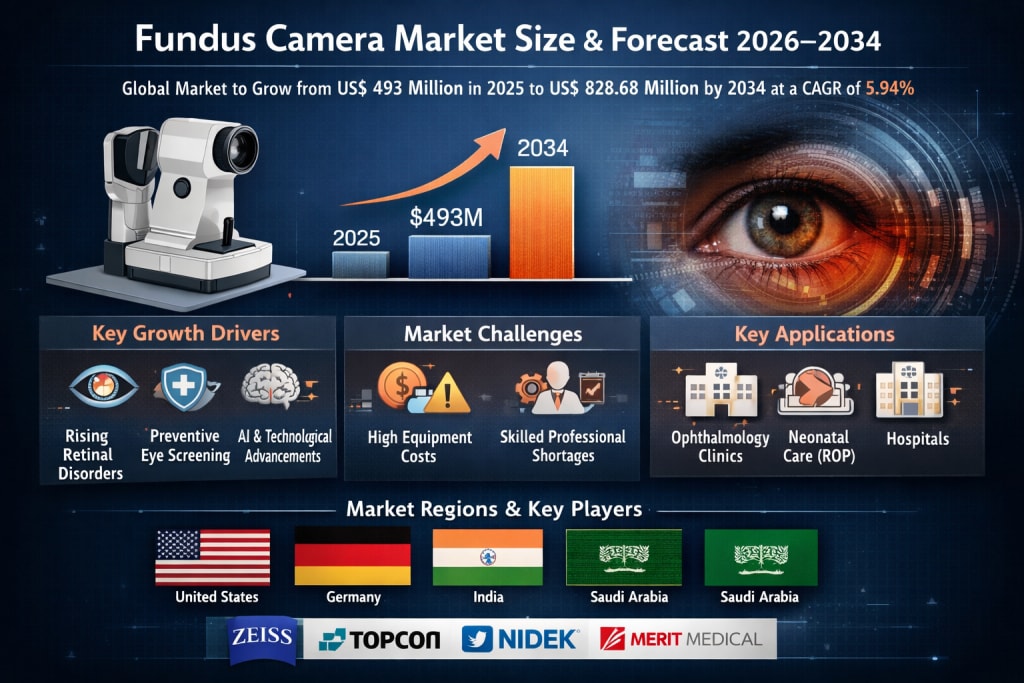
The global Fundus Camera Market is poised for steady expansion over the next decade. According to Renub Research, the market is projected to grow from US$ 493 Million in 2025 to US$ 828.68 Million by 2034, registering a CAGR of 5.94% during the forecast period 2026–2034.
This growth trajectory is strongly supported by the rising global prevalence of diabetic retinopathy and other retinal disorders, increasing adoption of preventive eye screening programs, and continuous technological advancements such as non-mydriatic and AI-enabled fundus cameras across hospitals, clinics, and teleophthalmology settings.
As healthcare systems worldwide shift toward early detection and value-based care, fundus cameras are becoming indispensable tools in modern ophthalmic diagnostics.
Fundus Camera Market Outlook
A fundus camera is a specialized ophthalmic imaging device used to capture high-resolution photographs of the internal surface of the eye, commonly referred to as the fundus. These images include the retina, optic disc, macula, and retinal blood vessels—critical structures for diagnosing and monitoring various ocular diseases.
Fundus cameras are essential in identifying and managing conditions such as diabetic retinopathy, glaucoma, age-related macular degeneration (AMD), retinal vein occlusion, and hypertensive retinopathy. The devices are broadly classified into mydriatic and non-mydriatic types. While mydriatic cameras require pupil dilation for imaging, non-mydriatic systems allow retinal imaging without dilation, significantly enhancing patient comfort and workflow efficiency.
Modern fundus cameras are increasingly integrated with digital imaging systems, wide-field imaging capabilities, electronic health record (EHR) compatibility, cloud-based storage, and artificial intelligence algorithms for automated disease detection. These innovations are transforming retinal imaging from a specialist-focused procedure into a scalable, technology-enabled screening solution.
Globally, adoption is accelerating due to the growing diabetic population, aging demographics, and increasing awareness about preventable blindness. Government-backed screening initiatives and tele-ophthalmology programs are further expanding accessibility, particularly in rural and underserved areas.
Growth Drivers of the Fundus Camera Market
Rising Prevalence of Eye Diseases and Chronic Conditions
The increasing burden of chronic diseases such as diabetes and hypertension is one of the primary drivers of the fundus camera market. These systemic conditions often lead to serious retinal complications if left undiagnosed.
Diabetic retinopathy, for instance, remains one of the leading causes of preventable blindness worldwide. Fundus cameras play a pivotal role in early detection by capturing detailed retinal images that allow ophthalmologists to identify microvascular abnormalities before symptoms appear.
According to the World Health Organization (WHO), over 2.2 billion people globally experience some form of vision impairment. A significant proportion of these cases are preventable or treatable with early diagnosis. Age-related macular degeneration, glaucoma, cataracts, refractive errors, and diabetic retinopathy collectively contribute to this growing burden.
As populations age—particularly in developed economies—the incidence of age-related retinal disorders is expected to increase substantially, thereby creating sustained demand for advanced retinal imaging technologies.
Technological Advancements in Retinal Imaging
Innovation remains central to the expansion of the fundus camera market. Modern systems offer improved image resolution, enhanced field of view, faster processing speeds, and improved patient comfort.
Non-mydriatic fundus cameras have gained strong traction in outpatient and screening environments due to their ability to eliminate pupil dilation. This reduces examination time and enhances patient acceptance.
AI-enabled fundus cameras are emerging as transformative solutions. These systems can automatically detect signs of diabetic retinopathy, glaucoma, and macular degeneration, thereby improving diagnostic accuracy and reducing specialist workload. Integration with cloud platforms allows seamless image sharing, remote consultation, and long-term patient monitoring.
In October 2025, Optos introduced the advanced Silverstone RGB system, combining multiple imaging modalities into a single device. Such innovations highlight the growing emphasis on comprehensive, high-performance retinal imaging solutions.
Similarly, portable and handheld fundus cameras are gaining popularity in community health programs and primary care settings, enhancing access in geographically remote regions.
Expansion of Preventive Eye Screening and Teleophthalmology
Preventive healthcare initiatives are reshaping the ophthalmology landscape. Governments and healthcare organizations are increasingly conducting large-scale screening programs for diabetic retinopathy and other retinal diseases.
Fundus cameras serve as the backbone of these initiatives, enabling standardized imaging in both urban and rural healthcare facilities.
The rapid expansion of telemedicine further strengthens market growth. Retinal images captured in primary care clinics can be transmitted to specialists in tertiary hospitals for evaluation. This model reduces patient travel, shortens diagnosis timelines, and enhances specialist productivity.
Collaborative models between telehealth providers and screening startups demonstrate how fundus cameras are central to decentralized eye care delivery systems.
Challenges in the Fundus Camera Market
High Equipment Costs and Budget Constraints
Despite technological progress, high equipment costs remain a significant barrier, particularly in developing economies. Advanced wide-field and AI-enabled systems require substantial capital investment.
In addition to acquisition costs, maintenance, software updates, and staff training add to operational expenses. Budget constraints in public healthcare systems may delay procurement decisions or limit adoption to entry-level models.
Although portable and cost-effective alternatives are emerging, affordability remains a critical consideration for broader market penetration.
Shortage of Skilled Professionals and Workflow Integration Issues
The effective use of fundus cameras requires trained operators and experienced ophthalmologists to interpret results accurately. Many developing regions face shortages of skilled eye care professionals.
Additionally, integrating new imaging technologies into existing hospital workflows and electronic medical systems can be challenging. Resistance to technological change and data management concerns may slow adoption in certain settings.
Product Type Insights
Mydriatic Fundus Camera Market
Mydriatic fundus cameras are primarily used in hospitals and specialized ophthalmology clinics requiring high-resolution and wide-field imaging. These systems deliver superior diagnostic clarity and are essential in managing complex retinal conditions such as advanced diabetic retinopathy and macular degeneration.
Although pupil dilation increases examination time, clinicians value the enhanced image quality and diagnostic reliability these systems provide.
ROP Fundus Camera Market
Retinopathy of Prematurity (ROP) fundus cameras are specifically designed for screening premature and low-birth-weight infants. These systems are widely used in neonatal intensive care units (NICUs) and pediatric ophthalmology centers.
Rising premature birth rates and increasing awareness of neonatal vision screening are driving demand. Compact designs and tele-ophthalmology integration allow images captured in NICUs to be reviewed remotely by specialists, improving access to timely interventions.
End-User Insights
Ophthalmology Clinics
Ophthalmology clinics represent a significant segment of the fundus camera market. Regular retinal screening for chronic diseases and preventive checkups fuels demand in outpatient settings.
Non-mydriatic cameras are particularly favored for their speed, ease of use, and patient-friendly approach. Compact systems also suit space-constrained clinics.
Hospitals
Hospitals constitute the largest end-user segment, especially for complex cases and multidisciplinary diagnostics. Fundus cameras are utilized not only in ophthalmology departments but also in neurology and internal medicine units to detect retinal changes linked to systemic diseases.
Hospitals typically prefer technologically advanced, high-throughput systems integrated with EHR platforms.
Regional Analysis
United States
The United States remains one of the largest markets for fundus cameras globally. High diabetes prevalence, strong reimbursement frameworks, and early adoption of AI-driven solutions contribute to market dominance.
In August 2025, Optomed USA launched the Optomed Lumo handheld fundus camera, expanding retinal imaging capabilities into primary care settings.
Germany
Germany emphasizes high diagnostic standards and regulatory compliance. Hospitals and eye care centers widely adopt advanced imaging technologies.
In October 2023, Topcon Healthcare introduced its NW500 model to the European market at the Euretina Congress, highlighting continuous innovation in retinal imaging.
India
India’s fundus camera market is expanding rapidly due to its large diabetic population and increasing government-led screening initiatives.
Non-mydriatic and portable devices are widely used in rural outreach programs and teleophthalmology networks. Public–private partnerships and cost-sensitive procurement strategies are shaping growth patterns.
Saudi Arabia
Saudi Arabia’s healthcare transformation initiatives and high diabetes prevalence are driving demand for advanced retinal imaging solutions.
Hospitals and specialized eye care centers are increasingly investing in modern fundus camera systems. Telemedicine integration further enhances service reach across remote areas.
Market Segmentation
By Product Type:
Mydriatic Fundus Camera
Non-Mydriatic Fundus Camera
Hybrid Fundus Camera
ROP Fundus Camera
By End User:
Ophthalmic & Optometrist Offices
Ophthalmology Clinics
Hospitals
By Region:
North America (United States, Canada)
Europe (France, Germany, Italy, Spain, United Kingdom, Belgium, Netherlands, Turkey)
Asia Pacific (China, Japan, India, Australia, South Korea, Thailand, Malaysia, Indonesia, New Zealand)
Latin America (Brazil, Mexico, Argentina)
Middle East & Africa (South Africa, Saudi Arabia, United Arab Emirates)
Competitive Landscape
The fundus camera market features several leading players focusing on innovation, product diversification, and strategic partnerships. Key companies include:
Carl Zeiss Meditec AG
Topcon Medical Systems, Inc.
Merit Medical Systems Inc.
NIDEK CO., LTD.
Revenio Group Corporation
These companies compete on product innovation, AI integration, global distribution networks, and after-sales support.
Final Thoughts
The Fundus Camera Market is entering a phase of stable, technology-driven growth. With projections indicating expansion from US$ 493 Million in 2025 to US$ 828.68 Million by 2034, the sector reflects broader healthcare trends emphasizing early detection, digital integration, and AI-assisted diagnostics.
Rising retinal disease prevalence, government screening programs, teleophthalmology expansion, and handheld imaging innovations will remain central growth catalysts.
While challenges such as cost sensitivity and workforce shortages persist, ongoing technological refinement and strategic public–private collaborations are expected to strengthen long-term market prospects.
About the Creator
Sakshi Sharma
Content Writer with 7+ years of experience crafting SEO-driven blogs, web copy & research reports. Skilled in creating engaging, audience-focused content across diverse industries.
Keep reading
More stories from Sakshi Sharma and writers in Trader and other communities.
Cloud Services Brokerage Market Size and Forecast 2026–2034
The Cloud Services Brokerage (CSB) market is entering a dynamic phase of expansion as enterprises accelerate their digital transformation initiatives. According to Renub Research, the Cloud Services Brokerage Market is expected to reach US$ 50.14 billion by 2034, up from US$ 14.22 billion in 2025, growing at a CAGR of 15.03% from 2026 to 2034.
By Sakshi Sharmaa day ago in Trader
Philippines ICT Market 2026: Digital Infrastructure Expansion, Cloud Adoption and Connectivity Transformation
Philippines ICT Market Overview The Philippines information and communication technology (ICT) market is experiencing strong expansion as digital transformation accelerates across government, enterprise and consumer ecosystems. ICT encompasses telecommunications, IT services, cloud computing, data infrastructure and digital platforms that collectively power the country’s digital economy. With rising internet penetration, growing outsourcing capabilities and increasing demand for advanced connectivity solutions, ICT has become a central pillar of economic modernisation and innovation in the Philippines.
By Manisha Dixit3 days ago in Trader
Philippines Citric Acid Market 2026: Food Processing Growth, Natural Additive Demand and Multi-Industry Expansion
Philippines Citric Acid Market Overview The Philippines citric acid market is experiencing steady expansion as demand rises across food processing, pharmaceuticals, personal care and cleaning applications. Citric acid — a naturally occurring organic acid widely used as an acidity regulator, preservative and chelating agent — plays a critical role in multiple industrial value chains. As consumption of processed foods increases and manufacturers shift toward natural additives, citric acid adoption is strengthening across domestic industries. Its versatility, cost efficiency and compatibility with eco-friendly formulations position it as a key functional ingredient within the Philippines specialty chemicals landscape.
By Manisha Dixit2 days ago in Trader




Comments
There are no comments for this story
Be the first to respond and start the conversation.