
Global E-Commerce Payment Market Size & Forecast 2026–2034
How Digital Wallets, BNPL, and Secure Payment Tech Are Reshaping the Future of Online Commerce

Global E-Commerce Payment Market: A Digital Economy in Motion
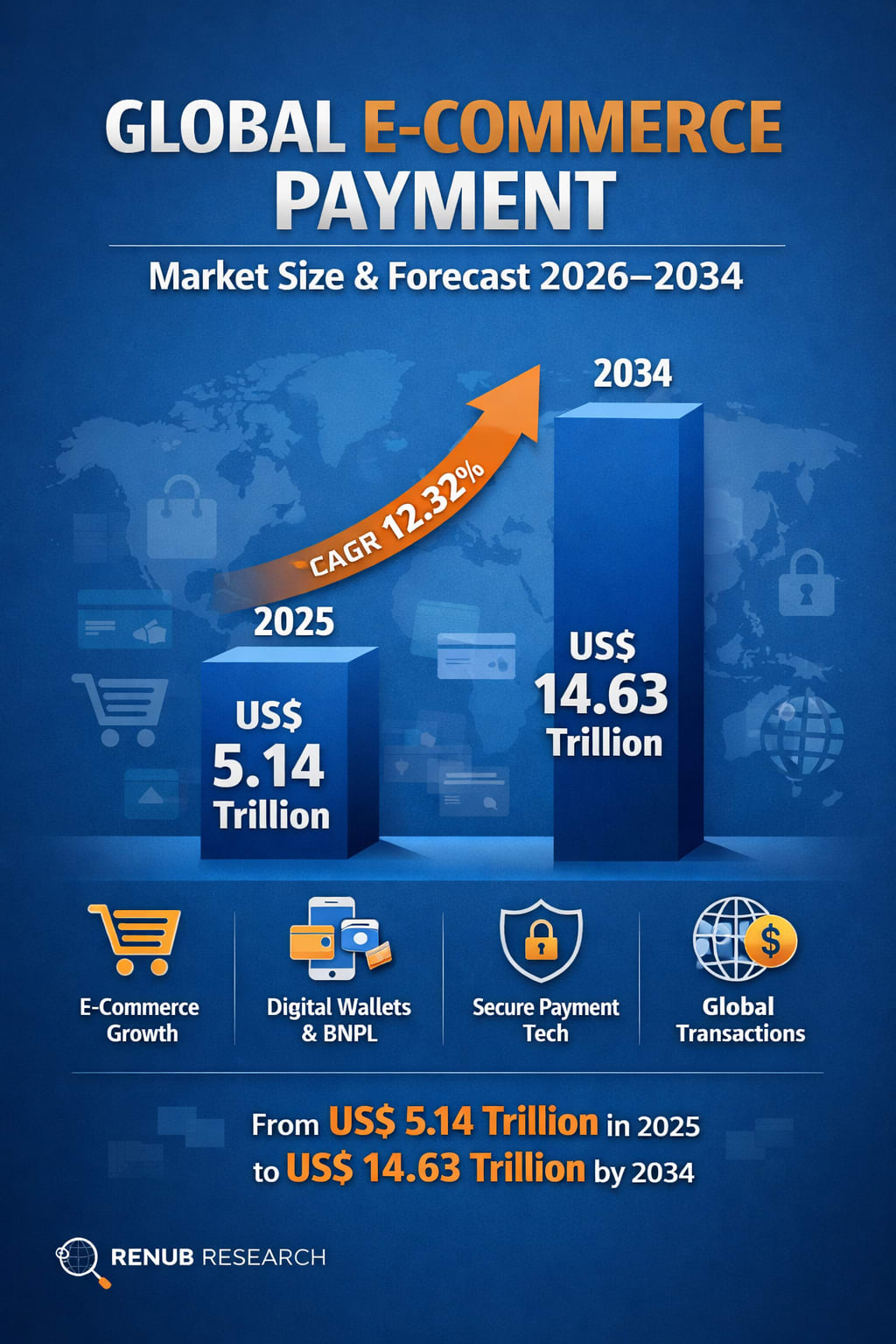
The global economy is increasingly running on clicks, taps, and swipes—and nowhere is this more visible than in the e-commerce payment ecosystem. According to Renub Research, the Global E-Commerce Payment Market is anticipated to grow from US$ 5.14 trillion in 2025 to US$ 14.63 trillion by 2034, registering a Compound Annual Growth Rate (CAGR) of 12.32% from 2026 to 2034. This remarkable expansion reflects not just the growth of online shopping, but a deeper transformation in how consumers and businesses exchange value in a digital-first world.
E-commerce payment refers to the digital methods and systems that enable consumers and businesses to pay for goods and services purchased online. These transactions are processed electronically through secure platforms and include credit and debit cards, digital wallets, bank transfers, buy-now-pay-later (BNPL) services, prepaid solutions, and real-time payment systems. Behind the scenes, advanced technologies such as encryption, tokenization, and multi-factor authentication work continuously to protect sensitive financial data and ensure trust in digital transactions.
Over the past decade, e-commerce payments have evolved from a convenience into a necessity. The explosive growth of online retail, mobile commerce, and app-based services has made cashless payments the default choice for millions of consumers worldwide. For merchants, digital payments are no longer just a way to collect money—they are a strategic tool to expand global reach, improve checkout experiences, reduce cart abandonment, and strengthen customer loyalty.
As digital ecosystems mature and more sectors move online—from groceries and healthcare to entertainment and education—the role of e-commerce payments is becoming even more central to the global economy.
E-Commerce Payment Market Outlook
The outlook for the global e-commerce payment market is strongly positive, driven by the convergence of technology, consumer behavior, and business innovation. Smartphones, faster internet connectivity, and the rise of super apps and mobile-first platforms have reshaped how people shop and pay. Consumers increasingly expect instant, seamless, and secure payment experiences, whether they are buying a product, subscribing to a service, or sending money across borders.
Merchants, in turn, are investing heavily in payment optimization. Faster checkout flows, localized payment methods, and flexible financing options such as BNPL and installments are now key differentiators in competitive online markets. At the same time, payment providers are racing to deploy AI-driven fraud detection, real-time transaction monitoring, and cloud-based payment infrastructures to handle growing volumes while maintaining security and reliability.
With global e-commerce continuing to expand into new categories and regions, e-commerce payments are set to remain one of the most dynamic segments of the digital economy throughout the 2026–2034 period.
Key Growth Drivers in the E-Commerce Payment Market
Rapid Expansion of Global E-Commerce
One of the strongest drivers of the e-commerce payment market is the continued expansion of global e-commerce itself. Today, there are billions of smartphone users worldwide, representing a massive, always-connected consumer base. The widespread availability of affordable smartphones and mobile internet has enabled people in both developed and developing economies to participate in online commerce more actively than ever before.
E-commerce is no longer limited to fashion and electronics. It now covers food delivery, healthcare services, digital subscriptions, education, and financial services, all of which rely on efficient and reliable digital payment systems. Cross-border e-commerce is also gaining momentum, increasing the demand for payment solutions that support multiple currencies, languages, and region-specific payment preferences.
As online shopping becomes more deeply embedded in everyday life, the need for scalable, secure, and user-friendly payment systems continues to rise, directly fueling market growth.
Rising Adoption of Digital Wallets and Mobile Payments
The growing popularity of digital wallets and mobile payments is another major catalyst for the e-commerce payment market. Digital wallets offer a powerful combination of speed, convenience, and enhanced security, often using biometric authentication and tokenization to protect user data. For consumers, this means fewer steps at checkout and a smoother overall shopping experience.
Mobile-first shopping and app-based commerce have made one-click and in-app payments more attractive than traditional card entry methods. Beyond payments, digital wallets often integrate loyalty programs, instant refunds, peer-to-peer transfers, and BNPL options, turning them into comprehensive financial tools rather than simple payment methods.
In December 2025, Visa launched three new digital wallets across Europe in partnership with BBVA, Klarna, and Vipps MobilePay, with another planned with Italy’s BANCOMAT in early 2026. These launches marked the first Visa-enabled wallets to use NFC technology supporting Host Card Emulation (HCE) on iOS, following a major regulatory shift in the European Union. Such developments highlight how innovation and regulation together are accelerating the adoption of next-generation payment experiences.
Technological Advancements in Payment Security and Innovation
Trust is the foundation of digital payments, and technological innovation in security is playing a critical role in strengthening that trust. Solutions such as tokenization, AI-powered fraud detection, real-time payment processing, and strong customer authentication are making online transactions safer while keeping them fast and convenient.
Cloud-based payment platforms and open APIs are also transforming the merchant experience, enabling faster integration, easier scaling, and global reach even for small and medium-sized businesses. In October 2025, nsKnox, a payment security specialist, launched Adaptive Payment Security as an evolution of its PaymentKnox platform. The system aims to eliminate B2B payment fraud by enabling global bank account validation using authoritative banking system data, reinforcing the industry’s push toward higher levels of transaction certainty.
Key Challenges Facing the Market
Cybersecurity Threats and Online Fraud
Despite major advances in security, cybersecurity threats and online fraud remain significant challenges. As digital transactions increase, so do attempts at phishing, account takeovers, and payment credential theft. Merchants and payment providers must invest heavily in real-time fraud prevention tools, monitoring systems, and compliance frameworks, which can raise operational costs.
There is also a delicate balance between security and user experience. Overly strict security checks can increase friction at checkout, leading to higher cart abandonment rates. Smaller merchants, in particular, often struggle to afford advanced security infrastructure, making them more vulnerable to attacks.
Regulatory Complexity and Fragmented Payment Standards
The global nature of e-commerce means payment providers must navigate a complex and fragmented regulatory landscape. Different countries enforce different rules related to data privacy, consumer protection, transaction reporting, and authentication standards. This diversity increases compliance costs and operational complexity, especially for companies operating across multiple regions.
In addition, regional differences in payment preferences—such as bank transfers, wallets, or installment plans—require localized solutions, further complicating cross-border expansion. Frequent regulatory updates also force continuous system upgrades, adding another layer of challenge for market participants.
Market Segmentation Insights
E-Commerce Digital Wallet Payment Market
The digital wallet segment is expanding rapidly as consumers prioritize speed, convenience, and seamless checkout experiences. By securely storing payment credentials, digital wallets enable one-click or biometric-authenticated payments, significantly reducing checkout time. Their growth is closely tied to the rise of mobile commerce, app-based shopping, and contactless transactions. Added features like loyalty rewards, instant refunds, and BNPL options further enhance their appeal.
E-Commerce Prepaid Payment Market
Prepaid payment solutions, including prepaid cards and vouchers, play an important role, particularly among unbanked and underbanked populations. Because they are not directly linked to bank accounts, they carry lower fraud risk and are often used for gifting, subscriptions, and controlled spending. In developing regions, prepaid solutions also serve as an entry point into the digital payments ecosystem, helping to broaden financial inclusion.
Application-Based Market Dynamics
Electronics & Media
The electronics and media segment is driven by high-value purchases such as smartphones, laptops, and digital subscriptions. Consumers in this category demand secure and flexible payment options, with credit cards, digital wallets, and installment plans being especially popular. BNPL and EMI options play a key role in improving affordability and boosting conversion rates.
Fashion Accessories
Fashion e-commerce is shaped by impulse buying, seasonality, and repeat purchases. Fast and frictionless payments are essential, making wallets and saved payment methods highly attractive. Easy returns and refunds are also critical, increasing demand for payment systems that support quick reversals and partial refunds. Mobile payments dominate this segment due to the strong influence of social media and mobile shopping.
Food & Personal Care
In food and personal care e-commerce, speed, reliability, and convenience are paramount because of frequent, often time-sensitive transactions. Digital payments, instant transfers, and subscription-based billing models are widely used. Since many of these purchases involve essential goods, payment reliability is crucial to maintaining customer trust and satisfaction.
Regional Market Highlights
United States
The U.S. e-commerce payment market is among the most technologically advanced, characterized by widespread internet adoption and strong innovation in fraud detection, tokenization, and biometric authentication. In June 2025, Coinbase Global Inc. announced efforts to develop a system where stablecoins could become a widely recognized payment method in e-commerce, signaling growing interest in blockchain-based payment alternatives.
United Kingdom
The UK market is highly digitized, with strong adoption of debit cards, instant bank payments, mobile wallets, and subscription billing. Security and consumer protection remain top priorities. In November 2025, Handepay announced enhancements to its e-commerce solution in partnership with Global Payments, enabling merchants to start selling online within 24 hours, highlighting the push to simplify digital commerce for small and medium-sized businesses.
China
China’s e-commerce payment ecosystem is mobile-first and deeply integrated into everyday digital life. In-app payments, QR codes, and super apps dominate the landscape, supporting massive transaction volumes across shopping, social commerce, and entertainment. In September 2024, PayPal launched PayPal Complete Payments, a one-stop solution designed to help Chinese merchants sell globally, underscoring the country’s central role in cross-border e-commerce.
Brazil
Brazil’s e-commerce payment market is growing quickly, driven by rising internet penetration and digital payment adoption. Consumers use a mix of cards, instant bank transfers, prepaid solutions, and digital wallets, with installment payments playing a major role in affordability. In October 2025, Juspay announced the integration of Mastercard’s Click to Pay service in Brazil, enabling one-click secure payments for millions of users.
Saudi Arabia
Saudi Arabia’s e-commerce payment market is expanding alongside the country’s broader digital transformation. Card-based and mobile payments are increasingly popular, supported by improved digital infrastructure. In July 2025, the Saudi Central Bank (SAMA) launched a new online payments interface as part of a strategy to enhance the national payments system and support the growing demand for online transactions.
Competitive Landscape and Key Players
The global e-commerce payment market features a diverse mix of technology giants, financial service providers, and specialized payment companies. Key players include:
Amazon.com Inc.
American Express Company
Apple Inc.
Fiserv Inc.
Mastercard Incorporated
PayPal Holdings Inc.
Visa Inc.
These companies are evaluated across multiple dimensions, including company overviews, key leadership, recent developments, SWOT analysis, revenue analysis, and overall market positioning. Competition is intense, with continuous innovation in user experience, security, and global acceptance shaping strategic priorities.
Final Thoughts: A Market Powering the Digital Future
The Global E-Commerce Payment Market is no longer just a support system for online shopping—it is a core pillar of the digital economy. With the market projected by Renub Research to grow from US$ 5.14 trillion in 2025 to US$ 14.63 trillion by 2034, the scale of transformation underway is unmistakable.
Driven by the rise of digital wallets, mobile commerce, BNPL solutions, and continuous innovation in security and infrastructure, e-commerce payments are becoming faster, smarter, and more inclusive. While challenges such as cybersecurity risks and regulatory complexity remain, the overall trajectory points toward a future where seamless, secure, and global digital payments are the norm rather than the exception.
About the Creator
Zoom Stock Analysis: Is Zoom Positioned for Long-Term Growth in Video Communications?
Introduction Zoom Video Communications stock is widely recognized for revolutionizing remote communication and collaboration. Zoom Video Communications provides cloud-based video conferencing, webinar solutions, chat, and collaboration tools. The pandemic accelerated Zoom adoption globally, but investors are now assessing whether Zoom stock can sustain growth in a post-pandemic world and maintain its position amid intense competition.
By Hammad Nawaz6 days ago in Trader




Comments
There are no comments for this story
Be the first to respond and start the conversation.